
X-ray printing personalization technique
a technology of x-ray printing and personalization, applied in the field of printing wiring patterns, can solve the problems of limited resolution, poor quality of screen printing masks, and low printing efficiency, and achieve the effect of improving the quality of printing
- Summary
- Abstract
- Description
- Claims
- Application Information
AI Technical Summary
Problems solved by technology
Method used
Image



Examples
Embodiment Construction
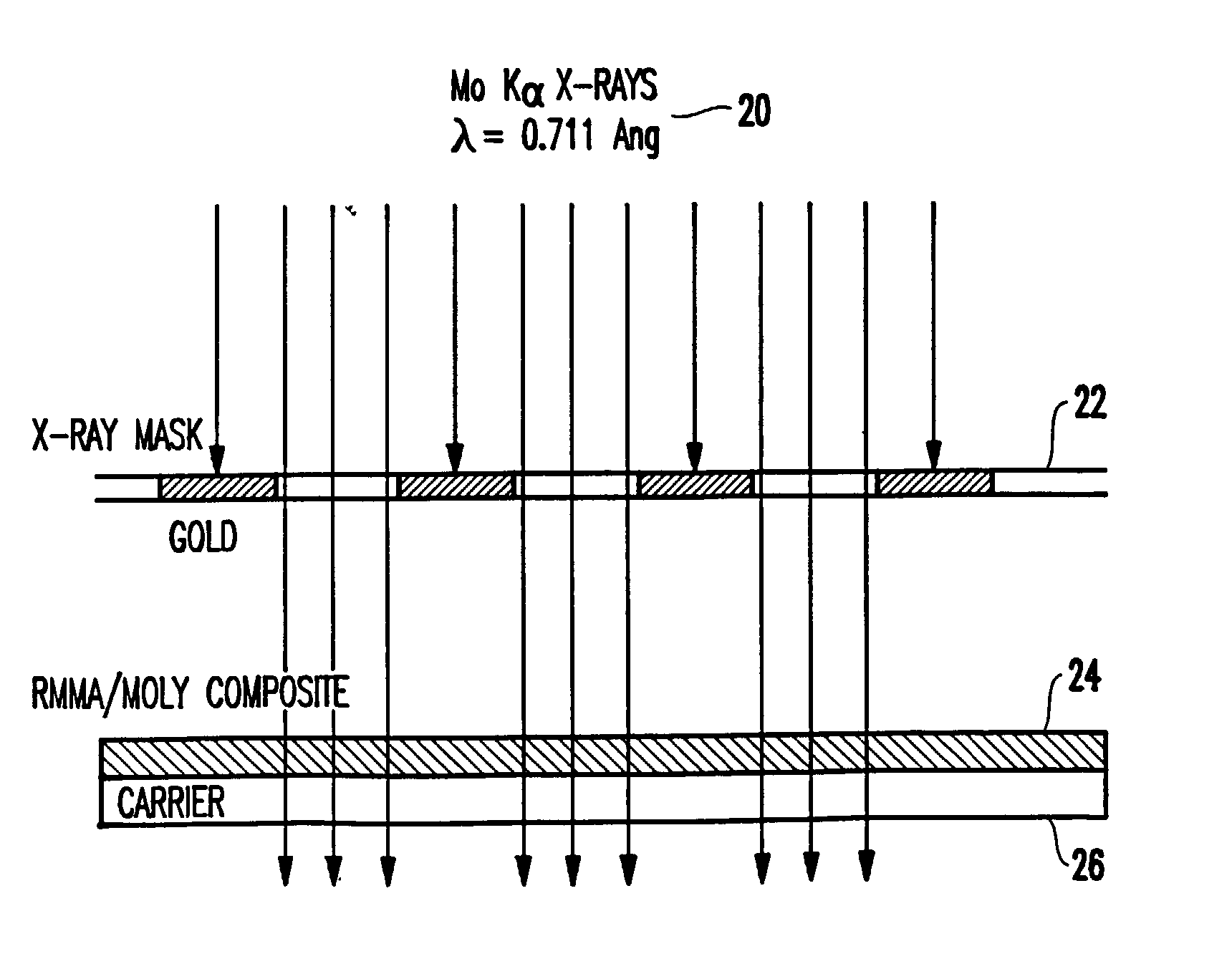
[0015] In order to address the drawbacks of the conventional processes discussed in the background section, the invention exposes a metal / polymer composite photoresist 24 to a flux of X-radiation 20 (as shown in FIG. 2). The composite resist's 24 relative transparency to X-rays, when compared to other forms of radiation (e.g. UV or visible light), is capable of defining fine line widths with large aspect ratios. Moreover, the X-rays 20 and photoresist 24 are preferably engineered with desired wavelengths (via the proper selection of acceleration voltage and X-ray source) and chemistries in order to optimize exposure times and the depth of the circuit pattern.
[0016] X-ray printing requires the proper selection of wavelength in order to maximize the radiation flux through the composite resist (and thus minimize exposure time). As an illustration, the interplay between incident wavelength and X-ray absorption is illustrated in FIGS. 1A and 1B for a nickel Cu--K .beta. filter (B. D. Cul...
PUM
| Property | Measurement | Unit |
|---|---|---|
| atomic number | aaaaa | aaaaa |
| diameter | aaaaa | aaaaa |
| particle sizes | aaaaa | aaaaa |
Abstract
Description
Claims
Application Information
 Login to View More