
Parallelized dynamic Huffman decoder
a dynamic huffman decoder and parallel technology, applied in the field of decoding variable length codes, can solve the problems of consuming valuable time, wasting huffman trees from storage devices to decoder memory, and wasting valuable time in determining the length of variable length codes
- Summary
- Abstract
- Description
- Claims
- Application Information
AI Technical Summary
Problems solved by technology
Method used
Image

Examples
Embodiment Construction
[0053] Embodiments of the invention will now be described with reference to the accompanying Figures, wherein like numerals refer to like elements throughout. The terminology used in the description presented herein is not intended to be interpreted in any limited or restrictive manner, simply because it is being utilized in conjunction with a detailed description of certain specific embodiments of the invention. Furthermore, embodiments of the invention may include several novel features, no single one of which is solely responsible for its desirable attributes or which is essential to practicing the inventions herein described.
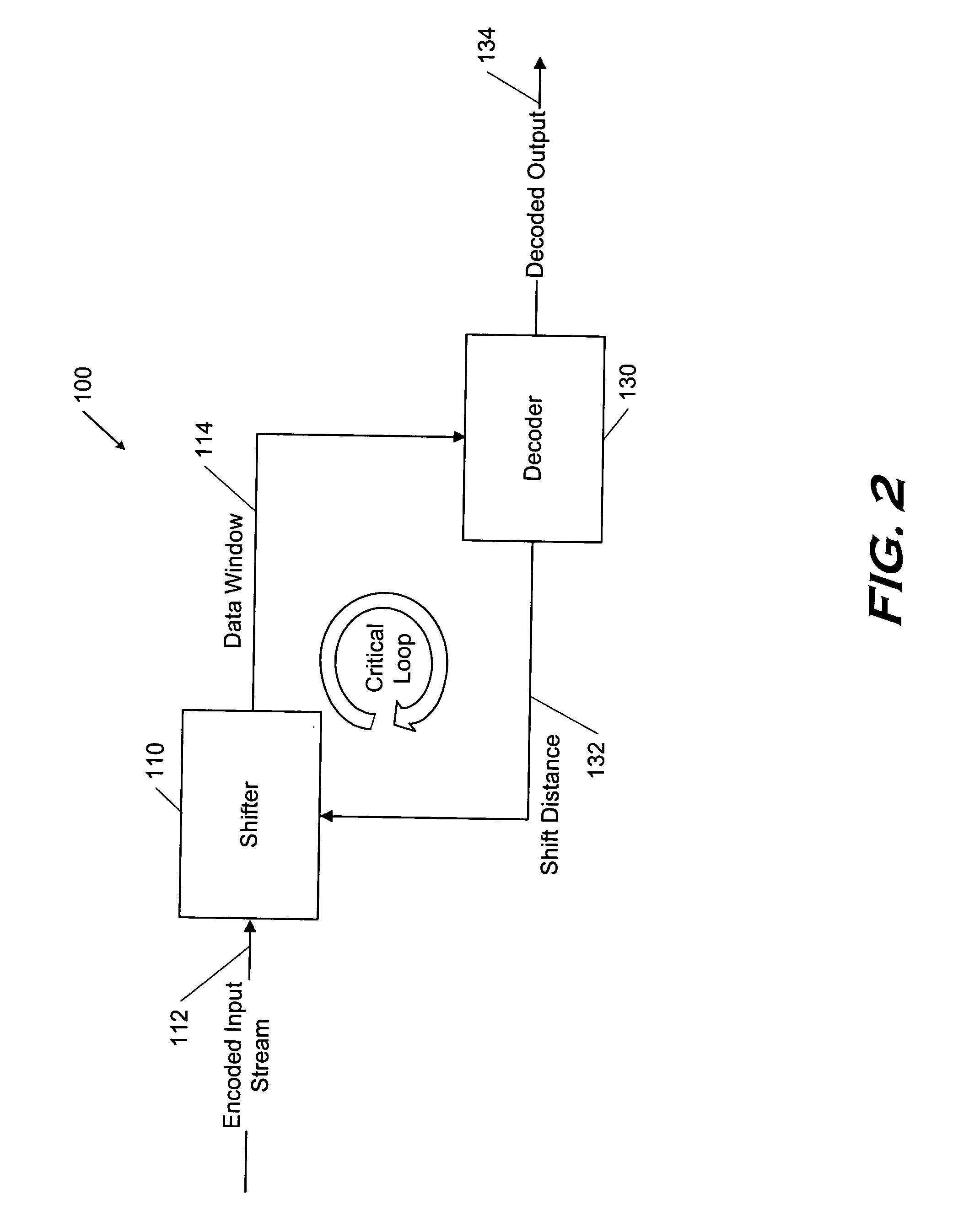
[0054] FIG. 2 is a top level block diagram illustrating the components of a system for decoding a data stream. As illustrated in FIG. 2, the system includes a shifter 110 and a decoder 130,
[0055] The shifter 110 receives a stream 112 of Huffman-encoded input data. The encoded input stream 112 may be a sequence of bytes, or a sequence of 32-bit words, for exa...
PUM
 Login to View More
 Abstract
Description
Claims
Application Information
 Login to View More