AI technical title is built by Patsnap AI team. It summarizes the technical point description of the patent document.
a technology of shares and loans, applied in the field of sharesloans, can solve the problems of low interest amount and high risk, and achieve the effect of generating investment profits
Inactive Publication Date: 2004-10-14
HALAWI IBRAHIM
View PDF0 Cites 19 Cited by
Summary
Abstract
Description
Claims
Application Information
AI Technical Summary
This helps you quickly interpret patents by identifying the three key elements:
Problems solved by technology
Method used
Benefits of technology
Benefits of technology
[0015] There are a, lot of borrowers that prefer to pay as little down payment as possible (0-3-5%), and to use their cash to invest in savings accounts bearing interest, or in the stock market, or in any other secure investment available. This allows the borrower to use their capital to generate investment profits, and to liquidate their capital quickly when they need to, responding to their financial obligations to be met such as paying their mortgage, preventing lenders' foreclosure to securing their assets such as the original and additional payment (investment) from any loss.
Problems solved by technology
When interest rates are high, the total interest amount is high which lenders like, but risk is high too, which lenders dislike.
However, but when interest rates are low, the interest amount is also low which lenders dislike since when a home sale takes place, lenders will receive only their loan balance.
Method used
the structure of the environmentally friendly knitted fabric provided by the present invention; figure 2 Flow chart of the yarn wrapping machine for environmentally friendly knitted fabrics and storage devices; image 3 Is the parameter map of the yarn covering machine
View more
Image
Smart Image Click on the blue labels to locate them in the text.
Viewing Examples
Smart Image
Click on the blue label to locate the original text in one second.
Reading with bidirectional positioning of images and text.
Smart Image
Examples
Experimental program
Comparison scheme
Effect test
case # 1
[0052] If the borrower decides to sell his home:
[0053] a--Suppose the economy inflation rate is about 3% per year and the property Appreciation is about 5% yearly (equity build up), a total of 8%.
[0054] b--The property sale's price is equal to $222,000 approximately, updated appraisal may be beneficial to both parties.
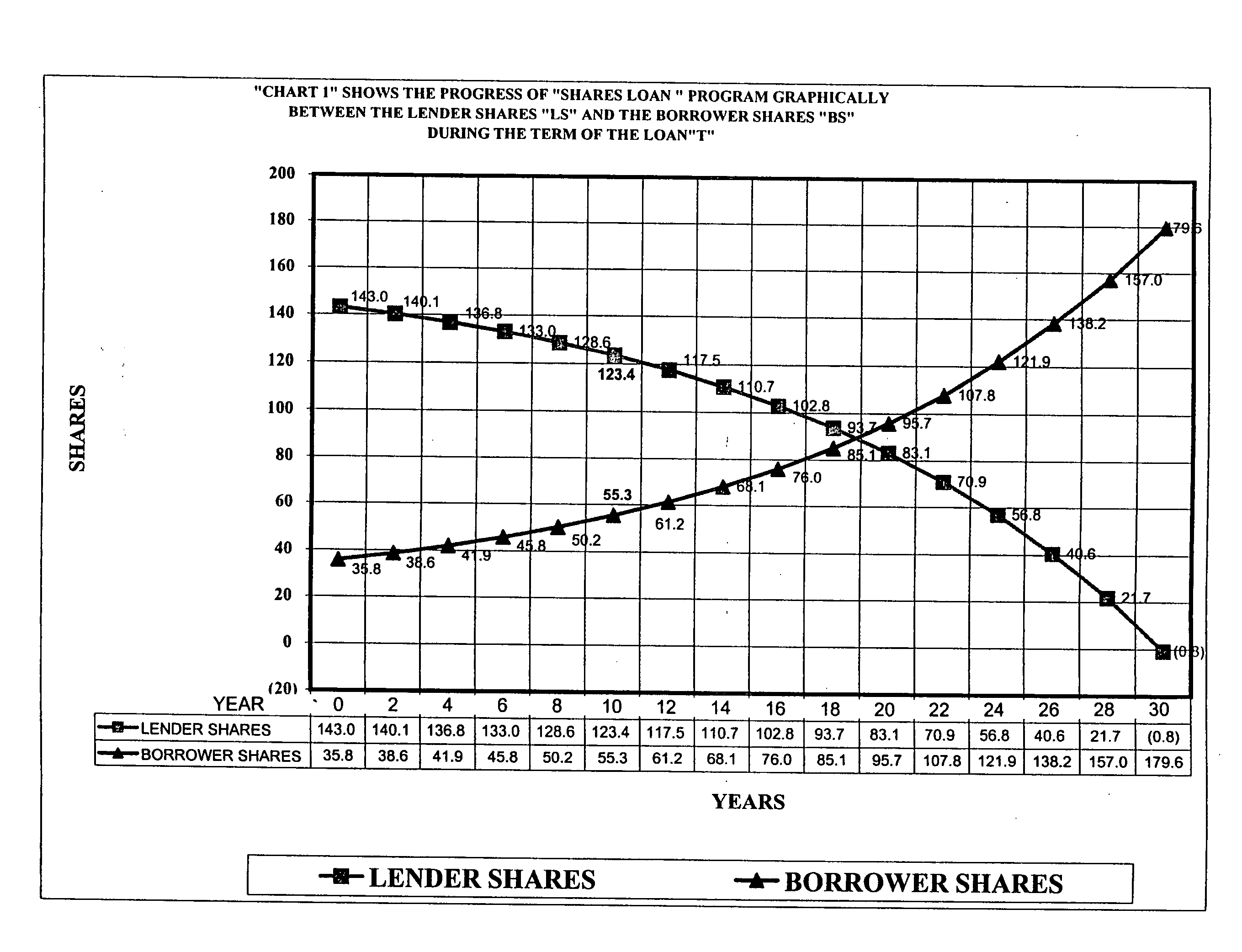
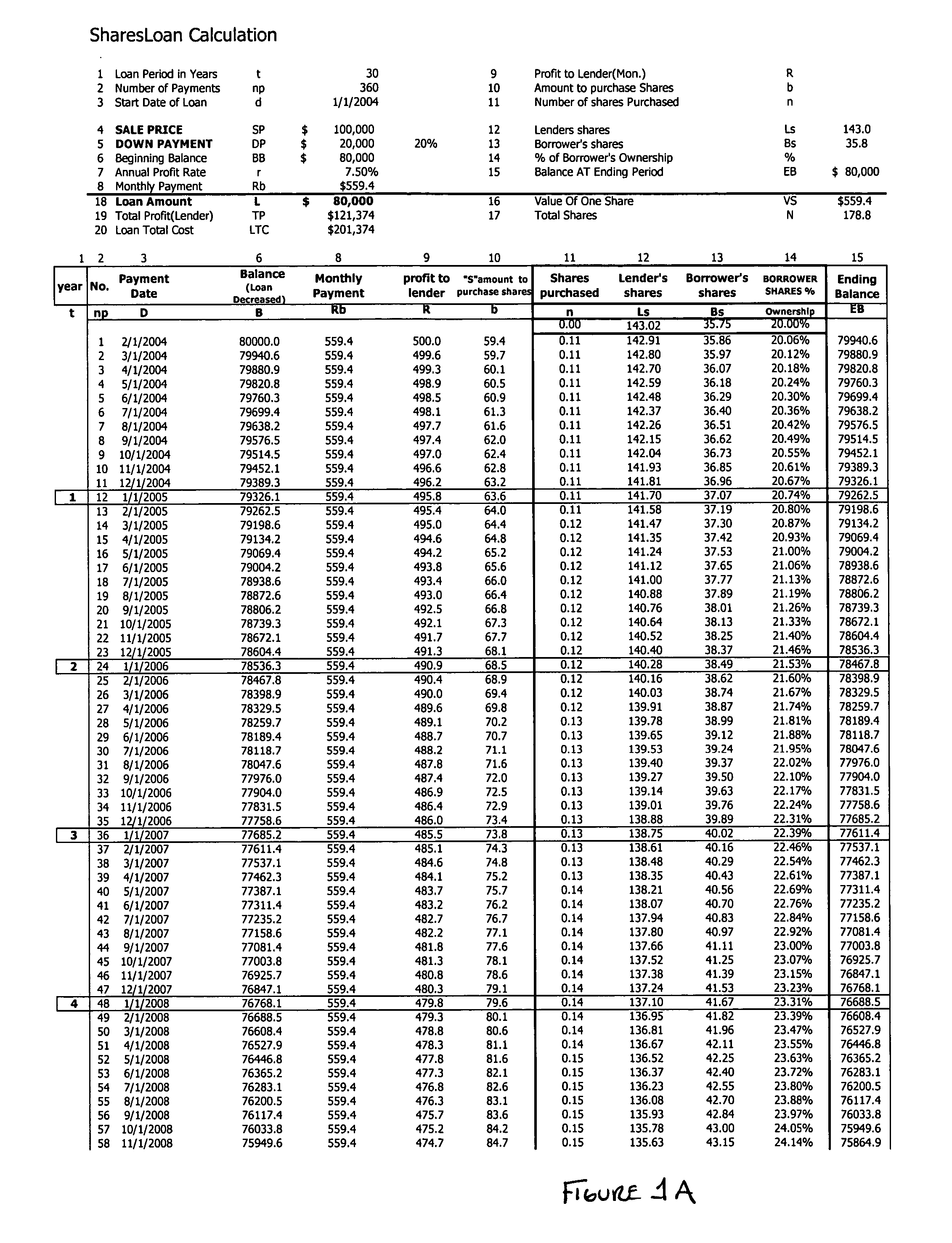
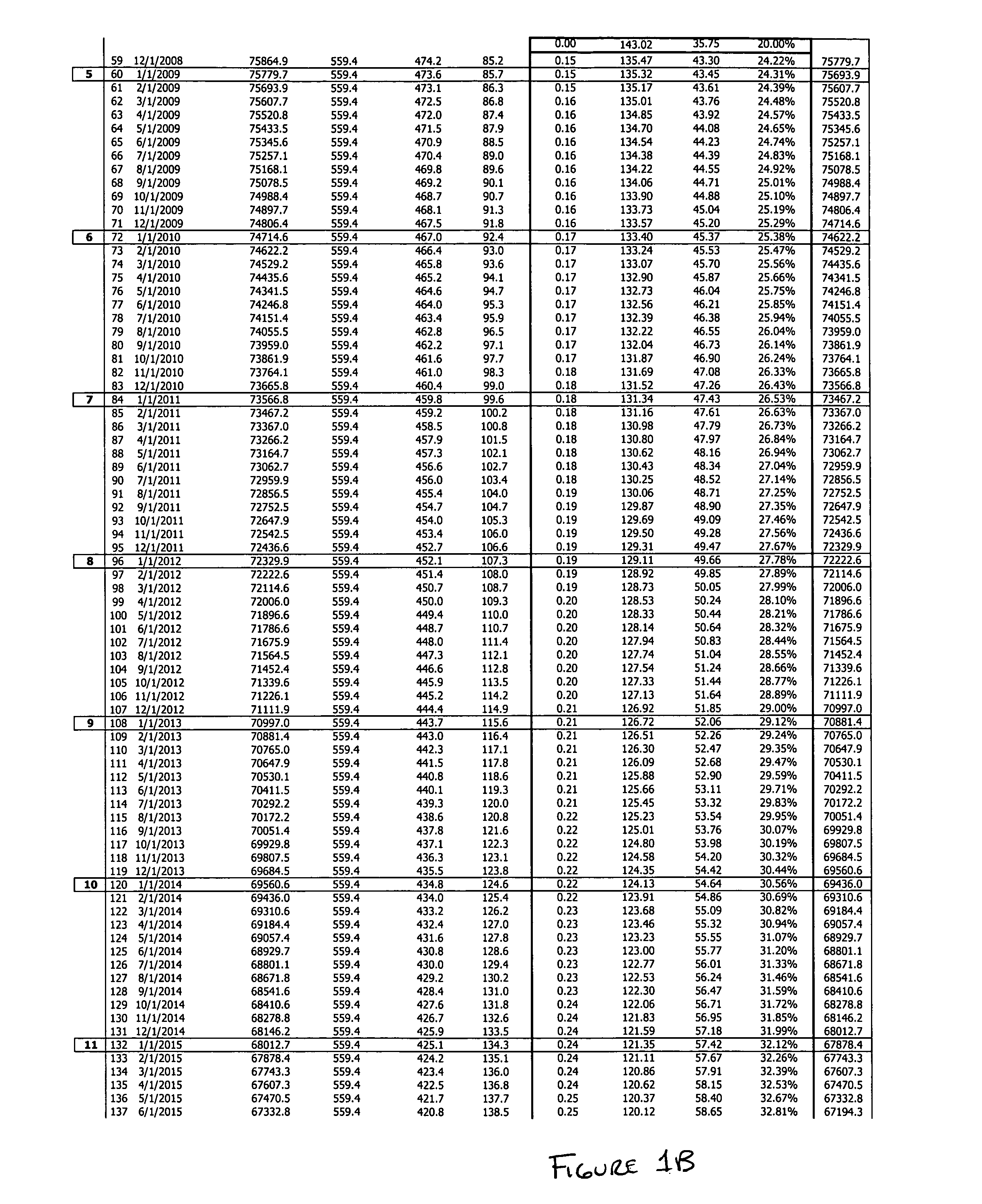
[0055] c--Then the value of one share increases from $559 to a future value equals to $1220=$222,000: 178.8 shares.
[0056] d--One share ($559) makes profit of $ 661=118%.
[0057] e--The balance of the lender's shares are 123.4, multiplied by $1220=$150,548.
[0058] f--Compared to the balance of conventional loan=$ 69,054
[0059] g--The lender can make additional profit of $81,494=118%.
[0060] h--The borrower owns 58.17 shares, multiplied by $1220=$70,967=118% profit
[0061] I--The equity here is divided proportionally
case # 2
[0062] If the borrower stops making payment for any reason, and under the Same market condition above (a, d, c, d, e, and f, h):
[0063] j--The Lender shares' balance is 123.4 and the borrower shares' balance is owns 58.17 shares.
[0064] k--The share value is equal to $1220 which means each share makes a profit of $ 661=118% (this is not an accumulated interest, this is a profit).
[0065] l--The lender as a partner will purchase back shares from the borrower shares at the original share's price which is agreed to from the outset, to some extent depending on the grace period agreed to from the outset between the Lender and the borrower.
[0066] m--Selling the home (in the grace period--within the security level, which is the number of share agreed to from the outset) might be the borrower's decision to avoid any additional loss for the benefit of both parties.
case # 3
[0067] Case # 3 : If the borrower used all his security shares in the allowable grace period and he reaches the penalty level. (In addition to the case #2 above)
[0068] n--The lender will collect the borrower's penalty shares as agreed from the outset and he owns the total shares of the property.
[0069] o--The property will now be completely the lender's, the decision (e.g., to sell, etc.) will be fully determined by the lender.
[0070] p--If a loss still occurs from the final sale, it should be limited to the penalty shares, no further liability to the borrower.
the structure of the environmentally friendly knitted fabric provided by the present invention; figure 2 Flow chart of the yarn wrapping machine for environmentally friendly knitted fabrics and storage devices; image 3 Is the parameter map of the yarn covering machine
Login to View More
PUM
Login to View More
Abstract
A system and a method of financing the purchase of real estate property based on shares, owned by two or more parties proportional to their contribution. The Sale Price "SP" of a property is converted into a specific number of shares "N", divided between both Lender "LS" and Borrower "BS" proportional to their contribution. The Borrower can increase his shares and thus his equity in the property by purchasing Lender's shares from the Lender's shares over the loan term subject to annual profit rate through regular, periodic payments and / or through additional payments / investments. The Lender loan amount "L" is converted into a definite number of shares "LS" as well and amortized based on shares over the loan term. A regular Payment "Rb" equals the value of one share "SV" which determines the value of one share. The borrower makes regular payment "Rb" consisting of two portions. One portion goes towards "R" the lender profit on his capital, and the other portion "b" goes towards the borrower to purchase shares "n" from the lender and decrease the lender's shares.
Description
[0001] This is a continuation in part of application Ser. No. 09 / 493,797 filed Jan. 28, 2000, which is hereby incorporated by reference.[0002] This invention relates to a Real Estate Purchase and Loan Repayment process (the Program) structured based on shares owned by the lender and the borrower proportionally to their loan original (and continuing) contribution taking in consideration all aspects of security, protection, penalties and all related issues for the benefit of both parties, lender and borrower as shares' holders / investors.BACKGROUND OF THE INVENTION / PROGRAM[0003] In Real Estate Purchase, a Borrower usually enters into a loan agreement with lending institution to make a purchase, and a Lender enter into loan agreements to make a profit. The profit that the lender makes is derived from the finance charges or interest ONLY. In some cultures, the charging of "interest" is not allowed or not desirable.[0004] The interest charged ("profit") is only valid when charged in excha...
Claims
the structure of the environmentally friendly knitted fabric provided by the present invention; figure 2 Flow chart of the yarn wrapping machine for environmentally friendly knitted fabrics and storage devices; image 3 Is the parameter map of the yarn covering machine
Login to View More
Application Information
Patent Timeline
Application Date:The date an application was filed.
Publication Date:The date a patent or application was officially published.
First Publication Date:The earliest publication date of a patent with the same application number.
Issue Date:Publication date of the patent grant document.
PCT Entry Date:The Entry date of PCT National Phase.
Estimated Expiry Date:The statutory expiry date of a patent right according to the Patent Law, and it is the longest term of protection that the patent right can achieve without the termination of the patent right due to other reasons(Term extension factor has been taken into account ).
Invalid Date:Actual expiry date is based on effective date or publication date of legal transaction data of invalid patent.
Login to View More
Patent Type & AuthorityApplications(United States)


 Login to View More
  Login to View More