Supercharge Your Innovation With Domain-Expert AI Agents!

Conduit loss compensation for a distributed electrohydraulic system

a distributed electrohydraulic system and conduit loss compensation technology, applied in the direction of fluid couplings, servomotors, couplings, etc., can solve the problems of insufficient account for conduit losses, inability to distribute control, and inability to adequately account for conduit losses located in close proximity to the actuator being controlled

Inactive Publication Date: 2005-12-29
HUSCO INT INC
View PDF5 Cites 6 Cited by
  • Summary
  • Abstract
  • Description
  • Claims
  • Application Information

AI Technical Summary

Benefits of technology

This approach ensures that each hydraulic actuator operates at the desired pressure level, improving the accuracy and efficiency of fluid flow and reducing the impact of conduit losses on system performance.

Problems solved by technology

Each of these conduits is subject to fatigue as they flex with motion of the boom assembly.
However, distributed control is not without drawbacks.
Furthermore, sensing the pressure at the hydraulic valves located in close proximity to the actuator being controlled does not adequately account for the conduit losses between that valve assembly and the tractor when determining the pressure level that the pump has to supply.
As a consequence with this type of system, losses in different sections of the supply and return conduits of the hydraulic system become very important.

Method used

the structure of the environmentally friendly knitted fabric provided by the present invention; figure 2 Flow chart of the yarn wrapping machine for environmentally friendly knitted fabrics and storage devices; image 3 Is the parameter map of the yarn covering machine
View more

Image

Smart Image Click on the blue labels to locate them in the text.
Viewing Examples
Smart Image
  • Conduit loss compensation for a distributed electrohydraulic system
  • Conduit loss compensation for a distributed electrohydraulic system
  • Conduit loss compensation for a distributed electrohydraulic system

Examples

Experimental program
Comparison scheme
Effect test

Embodiment Construction

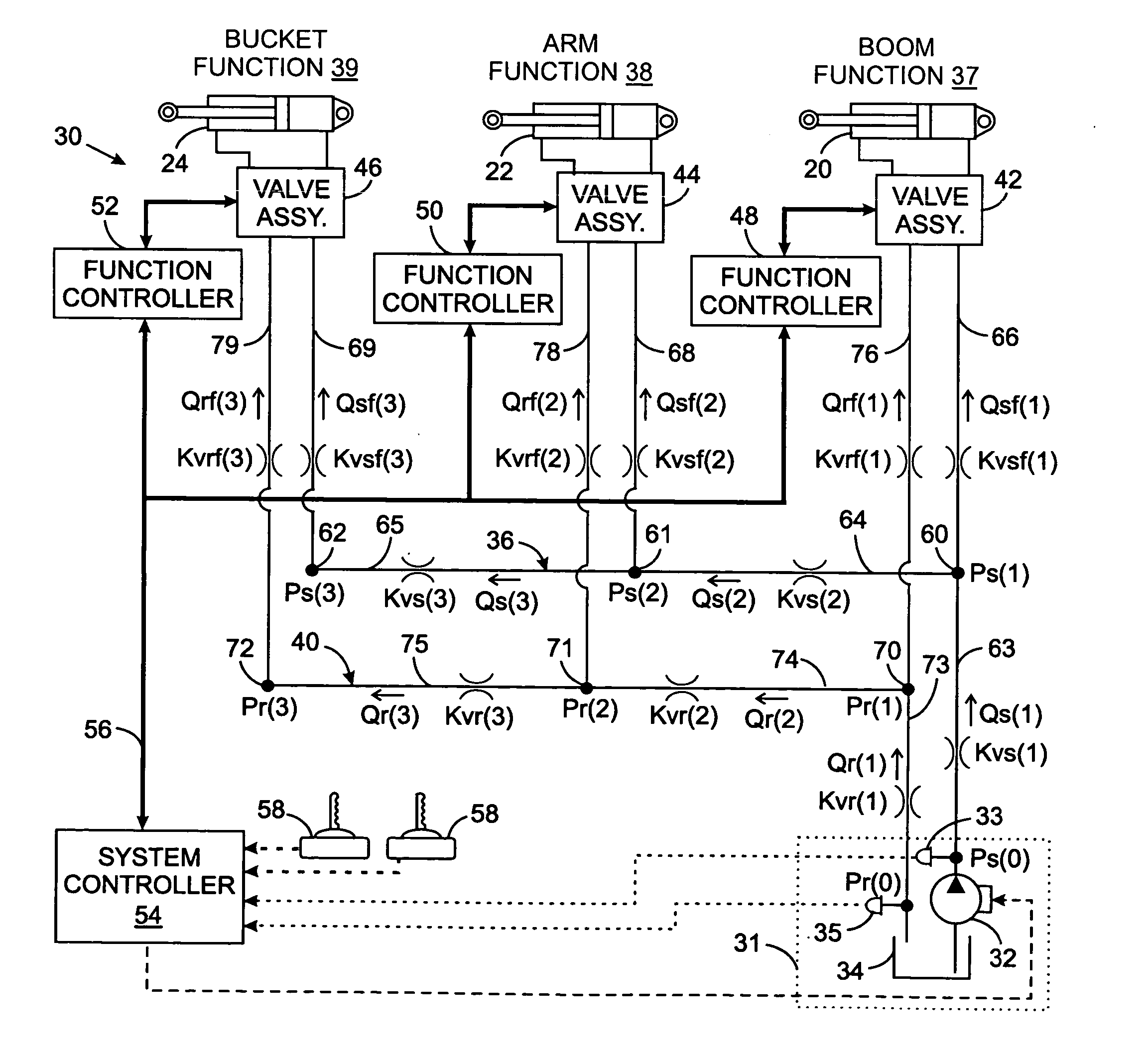
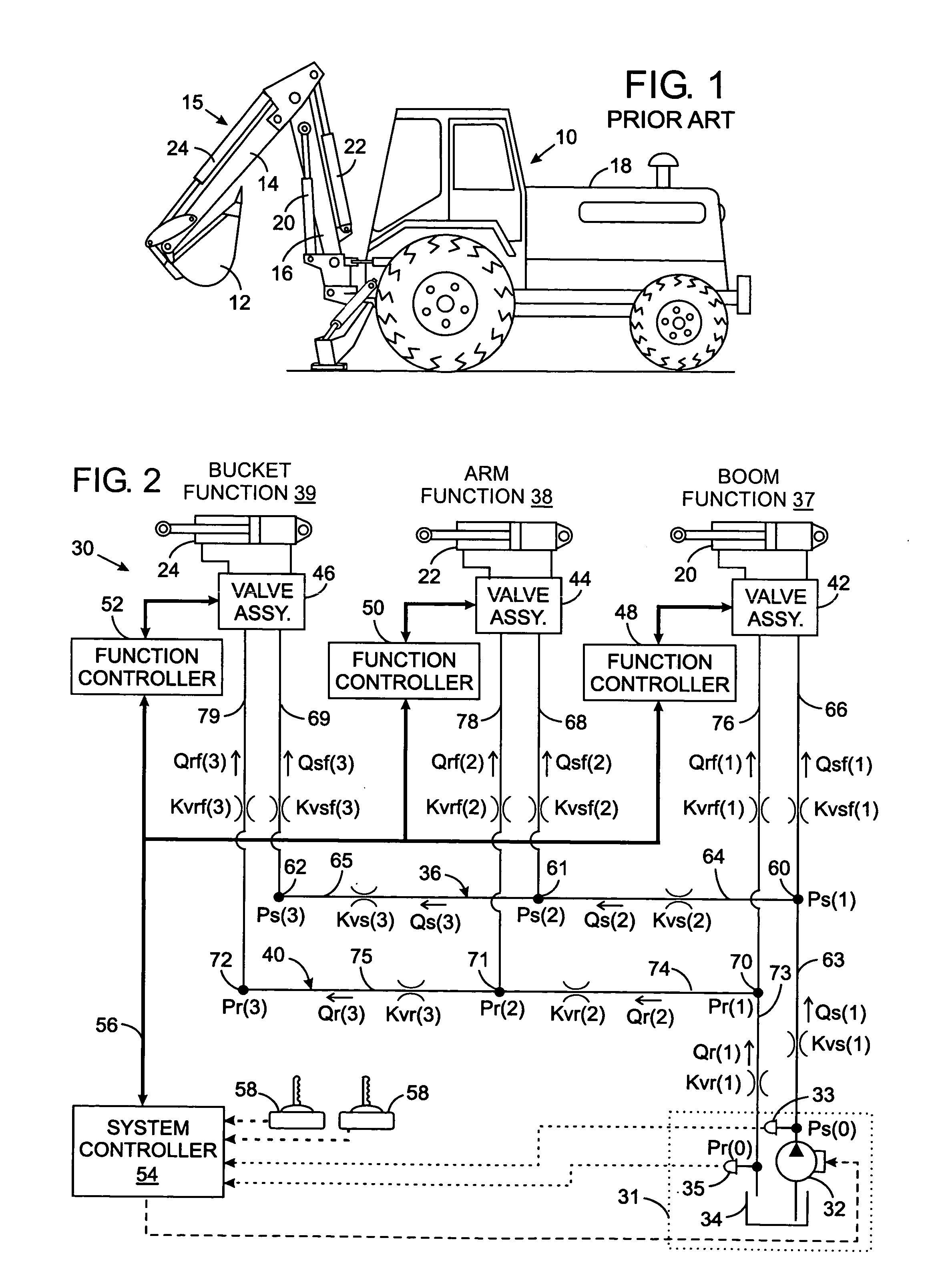
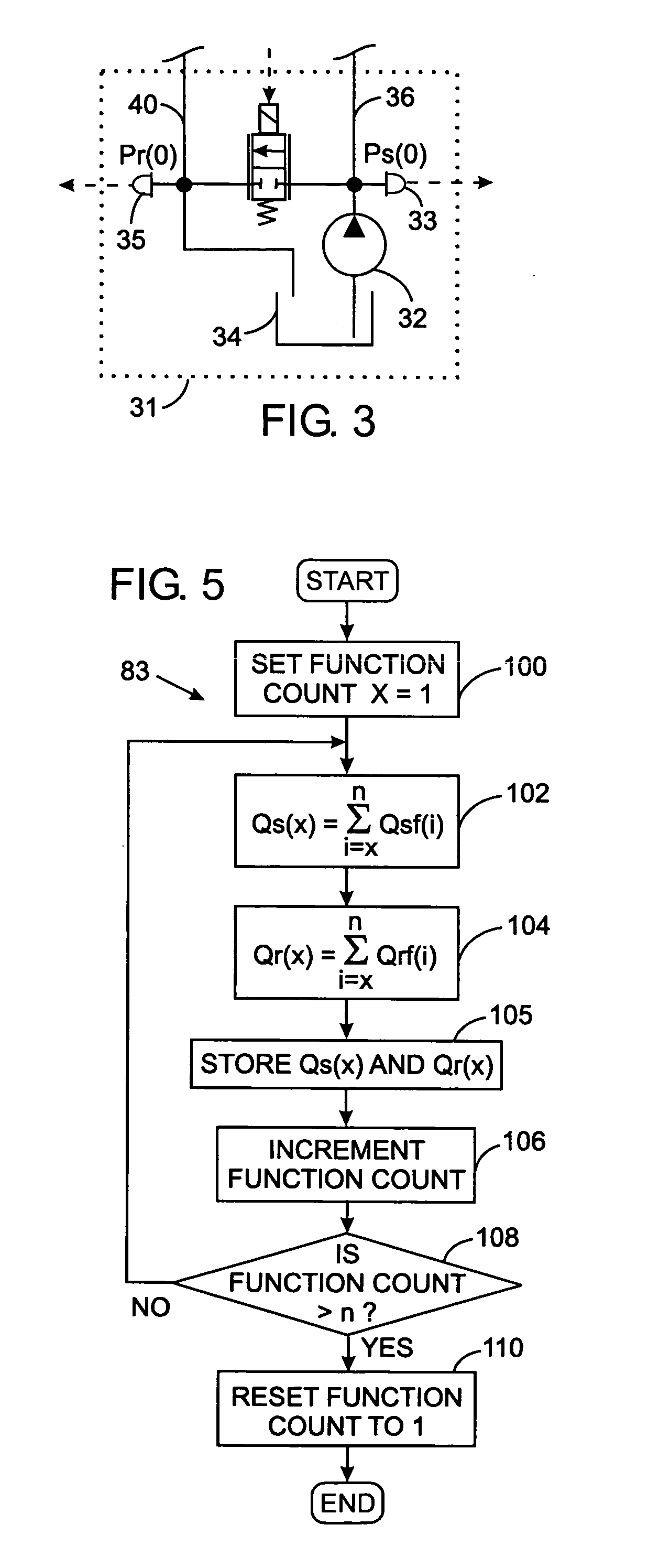
[0024] Referring initially to FIGS. 1 and 2, a hydraulic system 30 for controlling operation of the backhoe boom assembly 15 includes a fluid source 31 that has a variable displacement pump 32 which draws fluid from a tank 34 and forces that fluid under pressure into a supply conduit 36. Alternatively as shown in FIG. 3, a fixed displacement pump may be used with an unloader valve or similar mechanism being provided to regulate the pressure in the supply conduit 36. The outlet pressure Ps(0) from the pump is measured by a first sensor 33 in FIG. 2. The supply conduit 36 furnishes the pressurized fluid to a boom function 37, an arm function 38, and a bucket function 39, which respectively operate the boom cylinder 20, the arm cylinder 22 and the bucket cylinder 24. Fluid returns from these three functions 37-39 to the tank 34 via a return conduit 40. The return pressure Pr(0) at the inlet to the tank 34 is measured by a second sensor 35. The supply conduit 36 and the return conduit 4...

the structure of the environmentally friendly knitted fabric provided by the present invention; figure 2 Flow chart of the yarn wrapping machine for environmentally friendly knitted fabrics and storage devices; image 3 Is the parameter map of the yarn covering machine
Login to View More

PUM

No PUM Login to View More

Abstract

A plurality of hydraulic actuators are connected by valve assemblies to fluid supply and return conduits. Desired operating velocities are specified for the hydraulic actuators and used to define the amounts of fluid flow required by each actuator to move at the respective velocity. Provide the requisite flow amounts, fluid at related pressures must be provided at the different hydraulic actuators. In order for those pressures to occur, a pump has to furnish fluid at a greater pressure to allow for supply conduit losses. A process is provided for determining the pressure that the pump must provide to satisfy the greatest pressure that is necessary for the desired operation of all the hydraulic actuators.

Description

CROSS-REFERENCE TO RELATED APPLICATIONS [0001] Not Applicable STATEMENT REGARDING FEDERALLY SPONSORED RESEARCH OR DEVELOPMENT [0002] Not Applicable BACKGROUND OF THE INVENTION [0003] 1. Field of the Invention [0004] The present invention relates to hydraulic systems for powering machinery, and more particularly to distributed hydraulic systems in which each hydraulic actuator is operated by a control valve assembly located relatively close to the associated actuator. [0005] 2. Description of the Related Art [0006] With reference to FIG. 1, a backhoe 10 is a well known type of earth moving equipment that has a bucket 12 rotatably attached to the end of an arm 14 which in turn is pivotally coupled by a boom 16 to a tractor 18, thereby forming a boom assembly 15. A hydraulic boom cylinder 20 raises and lowers the boom 16 with respect to the tractor 18 and a hydraulic arm cylinder 22 pivots the arm 14 about the end of the boom. The bucket 12 is rotated at the remote end of the arm 14 by...

Claims

the structure of the environmentally friendly knitted fabric provided by the present invention; figure 2 Flow chart of the yarn wrapping machine for environmentally friendly knitted fabrics and storage devices; image 3 Is the parameter map of the yarn covering machine
Login to View More

Application Information

Patent Timeline
no application Login to View More
Patent Type & Authority Applications(United States)
IPC IPC(8): E02F9/22F15B11/16F15B13/04F15B21/08
CPCE02F9/2228F15B11/165F15B21/087F15B2211/20538F15B2211/20546F15B2211/40507F15B2211/6654F15B2211/50536F15B2211/513F15B2211/5157F15B2211/526F15B2211/6309F15B2211/6326F15B2211/45
Inventor PFAFF, JOSEPH L.
Owner HUSCO INT INC
Features
  • R&D
  • Intellectual Property
  • Life Sciences
  • Materials
  • Tech Scout
Why Patsnap Eureka
  • Unparalleled Data Quality
  • Higher Quality Content
  • 60% Fewer Hallucinations
Social media
Patsnap Eureka Blog
Learn More