
Electric double layer capacitor
- Summary
- Abstract
- Description
- Claims
- Application Information
AI Technical Summary
Benefits of technology
Problems solved by technology
Method used
Image

Examples
first embodiment
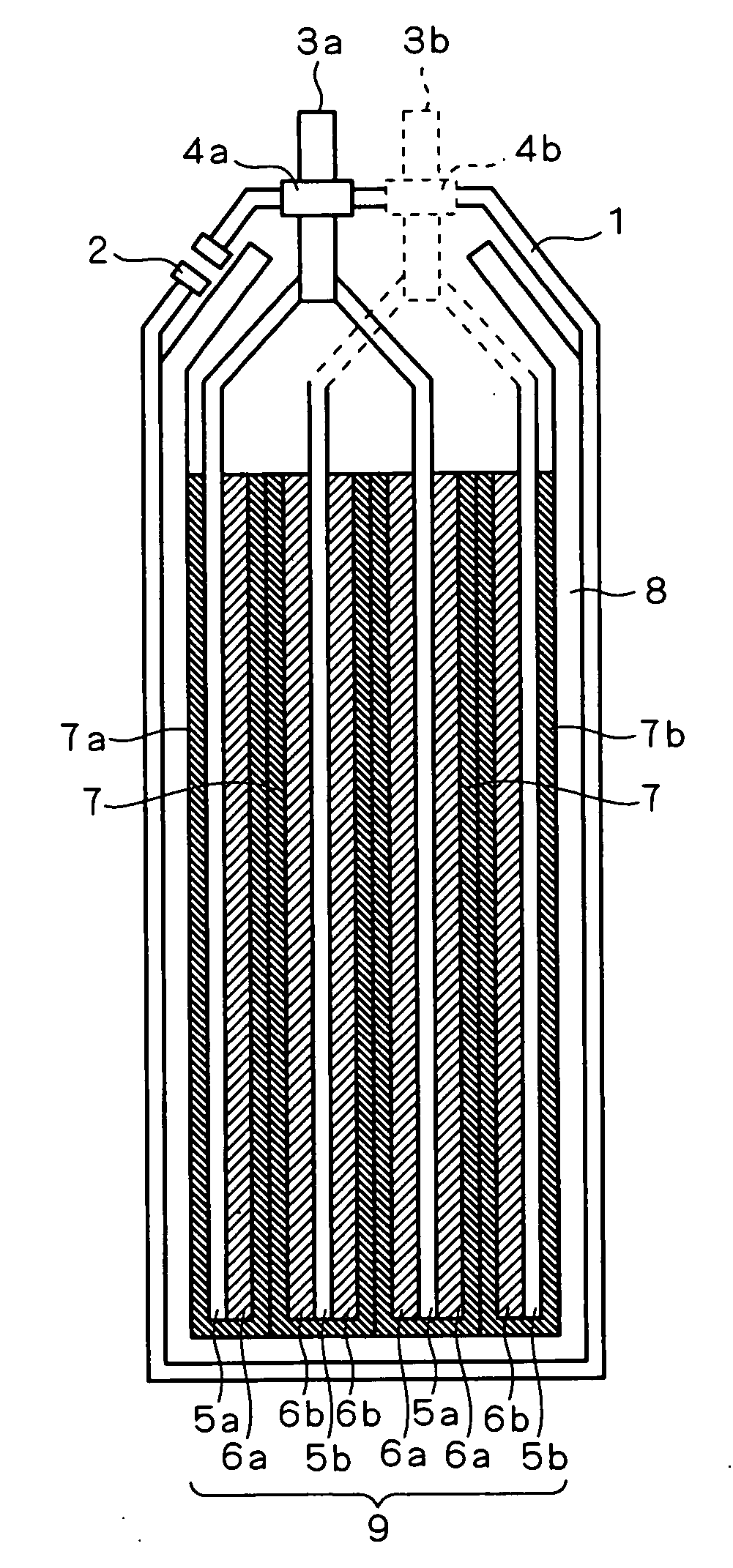
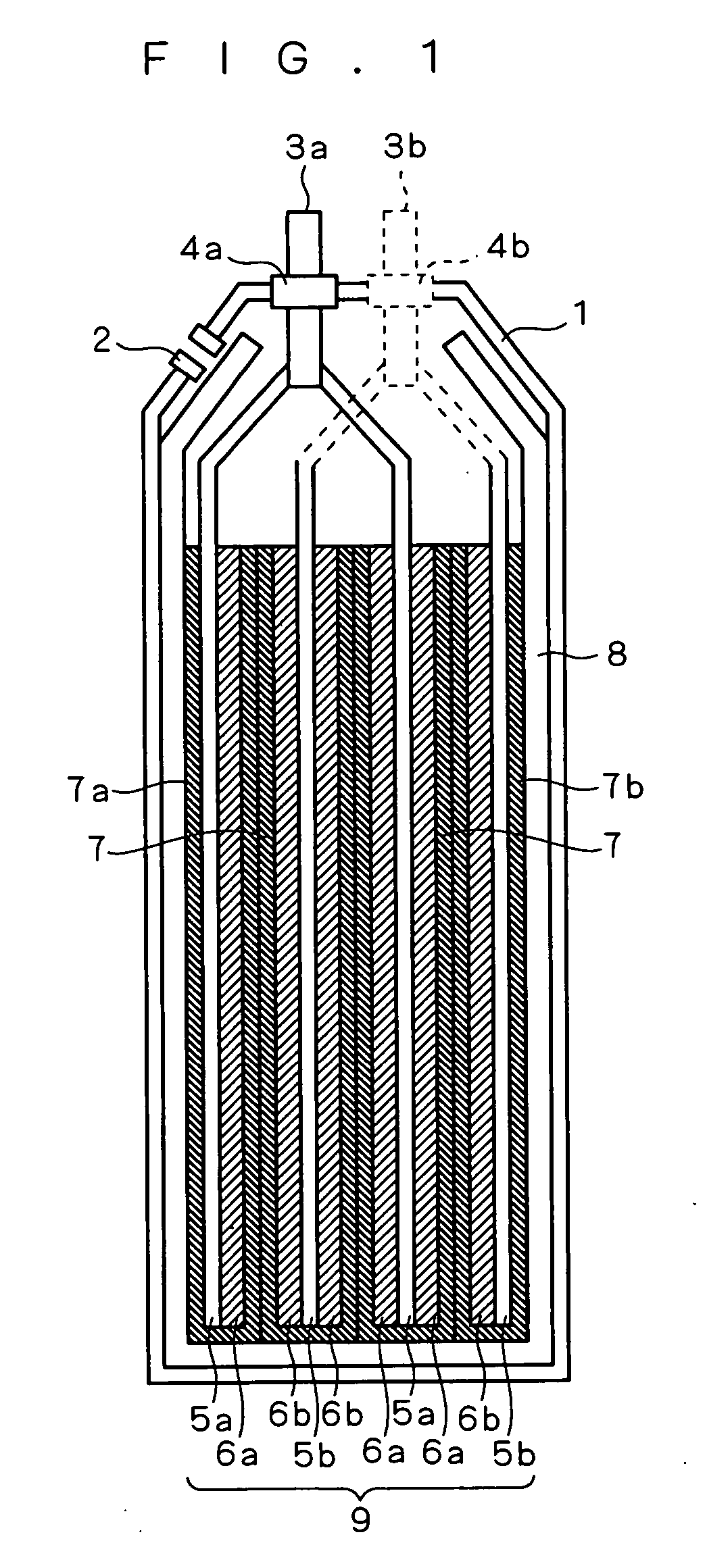
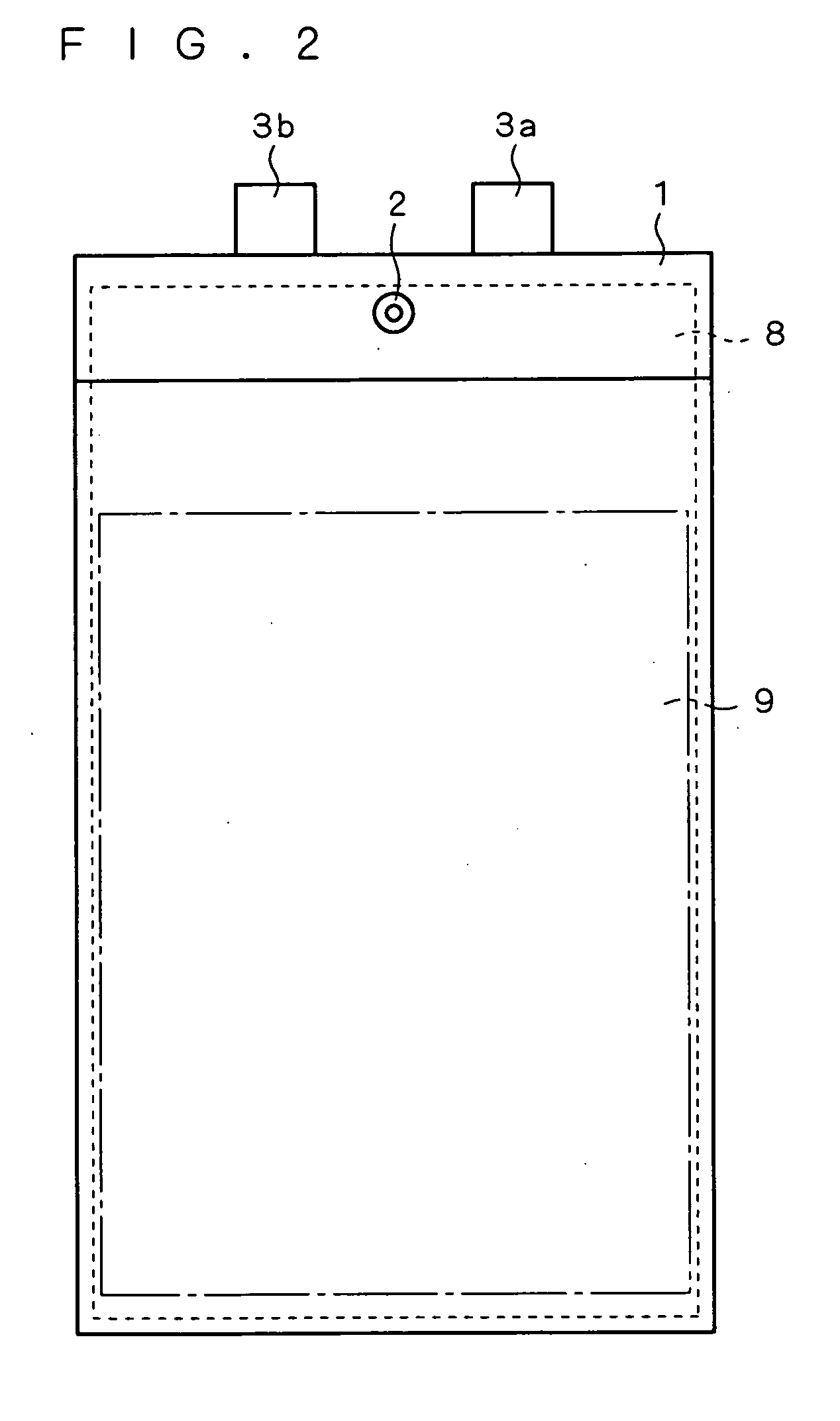
[0060]FIGS. 1 and 2 are respectively a sectional view and a front view showing the structure of an electric double layer capacitor according to a first embodiment of the present invention. With reference to FIGS. 1 and 2, a plurality of pairs of positive electrodes 6a and negative electrodes 6b, which face each other with a porous separator 7 placed in between, are layered on each other, and thereby, a cell portion 9 is formed. As for the positive electrodes 6a and the negative electrodes 6b, layers having a thickness of several hundreds of μm, where activated carbons or Nanogate carbons which each have a size of approximately 10 μm are bounded using a fluorine-based resin such as PTFE (polytetrafluoroethylene) as a binder, are used.
[0061] The positive electrodes 6a are formed on positive electricity collecting plates 5a and the negative electrodes 6b are formed on negative electricity collecting plates 5b. As for the positive electricity collecting plates 5a, aluminum foil is used...
second embodiment
[0078]FIG. 6 is a perspective view showing the structure of an electric double layer capacitor according to a second embodiment of the present invention, and shows the electric double layer capacitor with a portion of the exterior case and the electrolytic solution reservoir 8 cut out. In addition, FIG. 7 is a sectional view schematically showing the structure of a cross section in the case where the electric double layer capacitor shown in FIG. 6 is cut along a virtual plane 20.
[0079] Though an example of a layered type electric double layer capacitor is described in the first embodiment, as shown in FIGS. 6 and 7, the present invention can also be applied to a spiral type electric double layer capacitor.
[0080] In a spiral type electric double layer capacitor, unlike with the layered type, the respective sheets of a positive electrode 6a, a separator 7 and a negative electrode 6b are layered on top of each other and rolled, and thereby, a cell portion 9 is formed. In the electric...
third embodiment
[0082]FIG. 8 is a front view showing the structure of an electric double layer capacitor according to a third embodiment of the present invention. As shown in FIG. 8, the electric double capacitor according to the third embodiment is provided with an exterior case 101, an electrolytic solution reservoir 104 and a cell portion 105 which are contained within this exterior case 101, a positive electrode terminal 102 and a negative electrode terminal 103. The electrolytic solution reservoir 104 is formed of a plurality of electrolytic solution reservoirs 104a.
[0083]FIG. 9 and 10 are a sectional view and a perspective view showing the structure of the electrolytic solution reservoir 104 and the cell portion 105 in a state where the two are contained within the exterior case 101, respectively. FIG. 10 does not show the separator 110 that is shown in FIG. 9, for the sake of convenience. As shown in FIGS. 9 and 10, the cell portion 105 has a structure where a plurality of pairs of a positi...
PUM
 Login to View More
 Abstract
Description
Claims
Application Information
 Login to View More