
Frequency modulation radar apparatus for vehicle use background of the invention
- Summary
- Abstract
- Description
- Claims
- Application Information
AI Technical Summary
Benefits of technology
Problems solved by technology
Method used
Image

Examples
embodiment 1
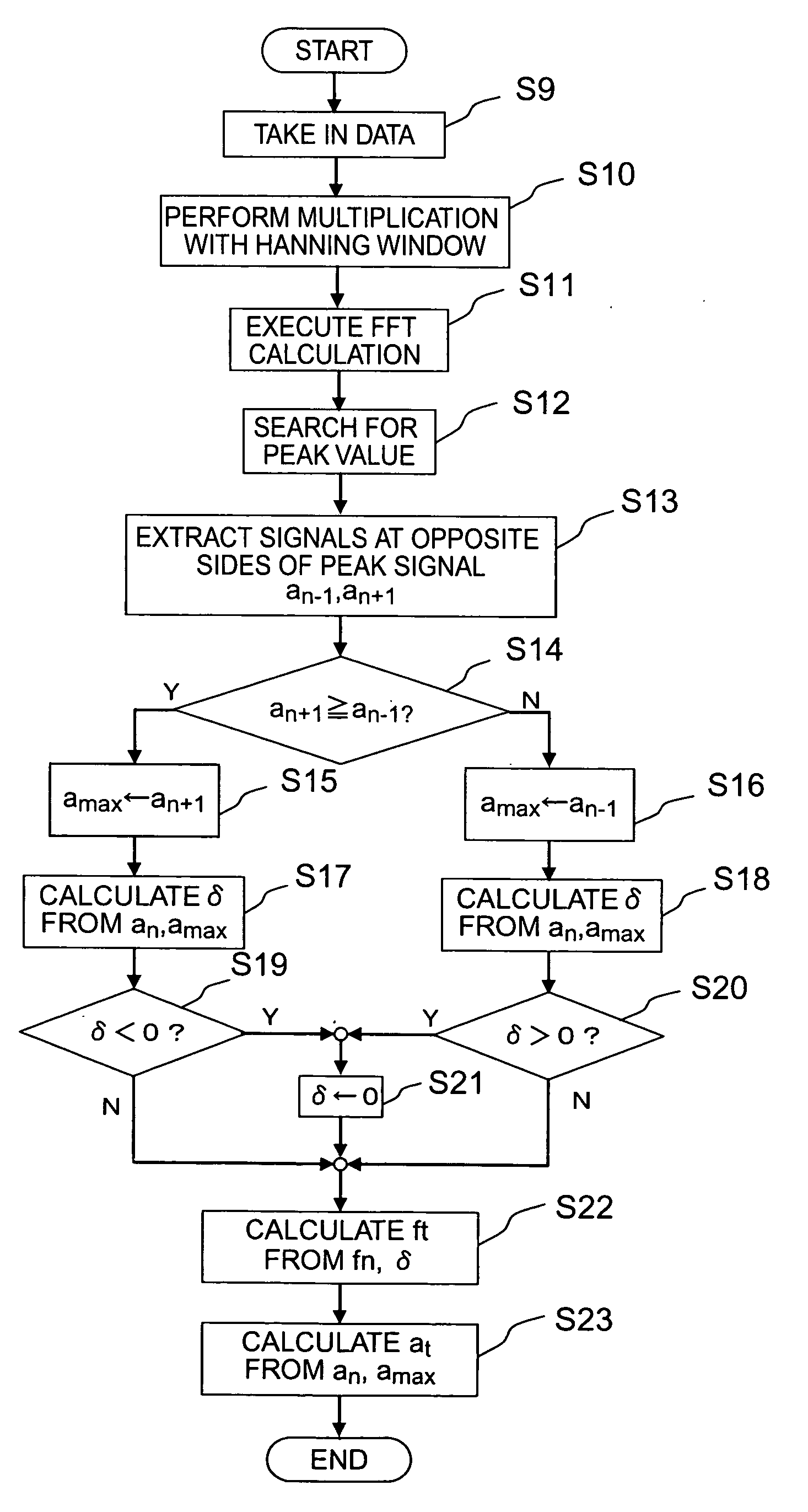
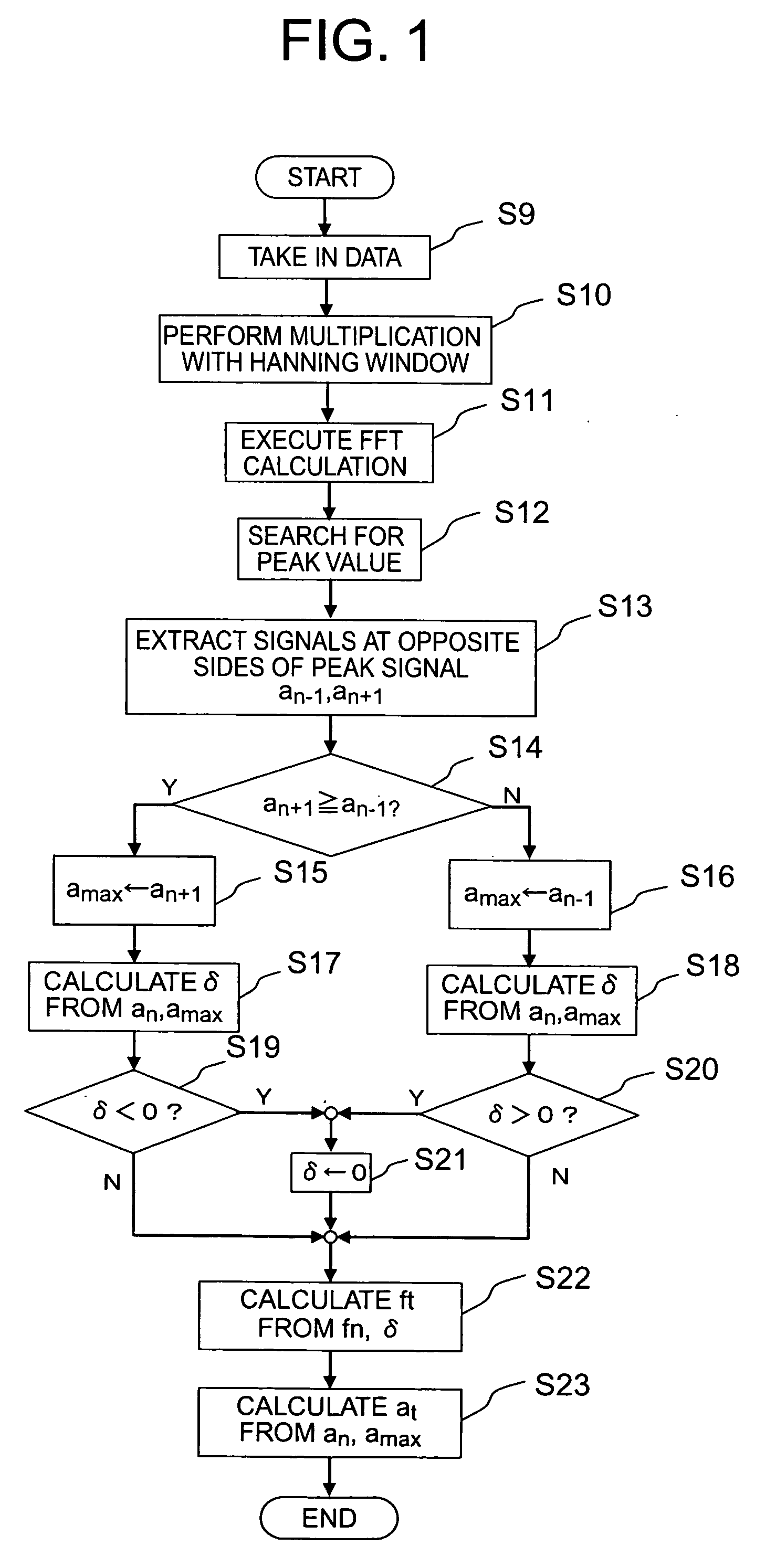
[0030]Referring to the drawings and first to FIG. 1, there is shown a flow chart that illustrates FFT calculation processing by a frequency modulation radar apparatus for vehicle use according to a first embodiment of the present invention. Here, note that the construction of the frequency modulation radar apparatus for vehicle use according to the first embodiment of the present invention is similar to that of the above-mentioned conventional apparatus (see FIG. 8), but is only different therefrom in a part of the calculation processing of the frequency fn and the strength an of a peak signal in an FFT calculation section 8.
[0031]In addition, the operation of the frequency modulation radar apparatus of this invention until a sampled beat signal is input to the FFT calculation section 8 and the processing operation of a CPU 1 are similar to those as stated before, and hence a detailed explanation thereof is omitted here.
[0032]In this case, the FFT calculation section 8 (see FIG. 8) ...
embodiment 2
[0081]Although in the above-mentioned first embodiment, an additive correction of the amount of frequency correction δ is used to calculate the frequency ft of the true peak signal, the frequency ft of the true peak signal may be calculated by using a strength amax of one of the strengths an−1, an+1 which is not smaller than the other and a frequency fmax corresponding to the strength amax based on a linear combination of the frequency fn of the peak signal and the frequency fmax.
[0082]Hereinafter, reference will be made to a frequency modulation radar apparatus for vehicle use according to a second embodiment of the present invention while referring to a flow chart in FIG. 3 together with FIGS. 8 and 9.
[0083]In this case, a frequency correction section in an FFT calculation section 8 calculates a frequency ft of a true peak signal based on a linear combination of a frequency fn of a peak signal and an under-mentioned frequency fmax, by using a strength an of the peak signal, a stre...
embodiment 3
[0107]Although in the above-mentioned first embodiment (see FIG. 1), the Hanning window is multiplied or used by the FFT calculation section 8 in step S10, a Hamming window may instead be applied, as shown in step S32 in FIG. 4.
[0108]Hereinafter, reference will be made to a frequency modulation radar apparatus for vehicle use according to a third embodiment of the present invention while referring to a flow chart in FIG. 4 together with FIGS. 8 and 9. In FIG. 4, the same or like processes (steps S9, S11 through S16, S19 through S22) as those described above (see FIG. 1) are identified by the same symbols while omitting a detailed description thereof.
[0109]First of all, an FFT calculation section 8 takes in a sampled beat signal from an A / D converter 7 (step S9), and then the sampled beat signal is multiplied by a Hamming window Wham(t), as shown in the following expression (18) (step S32).
Wham(t)={2546-2146cos2πTt(0≤t≤T)0(t<0,t>T)(18)
[0110]Hereinafter, the processes from the F...
PUM
 Login to View More
 Abstract
Description
Claims
Application Information
 Login to View More