
Techniques for reducing jitter for taps
a technology of touch sensor and jitter reduction, which is applied in the field of touch sensor panels, can solve the problems of excessive suppression of intended sliding motion, difficult for a user to control finger motion to produce a tapping motion, and difficult to distinguish from a true sliding gesture as intended by the user
- Summary
- Abstract
- Description
- Claims
- Application Information
AI Technical Summary
Benefits of technology
Problems solved by technology
Method used
Image

Examples
Embodiment Construction
[0022]In the following description of preferred embodiments, reference is made to the accompanying drawings which form a part hereof, and in which it is shown by way of illustration specific embodiments in which the invention can be practiced. It is to be understood that other embodiments can be used and structural changes can be made without departing from the scope of the embodiments of this invention.
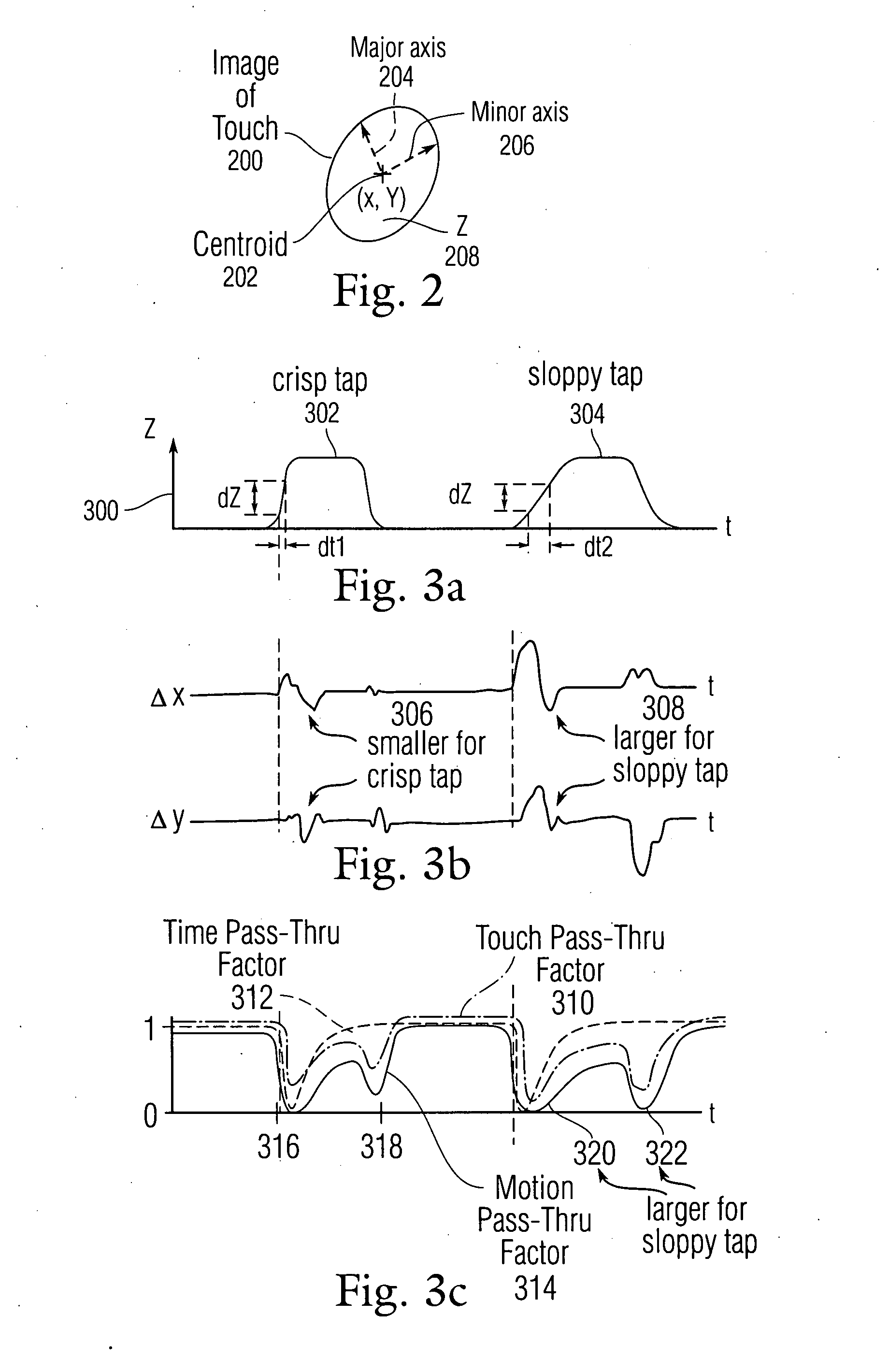
[0023]This relates to distinguish sloppy taps from sliding motions using an algorithm that can take into account both a time instability factor and a touch instability factor. A limited amount of motion per frame can be subtracted off or canceled during a time period immediately following the detection of a touch event. Small lateral motions indicative of a sloppy tap can be suppressed, while fast finger motions indicative of a quick, long cursor movement can immediately pass through the filter without being suppressed by a significant amount.
[0024]Although some embodiments of this i...
PUM
 Login to View More
 Abstract
Description
Claims
Application Information
 Login to View More