[0007]In view of the foregoing prior art problems, it is an object of the present invention to provide an improved battery manufacturing method and apparatus which not only can minimize an undesired thickness change of electrode sheets but also can minimize lowering of a
processing accuracy of the electrode sheets.
[0010]With the arrangement that the electrode sheet is roll-pressed after the formation, in the longitudinal direction, of the succession of corrugations, the extension produced in the active-material-coated portions of the electrode film due to the roll-pressing can be effectively absorbed in the corrugations, so that no
residual stress arises from a difference in extension between the active-material-coated portions and the non-active-material-coated portions of the electrode sheet; thus, the electrode sheet will not curve when it is
cut in the longitudinal direction thereof through the width of the sheet. Because almost no extension occurs in the non-active-material-coated portions of the electrode sheet, a thickness change of the electrode sheet can be minimized or prevented. Further, because the battery manufacturing method of the present invention is not arranged to process the side edges of the electrode sheet, it can effectively prevent reduction or lowering of
processing accuracy. As a result, it is possible to prevent unwanted breakage and further extension of the positive and negative sheet electrodes when constructing the electrode
assembly, and thus achieve an enhanced productivity and product quality of the battery.
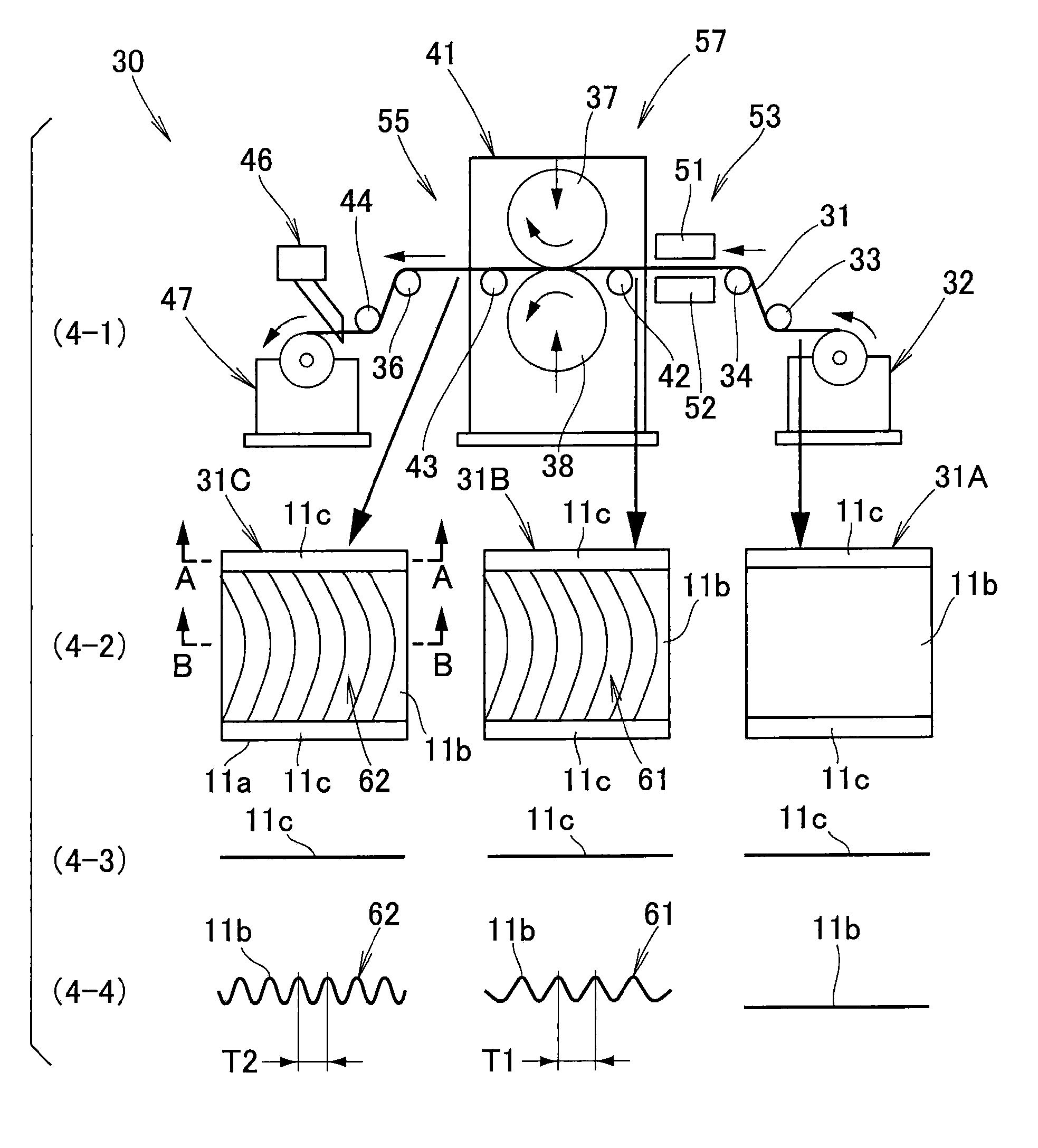
[0011]In an embodiment, the above-mentioned step of forming a succession of corrugations forms the corrugations on each of the positive and negative electrode sheets by imparting tension to portions of the electrode sheet located upstream and downstream of roll-pressing rollers when the electrode sheet is to be roll-pressed via the rollers. Namely, as the electrode sheet is fed forward through the rollers, the electrode sheet is pulled forwardly, i.e., downstream, of the rollers. Because the non-active-material-coated portions, having a smaller thickness than the active-material-coated portions, are not sandwiched and detained by the roll-pressing rollers with only the active-material-coated portions sandwiched and detained by the roll-pressing rollers, only the non-active-material-coated portions are moved forward in a sheet feeding direction, so that a succession of corrugations can be produced in the electrode sheet. Thus, the method of the invention can form the corrugations with ease by just imparting tension to the electrode sheet.
[0012]In one embodiment, the step of forming a succession of corrugations forms the corrugations on each of the positive and negative electrode sheets by plastically deforming the active-material-coated portions of the electrode sheet. Such plastically deformation allows the succession of corrugations to be formed with increased ease and accuracy.
[0013]In one embodiment, the step of forming a succession of corrugations forms the corrugations on each of the positive and negative electrode sheets after heating the active-material-coated portions of the electrode sheet. Such heating allows the active-material-coated portions (i.e., electrode active material and electrode film) to be plastically deformed easily, which can even further facilitate the formation of the corrugations.
[0015]In the roll-pressing section, only the active-material-coated portions (i.e., electrode active material and electrode film) are roll-pressed. Namely, the active-material-coated portions of the electrode sheet are roll-pressed and extended, while the non-active-material-coated portions of the electrode sheet are not roll-pressed and extended because they have a smaller thickness than the active-material-coated portions. With the arrangement that the electrode sheet is roll-pressed after the formation, in the longitudinal direction, of the succession of corrugations, the extension produced in the active-material-coated portions of the electrode film due to the roll-pressing can be absorbed in the corrugations, so that no
residual stress arises from a difference in extension between the active-material-coated portions and the non-active-material-coated portions of the electrode sheet; thus, the electrode sheet will not curve, due to a difference in extension between the active-material-coated portions and the non-active-material-coated portions, when it is
cut in the longitudinal direction thereof through the width of the sheet. Because almost no extension occurs in the non-active-material-coated portions of the electrode sheet, the thickness change of the electrode sheet, particularly the non-active-material-coated portions, can be minimized. Further, because the battery manufacturing apparatus of the invention is not arranged to process the side edges of the electrode sheet, it can effectively prevent reduction or lowering of
processing accuracy. As a result, it is possible to prevent unwanted breakage and further extension of the positive and negative sheet electrodes when constructing the electrode assembly, and thus achieve an enhanced productivity and product quality of the battery.


 Login to View More