
A Simplified Method To Retrieve Chitosan From Acidic Solutions Thereof
a technology of acidic solutions and chitosan, applied in the direction of medical preparations, pharmaceutical non-active ingredients, etc., can solve the problems of reducing limiting the number of methodologies that can be used, and reducing the polydispersity of chitosan, so as to prevent further hydrolysis of chitosan, reduce the polydispersity, and yield
- Summary
- Abstract
- Description
- Claims
- Application Information
AI Technical Summary
Benefits of technology
Problems solved by technology
Method used
Image

Examples
example 1
Chitosan (70 kDa, 84% Deacetylated) Salting Out with Na2SO4
[0104] Twenty grams of chitosan 70 kDa obtained from Fluka (Sigma-Aldrich, St Louis, Mo., USA) is dissolved in 5% acetic acid (500 ml). Seventy-five grams of Na2SO4 (final concentration, 0.47 M) are added by portions, under stirring. The salted out chitosan is kept at 4° C. for about 30 minutes and then centrifuged (8000×g) for about 20 min. The supernatant does not contain any appreciable amounts of chitosan as assayed qualitatively by the addition of polyphosphoric acid as an example which is previously known in the art to form chitosan salts that are insoluble in aqueous media (Roberts (1992) Chitin chemistry, MacMillan Press Ltd, Houndmills, Hampshire, UK. page 281). Alternatively, the amount of said chitosan remaining in solution is determined quantitatively using the colorimetric assay described by Muzzarelli (Muzzarelli 1998, supra). This assay is reported to be a more sensitive and reproducible method to quantitate ...
example 2
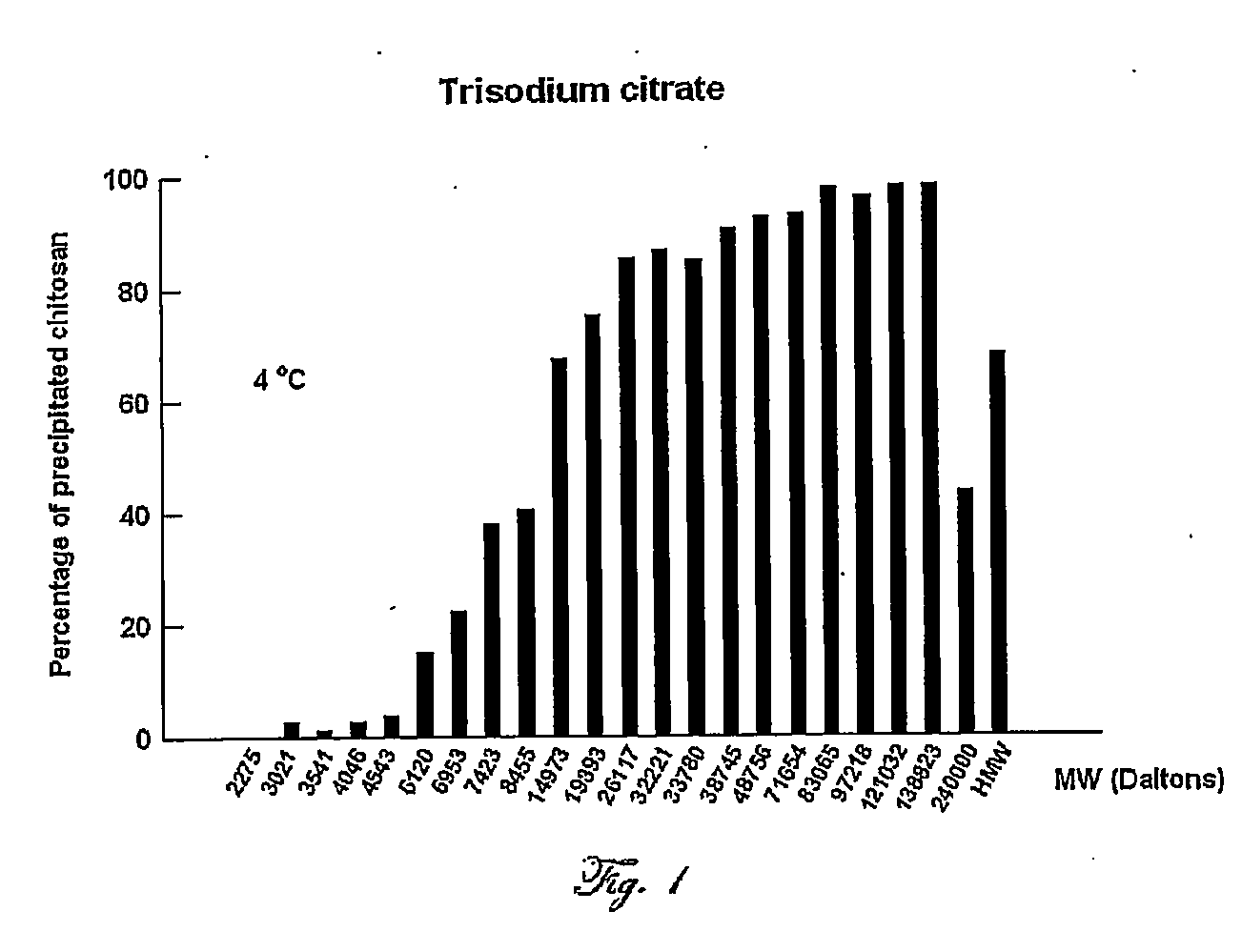
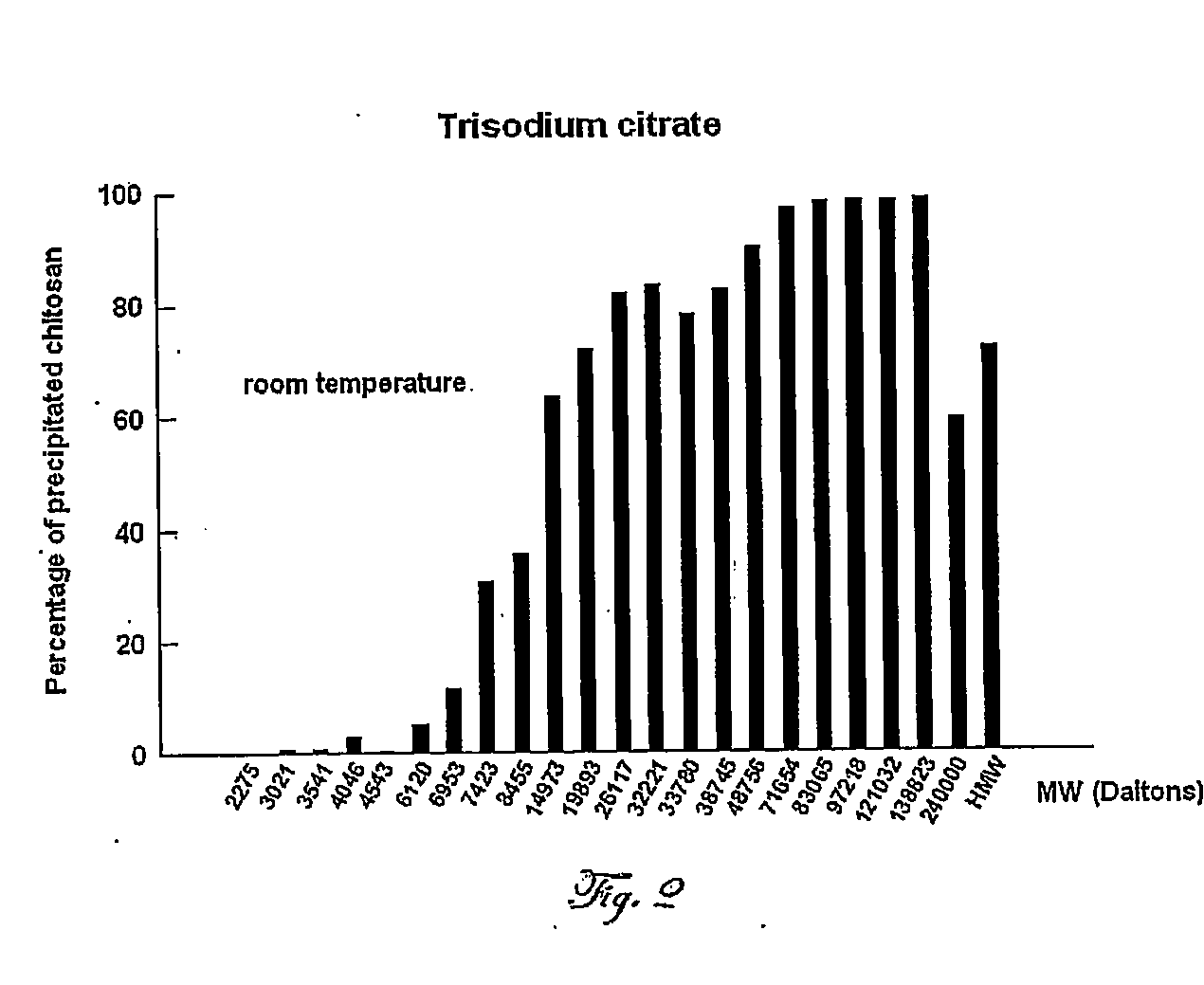
Chitosan (70 kDa, 84% Deacetylated) Salting Out with Trisodium Citrate
[0105] Twenty grams of chitosan 70 kDa obtained from Fluka (Sigma-Aldrich) is dissolved in 5% acetic acid (500 ml). Eighty grams of trisodium citrate (final concentration, 0.34 M) are added by portions, under stirring. The salted out chitosan is kept at 4° C. for 30 minutes and then centrifuged (8000×g) for 20 min. The supernatant does not contain any appreciable amounts of said chitosan as assayed by the addition of polyphosphoric acid (Roberts 1992; supra) or by colorimetric assay according to the method published by Muzzarelli (Muzzarelli 1998, supra). The salted out chitosan is washed 3 to 5 times with water and collected by centrifugation.
example 3
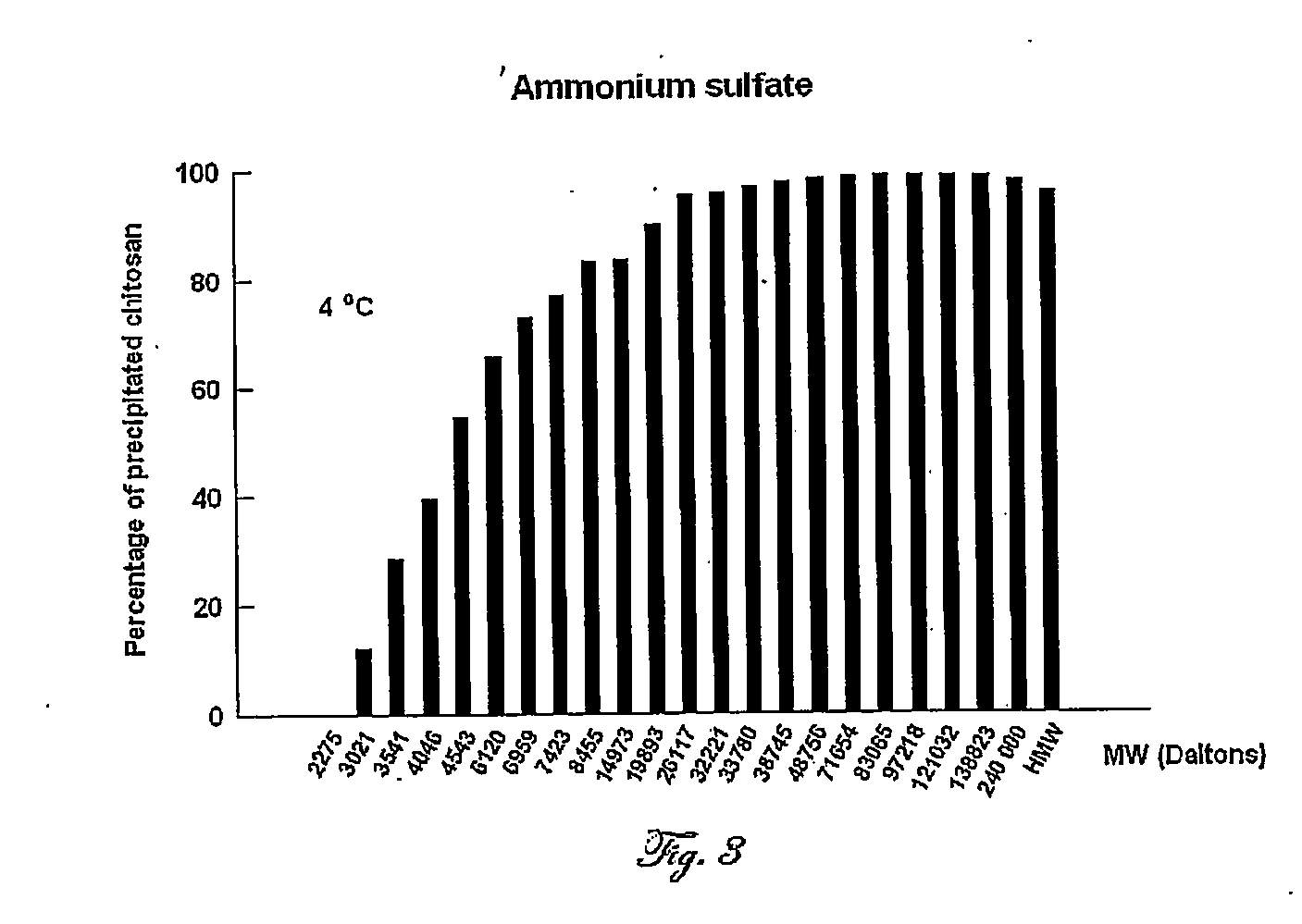
Chitosan (30 kDa, 92% Deacetylated) Salting Out with Ammonium Sulfate
[0106] One part of 92% deacetylated chitosan of molecular weight 30 kDa determined with a triple detector array apparatus equipped with a low angle light scattering device (Viscotek Corporation, Houston, Tex., USA) obtained by enzymatic hydrolysis of commercial chitosan (Marinard Biotech Ltée, Rivière-au-Renard, Gaspésie, Quebec, Canada) is dissolved in 5% aqueous acetic acid. Four parts of a concentrated aqueous solution of ammonium sulfate are added by portions. The suspension is stirred at 4° C. for 30 to 60 minutes, depending on the amounts of chitosan to be processed. The supernatant does not contain any appreciable amounts of said chitosan as assayed by the addition of polyphosphoric acid (Roberts 1992; supra) or by calorimetric assay according to the method published by Muzzarelli (Muzzarelli 1998, supra). The salted out chitosan is washed 3 to 5 times with water and collected using suitable methods describ...
PUM
| Property | Measurement | Unit |
|---|---|---|
| molecular weight | aaaaa | aaaaa |
| molecular weight | aaaaa | aaaaa |
| temperature | aaaaa | aaaaa |
Abstract
Description
Claims
Application Information
 Login to View More