
Method for OFDM and ofdma channel estimation
a channel estimation and channel estimation technology, applied in the field of channel estimation, can solve the problems of severe model error, lack of proper theoretical foundation, and inability to solve optimally, and achieve the effect of improving effective transmission performance, long channel delay, and large channel delay spread
- Summary
- Abstract
- Description
- Claims
- Application Information
AI Technical Summary
Benefits of technology
Problems solved by technology
Method used
Image

Examples
Embodiment Construction
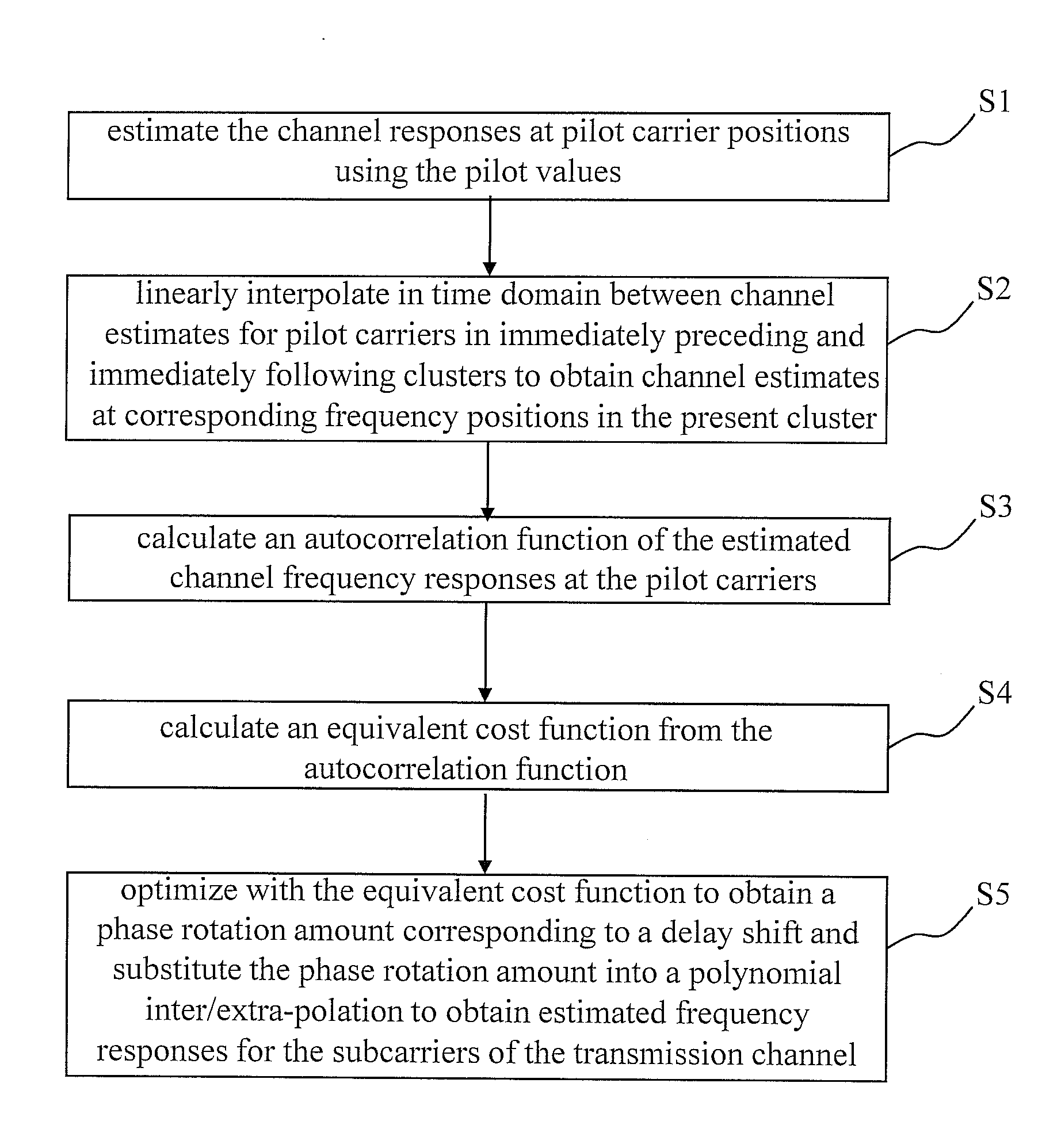
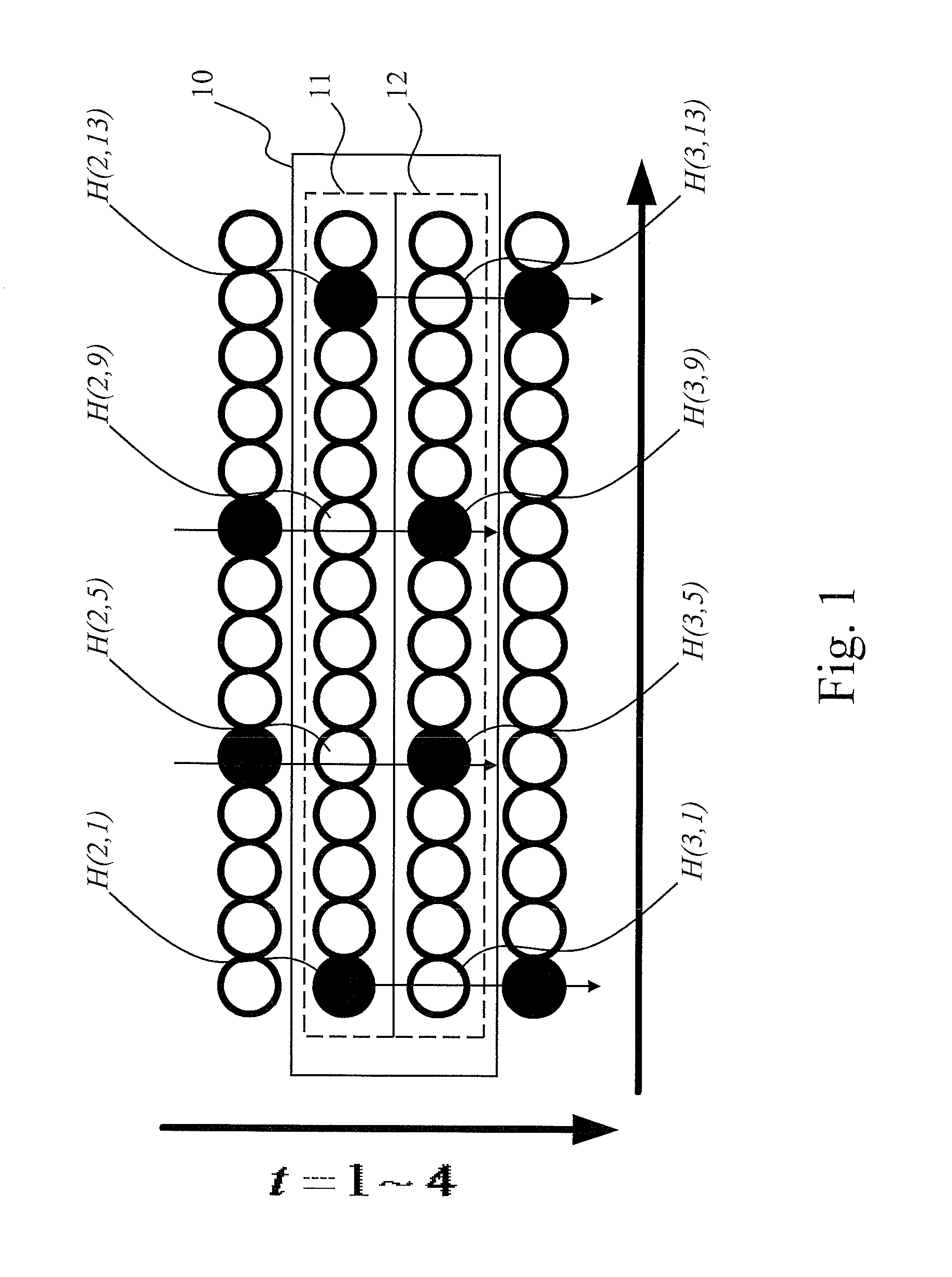
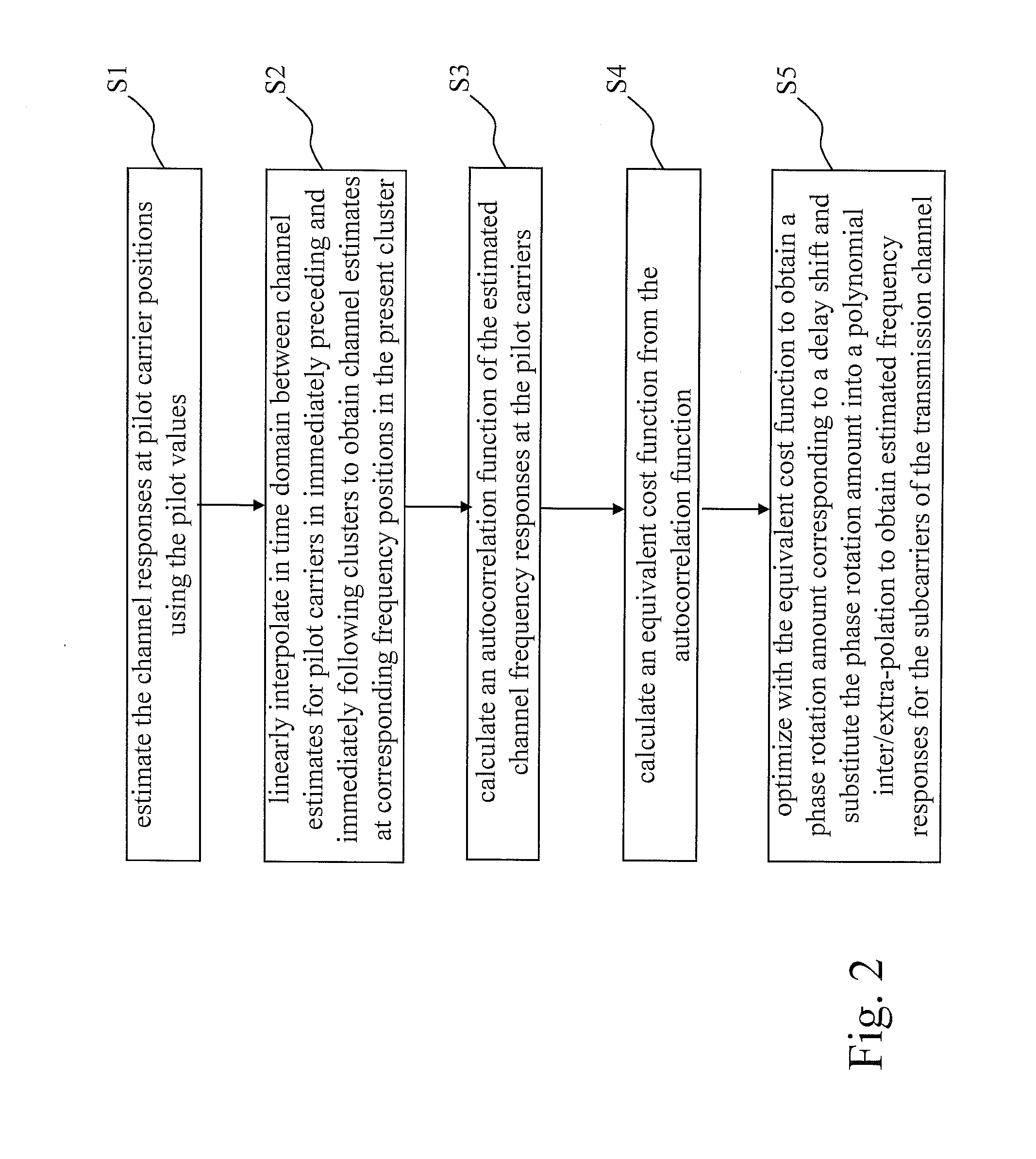
[0018]In multicarrier communication systems, e.g. orthogonal frequency-division multiplexing (OFDM) and orthogonal frequency-division multiple access (OFDMA) systems, polynomial inter / extra-polation is an efficient channel estimation technique, of which the simplest and most basic is the first-order (that is, linear) inter / extra-polation. Take the conventional linear inter / extra-polation channel estimation, as an example. It proceeds as follows: obtaining an initial channel estimate at the pilot carrier positions employing known pilot values (e.g. via least-square estimation method); and then estimating the channel responses at data carriers by linear inter / extra-polation. The linear inter / extra-polation estimates unknown values between or outside the range of two coordinate positions that have known values, and it is given by
H^(f+k)=F-kFH^(f)+kFH^(f+F)(1)
where Ĥ(f) and Ĥ(f+F) are channel estimates at two pilot carriers in a set of data carriers, F is pilot subcarrier spacing, and Ĥ...
PUM
 Login to View More
 Abstract
Description
Claims
Application Information
 Login to View More