Unlock instant, AI-driven research and patent intelligence for your innovation.

Method of producing polyolefin resin film

a polyolefin resin and film technology, applied in the field of polyolefin resin film production, can solve the problems of not being satisfied in the cost of the molding apparatus, not necessarily satisfactory in the transparency of the resultant film, and the molding method by air-cooling mode inflation molding apparatus, etc., and achieve excellent transparency

Inactive Publication Date: 2009-11-12
SUMITOMO CHEM CO LTD
View PDF9 Cites 0 Cited by
  • Summary
  • Abstract
  • Description
  • Claims
  • Application Information

AI Technical Summary

Benefits of technology

The present invention provides a method for producing a polyolefin resin film with excellent transparency. The method involves melt-extruding the polyolefin resin from a circular die towards the antigravity direction to form a tubular film, and cooling the tubular film while receiving it towards the antigravity direction. A water-absorbing material containing water and having a width in the gravity direction of 5 mm or more is brought into contact with the peripheral surface of the tubular film to cool it. This method is more effective in improving transparency than the air-cooling mode inflation molding apparatus, while being more cost-effective than the water-cooling mode inflation molding apparatus.

Problems solved by technology

The molding method by an air-cooling mode inflation molding apparatus, however, is not necessarily satisfactory in the transparency of the resultant film.
The molding method by a water-cooling mode inflation molding apparatus is more preferable in the transparency of the resultant film than the molding method by an air-cooling mode inflation molding apparatus, however, is not necessarily satisfactory in the cost of the molding apparatus since an extruder, circular die and the like are arranged in upper positions.

Method used

the structure of the environmentally friendly knitted fabric provided by the present invention; figure 2 Flow chart of the yarn wrapping machine for environmentally friendly knitted fabrics and storage devices; image 3 Is the parameter map of the yarn covering machine
View more

Image

Smart Image Click on the blue labels to locate them in the text.
Viewing Examples
Smart Image
  • Method of producing polyolefin resin film
  • Method of producing polyolefin resin film
  • Method of producing polyolefin resin film

Examples

Experimental program
Comparison scheme
Effect test

example 1

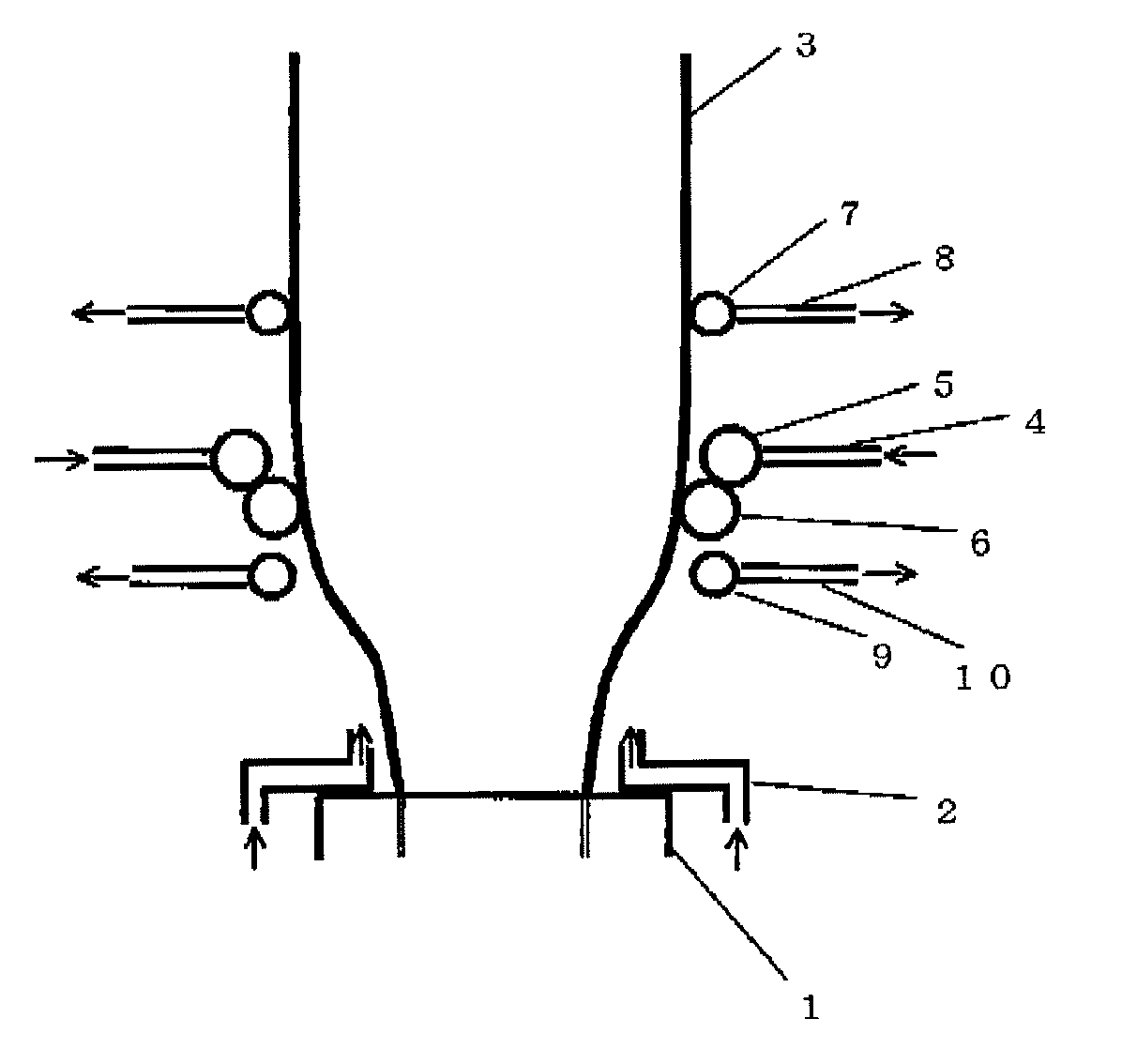
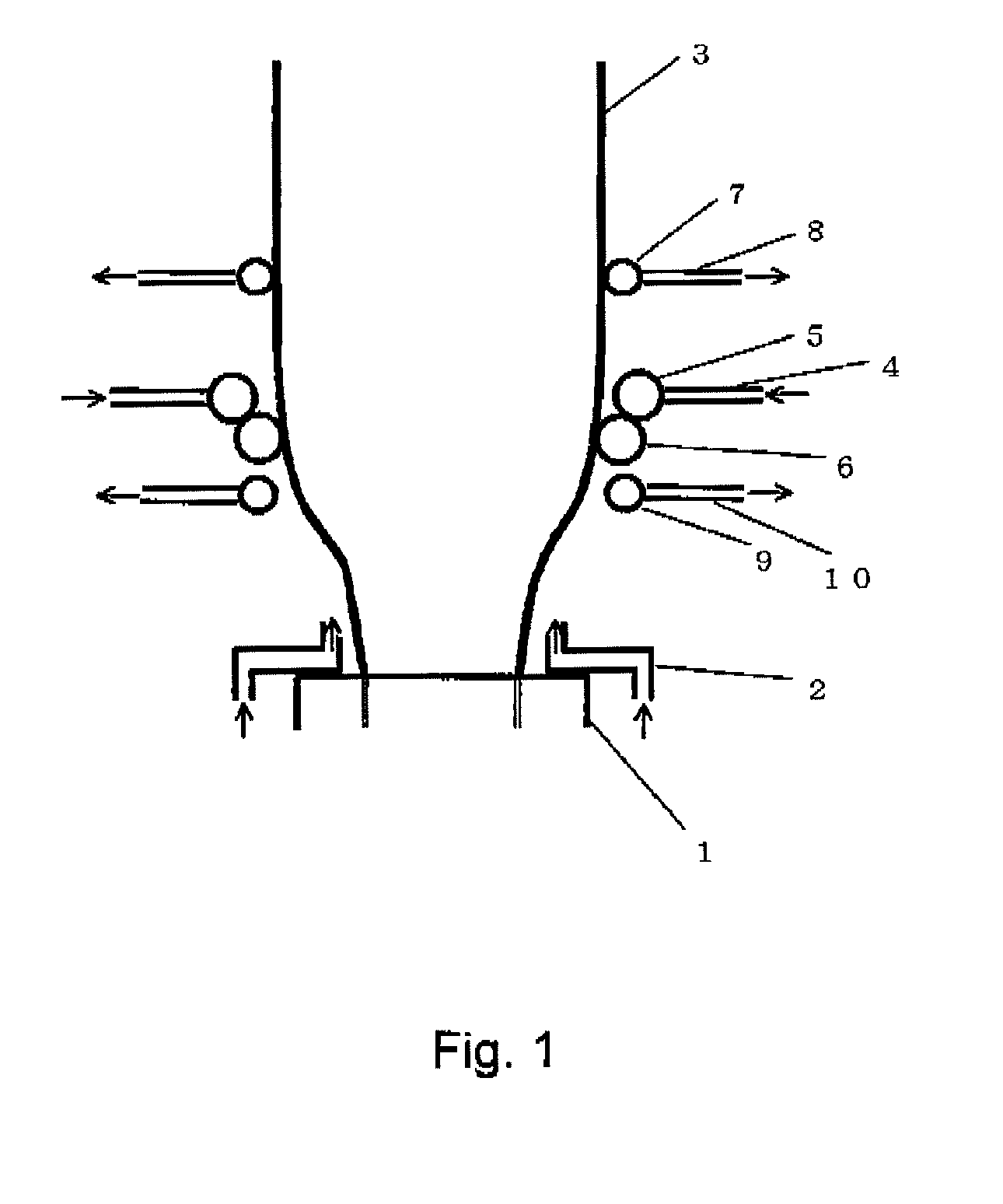
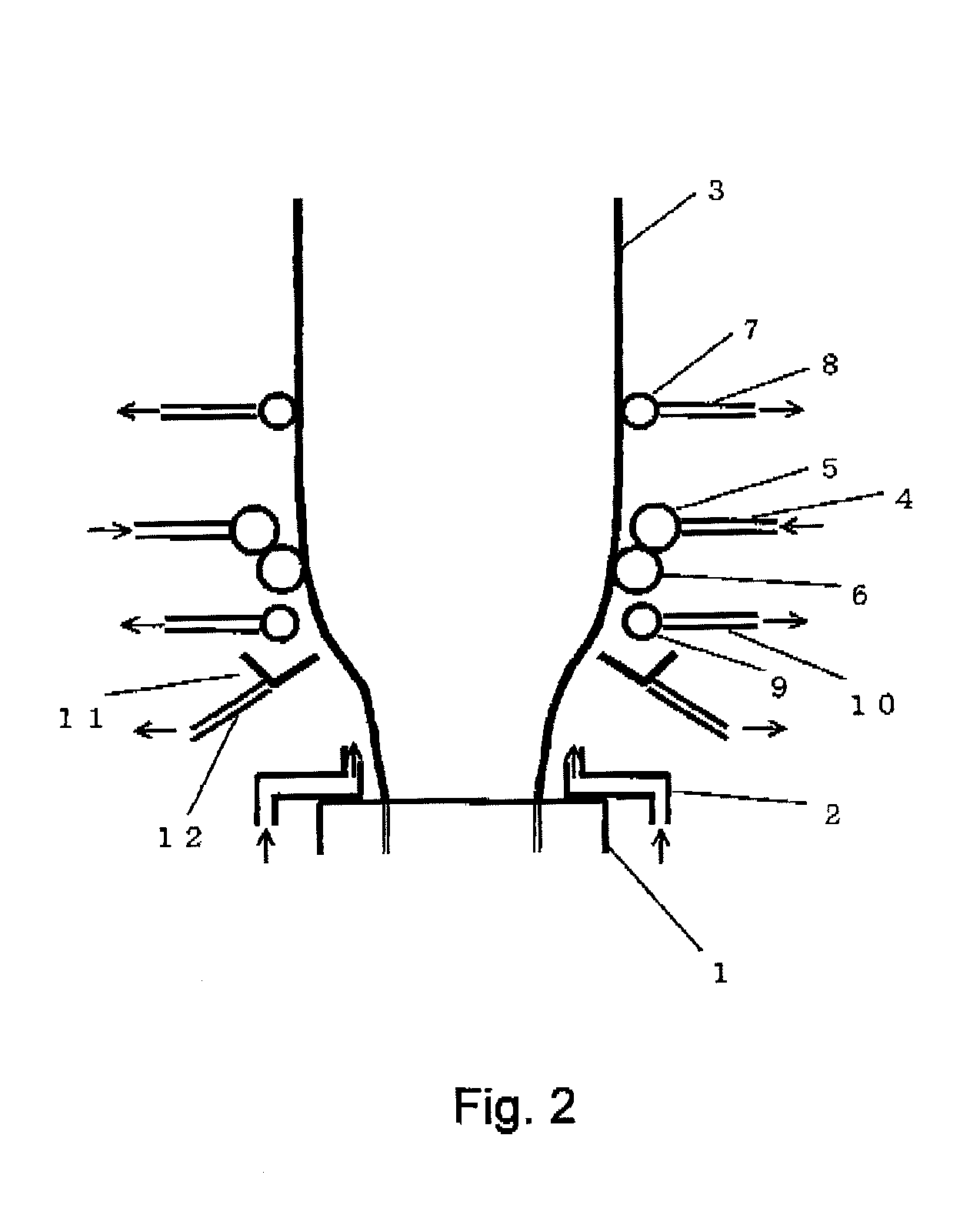
[0058]An upward air-cooling mode inflation molding apparatus manufactured by PLACO Co., Ltd. having a 50 mmφ extruder, circular die (lip diameter: 125 mm, lip opening: 2.0 mm), air ring apparatus and receiver was equipped with a water-cooling apparatus as shown in FIG. 1, that is, a water-cooling apparatus having a water feeding means having a water feeding tube, water feeding ring and contact ring for water feeding, and a water removal means having a downstream water recovery ring, downstream water discharge tube, upstream water recovery ring and upstream water discharge tube. On the contact ring for water feeding, a polyester-based nonwoven fabric sheet having a width of 30 mm (strong dew condensation water-absorbing tape 30 silver E 101, manufactured by NITOMS Inc.) was wound as a water-absorbing material.

[0059]An ethylene•1-hexene copolymer (marketed by Sumitomo Chemical Co., Ltd., manufactured by Nippon Evolue K.K., trade name: Sumikathene-E FV203 (hereinafter, referred to as P...

example 2

[0060]The same procedure as in Example 1 was carried out excepting that an ethylene•1-hexene copolymer (manufactured by Sumitomo Chemical Co., Ltd., trade name: Sumikathene α CS8051 (hereinafter, referred to as PE-2)) produced with a Ziegler catalyst was used instead of PE-1. The results of evaluation of the physical properties of the resultant film are shown in Table 1.

example 3

[0061]The same procedure as in Example 1 was carried out excepting that an ethylene•1-butene copolymer (manufactured by Sumitomo Chemical Co., Ltd., trade name: Sumikathene-L CL1079 (hereinafter, referred to as PE-3)) produced with a Ziegler catalyst was used instead of PE-1, and the processing temperature was changed to 190° C. The results of evaluation of the physical properties of the resultant film are shown in Table 1.

the structure of the environmentally friendly knitted fabric provided by the present invention; figure 2 Flow chart of the yarn wrapping machine for environmentally friendly knitted fabrics and storage devices; image 3 Is the parameter map of the yarn covering machine
Login to View More

PUM

PropertyMeasurementUnit
widthaaaaaaaaaa
widthaaaaaaaaaa
distanceaaaaaaaaaa
Login to View More

Abstract

A method of producing a polyolefin resin film comprising melt-extruding a polyolefin resin from a circular die toward the antigravity direction to form a tubular film and cooling the tubular film while receiving the film toward the antigravity direction, wherein a water-absorbing material containing water and having a width in the gravity direction of 5 mm or more is brought into contact with the peripheral surface of the tubular film to cool the film, at any position distant by 0 to 200 mm toward the gravity direction from the frost line obtained by air cooling.

Description

TECHNICAL FIELD[0001]The present invention relates to a method of producing a polyolefin resin film.BACKGROUND ART[0002]Films made of polyolefin resins such as a polyethylene resin, polypropylene resin and the like are used as films for wrapping of foods, daily miscellaneous goods and the like because of excellent strength and hygiene (for example, JP-A No. 10-237187). As the method of producing a film made of such a polyolefin resin, there are suggested a method of molding by an apparatus by which a polyolefin resin is melt-extruded toward the upper direction (antigravity direction) from a circular die to form a tubular film and the tubular film is air-cooled while receiving the film toward the upper direction, what is called an upward air-cooling mode inflation molding apparatus (for example, JP-A No. 6-114929), a method of molding by an apparatus by which a polyolefin resin is melt-extruded toward the lower direction (gravity direction) from a circular die connected to an extrude...

Claims

the structure of the environmentally friendly knitted fabric provided by the present invention; figure 2 Flow chart of the yarn wrapping machine for environmentally friendly knitted fabrics and storage devices; image 3 Is the parameter map of the yarn covering machine
Login to View More

Application Information

Patent Timeline
no application Login to View More
Patent Type & Authority Applications(United States)
IPC IPC(8): B29C47/00B29C48/10B29C48/32
CPCB29C47/0026B29K2023/06B29C47/8835B29C48/10B29C48/913
Inventor CHIKANARI, KENZOASAMI, KAZUHIRO
Owner SUMITOMO CHEM CO LTD