This helps you quickly interpret patents by identifying the three key elements:
Problems solved by technology
Method used
Benefits of technology
Benefits of technology
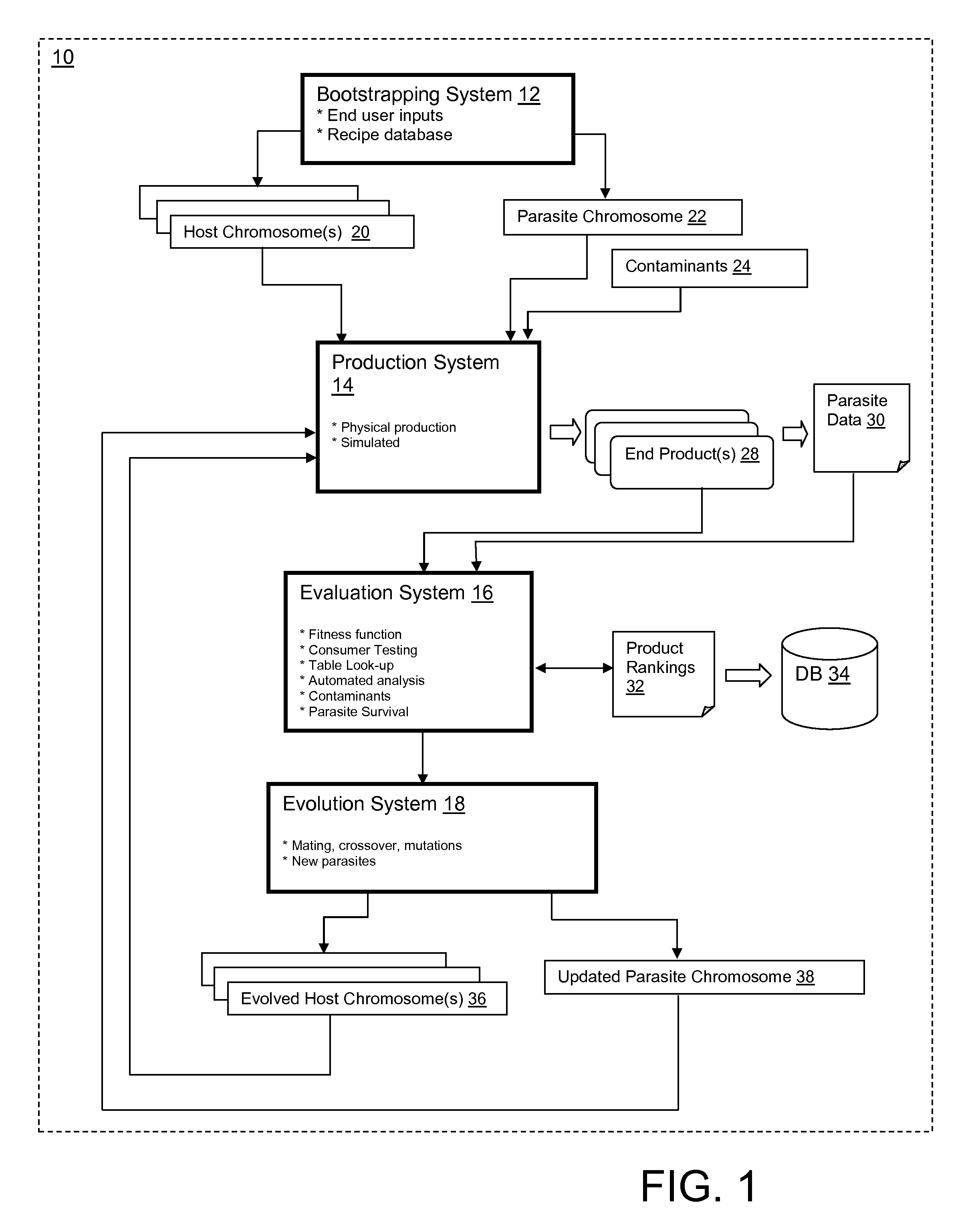
According to another embodiment of the present invention, a method for enhancing food production is provided, comprising: producing a set of end products based on a set of host chromosomes and a parasite chromosome; evaluating each end product; generating a set of evolved host chromosomes and an updated parasite chromosome; and producing a further set of end products based on the evolved host chromosomes and the updated parasite chromosome.
Problems solved by technology
Moreover, such preference may change over time as population and attitudes shift.
Currently, there is little ability for businesses to rapidly interpret personalized requirements and deliver customized products efficiently, safely and on an economy of scale.
Method used
the structure of the environmentally friendly knitted fabric provided by the present invention; figure 2 Flow chart of the yarn wrapping machine for environmentally friendly knitted fabrics and storage devices; image 3 Is the parameter map of the yarn covering machine
View more
Image
Smart Image Click on the blue labels to locate them in the text.
Viewing Examples
Smart Image
Click on the blue label to locate the original text in one second.
Reading with bidirectional positioning of images and text.
2. Determine which of the elements of the product characteristic model match those characteristics obtained;
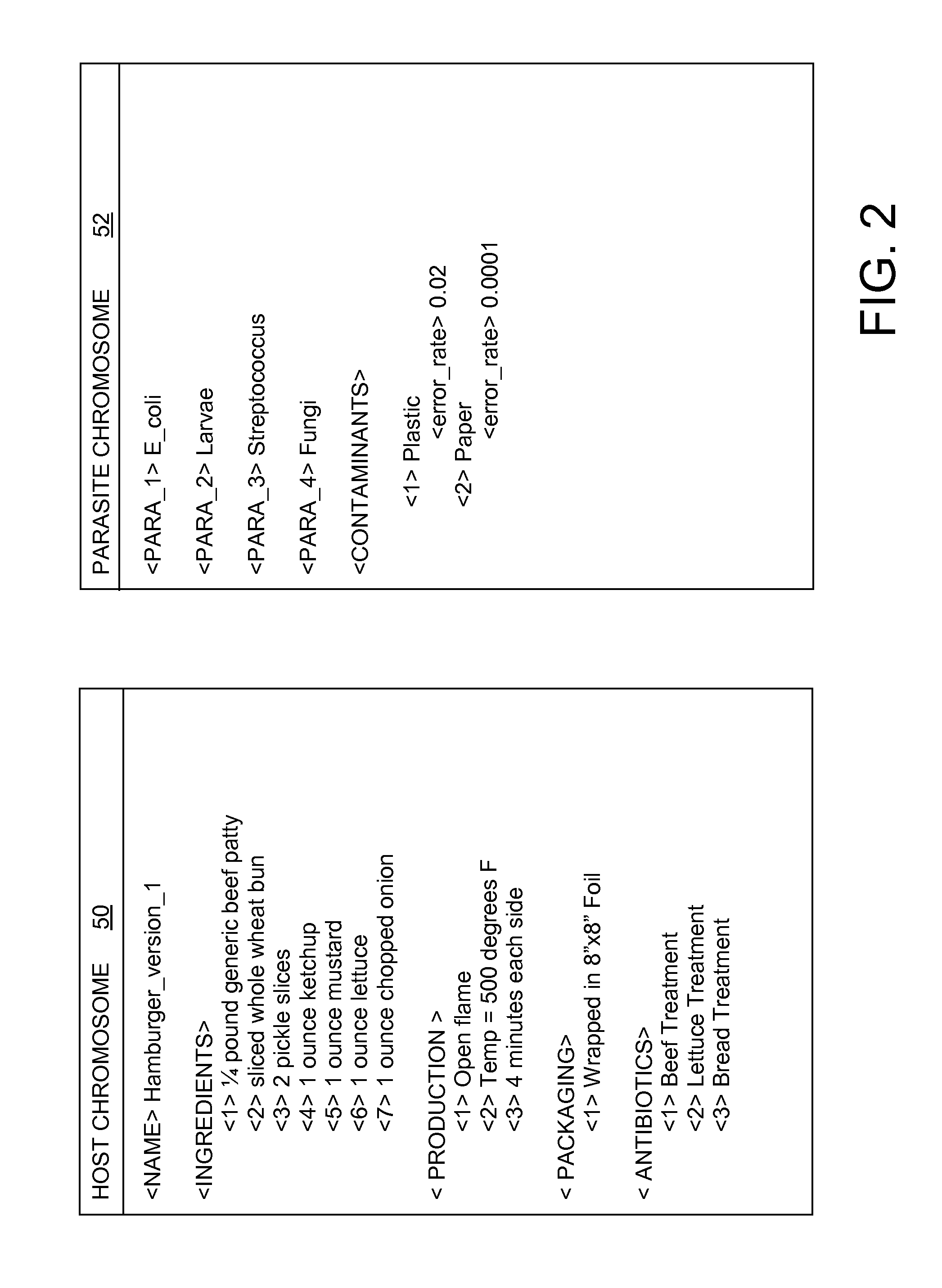
3. Measure the product (rate of change, acceleration, mass, chemical shifts, texture, etc.) and encode into a genetic algorithm representation, i.e., host chromosome;
4. Measure the “parasites” and encode into a genetic algorithm representation, i.e., parasite chromosome;
5. Include a probability of contaminants in the parasite chromosome, e.g., the measured probability 6-sigma of dropping a piece of plastic in the food;
8. Assemble the products and create chromosomes again with an entropy factor, e.g., when to get chemicals that are not in the system; and
9. Continue iterating until exit criterion is reached, e.g., quality is good enough.
Additional features may incl...
example methodology 2
1. A set of chromosomes represent ingredients for a product in the form of a feature vectora. The feature vector is bootstrapped either from an existing product or from one iteration of a product assembly
2. A set of parasite chromosomes are paired with product chromosomea. Parasites / bacteria are found using nuclear magnetic resonance imaging and examining chemical shifts, or any other actual or simulated techniqueb. Contaminants, i.e., potential human or machine errors are identifiedc. The host / parasite paradigm is established
3. Processes or assembly lines decode the product genotype (features)->a phenotype (ingredients)a. The host or product chromosome is akin to a recipe and processb. Parasite features are measured at the end to encode a parasite chromosome; phenotype->genotypec. The chromosomes become diploids where a pair represents a host and a parasite
4. Each diploid is measured with fitness that is translated from a meta heuristic, e.g., user preferences, strength of parasite...
the structure of the environmentally friendly knitted fabric provided by the present invention; figure 2 Flow chart of the yarn wrapping machine for environmentally friendly knitted fabrics and storage devices; image 3 Is the parameter map of the yarn covering machine
Login to View More
PUM
Login to View More
Abstract
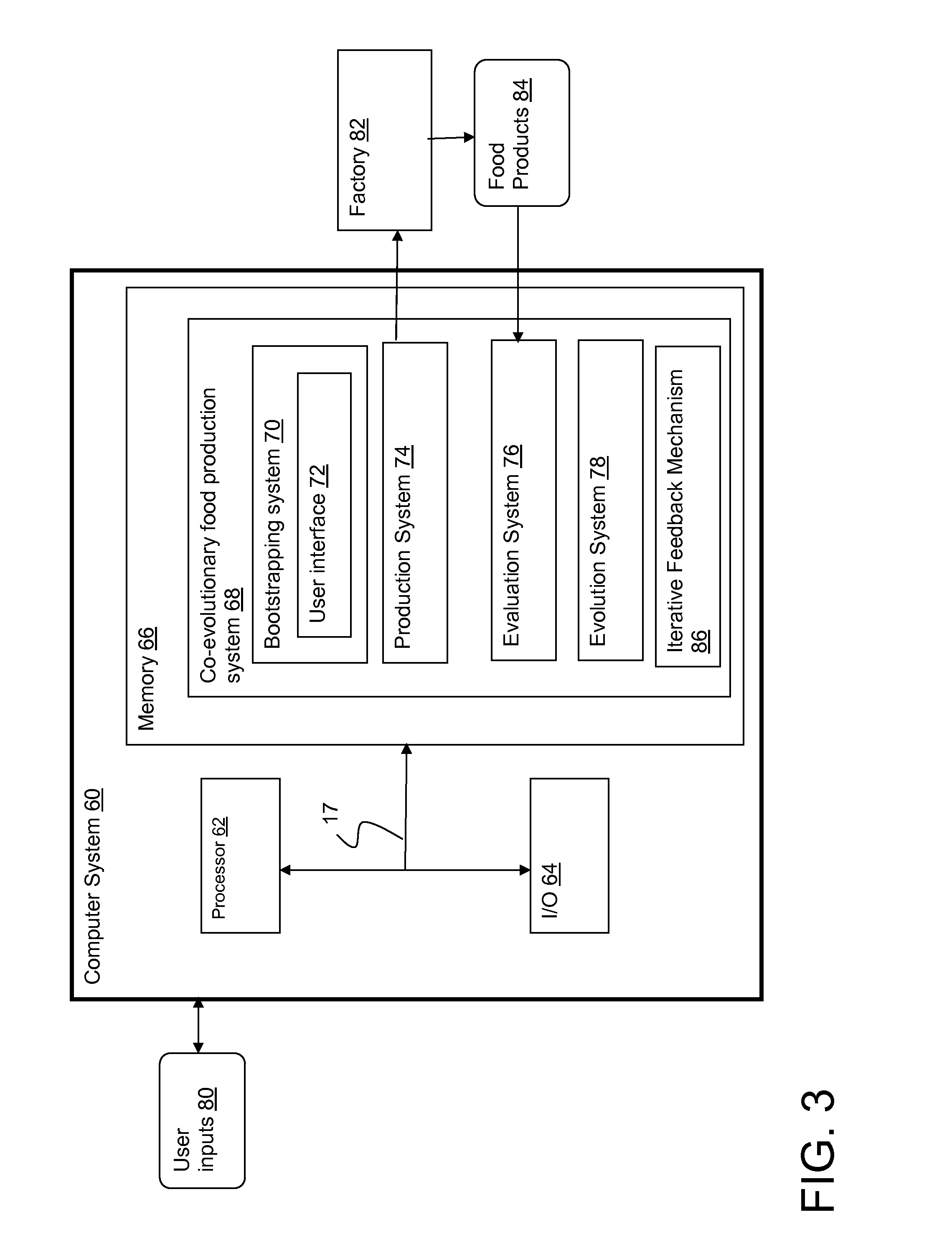
A system, method and program product for enhancing individualized and safe food production using an iterative co-evolutionary approach. A system is disclosed that includes a production system for generating a set of end products based on an inputted set of host chromosomes and a parasite chromosome (which may include machine / human contaminants); an evaluation system for evaluating each end product; an evolution system for generating a set of evolved host chromosomes and an updated parasite chromosome; and a mechanism for generating a further set of end products based on the evolved host chromosomes and the updated parasite chromosome.
Description
BACKGROUNDThe present invention relates to providing customized products for consumers while eradicating contaminants, and more specifically for providing customized food products using a co-evolutionary process involving a host / parasite paradigm.In many industries, such as the food industry, businesses want to provide sterile and safe customized products for their consumers. In some cases this may involve tailoring products for individuals or groups of individuals. For instance, different geographic regions may have different taste preferences that food producers need to assimilate into variations of a food product. For example, people from one geographic region may typically prefer mustard and ketchup on a hamburger, while people from another geographic region may typically prefer just ketchup. Moreover, such preference may change over time as population and attitudes shift. In addition, each region has varying viruses, parasites and contaminants that gradually evolve over time. M...
Claims
the structure of the environmentally friendly knitted fabric provided by the present invention; figure 2 Flow chart of the yarn wrapping machine for environmentally friendly knitted fabrics and storage devices; image 3 Is the parameter map of the yarn covering machine
Login to View More
Application Information
Patent Timeline
Application Date:The date an application was filed.
Publication Date:The date a patent or application was officially published.
First Publication Date:The earliest publication date of a patent with the same application number.
Issue Date:Publication date of the patent grant document.
PCT Entry Date:The Entry date of PCT National Phase.
Estimated Expiry Date:The statutory expiry date of a patent right according to the Patent Law, and it is the longest term of protection that the patent right can achieve without the termination of the patent right due to other reasons(Term extension factor has been taken into account ).
Invalid Date:Actual expiry date is based on effective date or publication date of legal transaction data of invalid patent.
Login to View More
IPC IPC(8): G01N33/02G06G7/48C12M1/34
CPCG06N3/126
InventorBAUGHMAN, AARON K.MALKIN, PETER K.GREENLAND, ARNOLD


 Login to View More
  Login to View More