
Tunable wireless energy transfer for in-vehicle applications
a wireless energy transfer and in-vehicle technology, applied in the field of wireless energy transfer, can solve the problems of inability to transfer useful amounts of electrical energy, inability to achieve effective power transfer, and very inefficient radiative transfer
- Summary
- Abstract
- Description
- Claims
- Application Information
AI Technical Summary
Benefits of technology
Problems solved by technology
Method used
Image

Examples
examples
System Block Diagrams
[0489]We disclose examples of high-Q resonators for wireless power transmission systems that may wirelessly power or charge devices at mid-range distances. High-Q resonator wireless power transmission systems also may wirelessly power or charge devices with magnetic resonators that are different in size, shape, composition, arrangement, and the like, from any source resonators in the system.
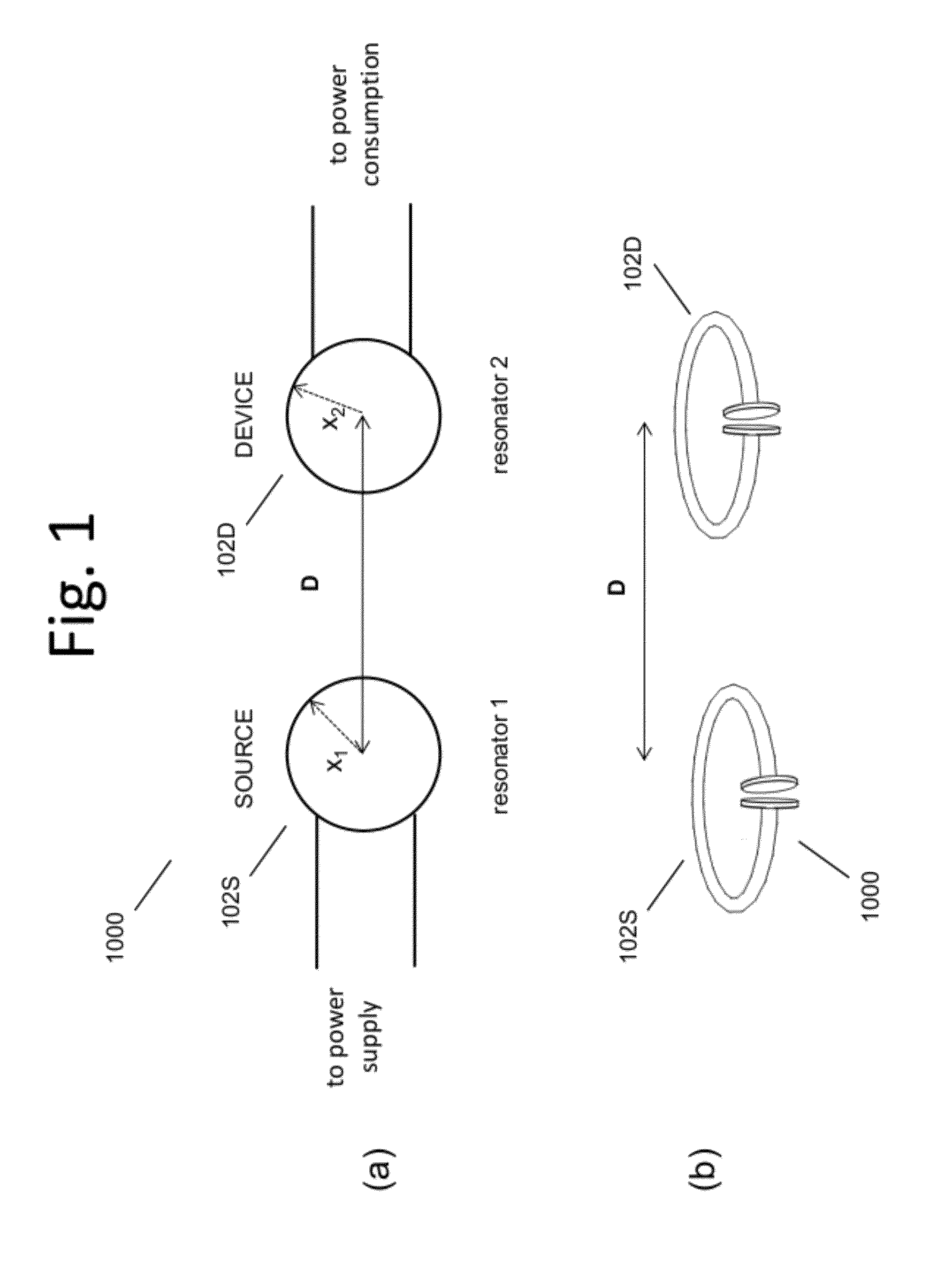
[0490]FIG. 1(a)(b) shows high level diagrams of two exemplary two-resonator systems. These exemplary systems each have a single source resonator 102S or 104S and a single device resonator 102D or 104D. FIG. 38 shows a high level block diagram of a system with a few more features highlighted. The wirelessly powered or charged device 2310 may include or consist of a device resonator 102D, device power and control circuitry 2304, and the like, along with the device 2308 or devices, to which either DC or AC or both AC and DC power is transferred. The energy or power source for a ...
PUM
 Login to View More
 Abstract
Description
Claims
Application Information
 Login to View More