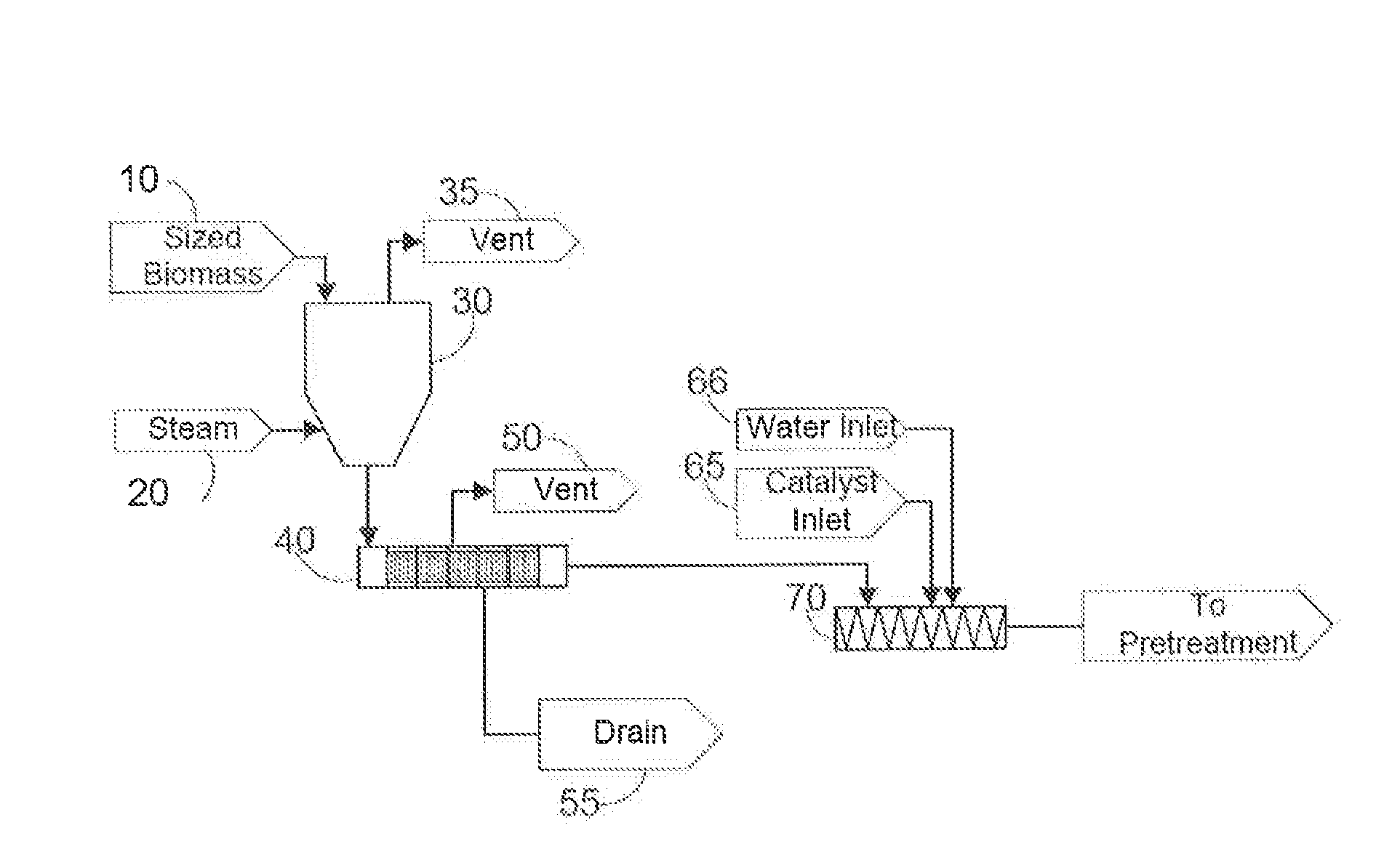
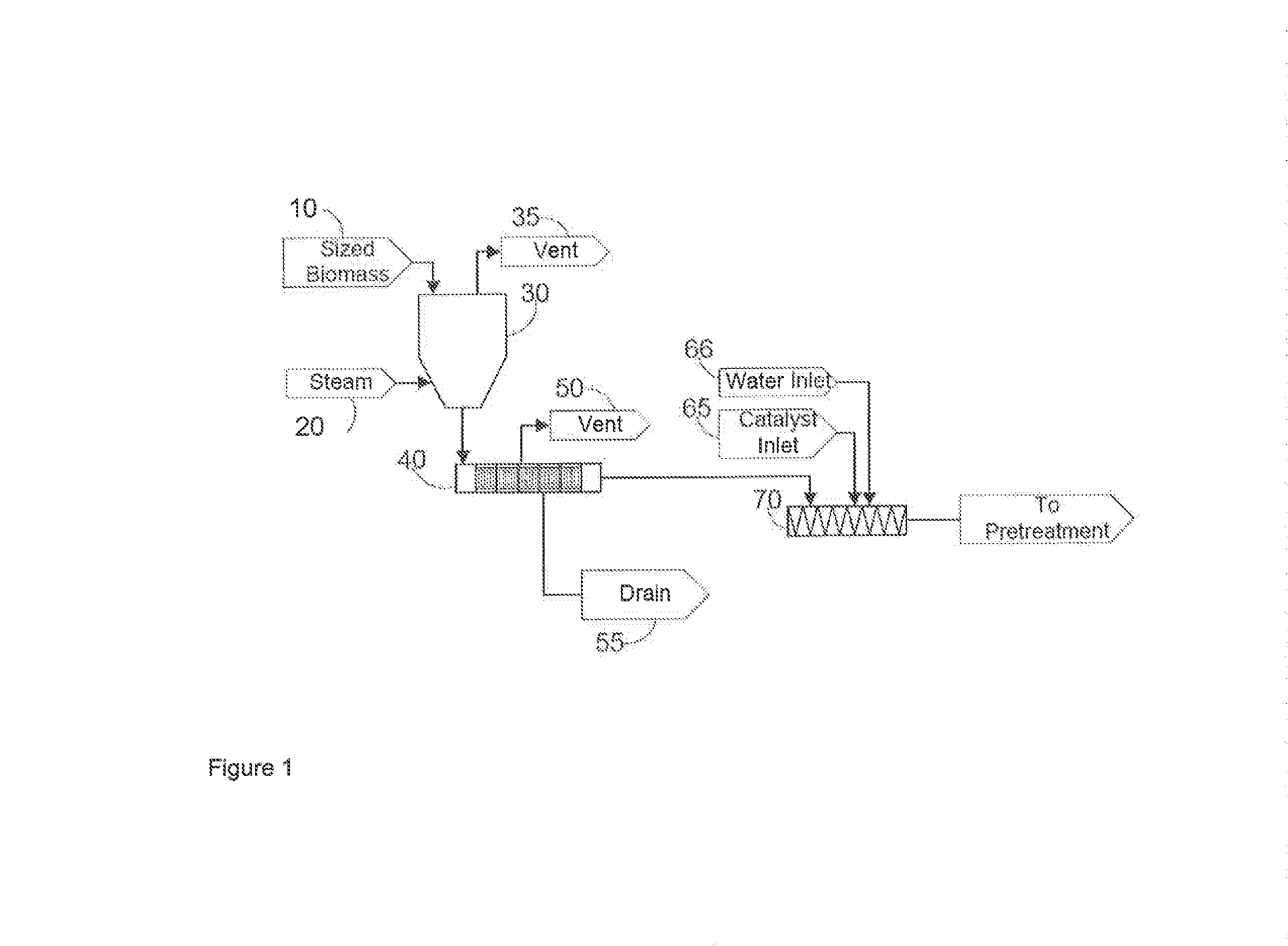
Conditioning of biomass for improved c5/c6 sugar release prior to fermentation

a technology of lignocellulosic biomass and c6 sugar, which is applied in the field of conditioning of lignocellulosic biomass, can solve the problems of limited availability of feedstocks, difficult hydrolysis of reactive cellulose from lignocellulosic biomass, and limited use of potential food or feed plants to produce fuel, etc., so as to improve the effect of reducing the content of inhibitory compounds, improving the results, and softening the fibers

a technology of lignocellulosic biomass and c6 sugar, which is applied in the field of conditioning of lignocellulosic biomass, can solve the problems of limited availability of feedstocks, difficult hydrolysis of reactive cellulose from lignocellulosic biomass, and limited use of potential food or feed plants to produce fuel, etc., so as to improve the effect of reducing the content of inhibitory compounds, improving the results, and softening the fibers

US20130014749A1Inactive Publication Date: 2013-01-17OWENS CORNING INTELLECTUAL CAPITAL LLC

Image

Smart Image Click on the blue labels to locate them in the text.
Viewing Examples
Smart Image
  • Conditioning of biomass for improved c5/c6 sugar release prior to fermentation
  • Conditioning of biomass for improved c5/c6 sugar release prior to fermentation

Examples

Experimental program
Comparison scheme
Effect test

example 1

Adjusting Moisture Content Improves Cellulose Digestibility and Hemicellulose Recovery

[0035]

TABLE 1Effect of moisture content in incoming corncobs on recovery of hemicelluloseTable 1. Effect of moisture content in incomingcorn cobs on recovery of hemicelluloseMoisture (%)Incoming cobs69665446352911Hemicellulose Recovery72716259504527(% of incoming)Soluble hemicellulose25324921820717615895sugars (kg / mtdmincoming corn cobs)Hemicellulose sugar21120818217314713279monomers (kg / mtdmincoming corn cobs)

[0036]Table 1 illustrates that hemicellulose sugar recovery increased by greater than 40% as moisture content was increased from 35% to 66%. In order to further increase the ratio of sugar monomers over oligomers, the recovered soluble hemicellulose sugars can be hydrolyzed post recovery either with hemicellulase enzymes or acid catalyst.

TABLE 2Effect of moisture content in incoming corn cobson cellulose digestibilityTable 2. Effect of moisture content in incoming corn cobson cellulose digest...

example 2

Pre-Heating with Steam Improves Cellulose Digestibility

[0037]Corncobs at 50% moisture were pre-heated with steam at atmospheric pressure with low pressure (5 psig) steam for 10 minutes prior to pre-treatment as described in pending U.S. patent application Ser. No. 12 / 560,843. The results of cellulose digestibility were compared (Table 1) to a control using 1 minute of pre-steaming at 300 psi using super heated steam.

TABLE 3Effect of steaming on cellulose digestibilityTable 3. Effect of steaming on cellulose digestibilityand resulting production of glucose monomersSteam heating prior to pretreatment(1) &Pre-treatment conditions (2)10 min, atmosphericGlucose monomers(1) 1 min, 300 psigpressure(kg / mtdm incoming cobs)(2) 235 psig, 8 minEnzyme load0.225342360(% w / w, DM on cobs)0.295368375Table 3. Effect of steaming on cellulose digestibility

[0038]The longer steam heating time reduced the hydrolysis time by 18% to 24% depending on the enzyme dosage. Hemicellulose sugar recovery was not af...

the structure of the environmentally friendly knitted fabric provided by the present invention; figure 2 Flow chart of the yarn wrapping machine for environmentally friendly knitted fabrics and storage devices; image 3 Is the parameter map of the yarn covering machine
Login to View More

PUM

PropertyMeasurementUnit
temperatureaaaaaaaaaa
Login to View More

Abstract

Disclosed is an improvement in a conventional process for C5 and C6 sugar recovery from lignocellulosic biomass for fermentation to ethanol, which process including the conventional steps of pretreatment of the biomass with steam at elevated temperature and pressure, collection of C5 sugars from hemicellulose breakdown, cellulose hydrolysis and collection of C6 sugars from cellulose breakdown. The improvement includes conditioning of the biomass prior to the pretreatment step by heating the biomass with steam for a time period between 5 minutes to 60 minutes to achieve a steam treated biomass having a temperature of about 80 to 100°C.; and adjusting a moisture content of the steam treated biomass to about 45% to 80%. An increased recovery of C5 and C6 sugars is achieved compared to the conventional process.

Description

[0001]This application claims the benefit of priority of U.S. Provisional Patent Application No. 61 / 508,407 filed Jul. 15, 2011, the contents of which is incorporated herein by reference.FIELD OF THE INVENTION[0002]The invention relates to the conditioning of lignocellulosic biomass as part of a biochemical ethanol production process, in particular to conditioning prior to pretreatment for hemicellulose breakdown and removal.BACKGROUND AND DESCRIPTION OF PRIOR ART[0003]There is a growing demand for transportation fuels made from renewable feedstocks. These renewable fuels displace fossil fuels resulting in a reduction of greenhouse gas emissions, along with other benefits (1-3). Biofuels include fuel ethanol. Fuel ethanol is roduced from biomass by converting starch or cellulose to sugars, fermenting the sugars to ethanol, and then distilling and dehydrating the ethanol to create a high-octane fuel that can substitute in whole or in part for gasoline.[0004]In North America, the feed...

Claims

the structure of the environmentally friendly knitted fabric provided by the present invention; figure 2 Flow chart of the yarn wrapping machine for environmentally friendly knitted fabrics and storage devices; image 3 Is the parameter map of the yarn covering machine
Login to View More

Application Information

Patent Timeline
17 Jan 2013
Publication
US20130014749A1
IPC
C13K13/00
CPC
C12P2201/00; C13K1/02; Y02E50/10
Inventors
DOTTORI, FRANK A.; BENSON, ROBERT ASHLEY COOPER