Lock Cylinder

US20140137613A1Inactive Publication Date: 2014-05-22HUF HULSBECK & FURST GMBH & CO KG
13 Cites 0 Cited by

Patent Information

Authority / Receiving Office
US · United States
Current Assignee / Owner
Publication Date
2014-05-22
Estimated Expiration
Not applicable · inactive patent

Smart Images

  • Figure 1
    Figure 1
  • Figure 2
    Figure 2
  • Figure 3
    Figure 3
Patent Text Reader

Abstract

A lock cylinder includes a housing, in which a sleeve having a cylinder core accommodated therein is rotatably supported. The cylinder core has spring-loaded tumblers forming a form closure with recesses arranged in the sleeve when a key engaging the tumblers is removed. Inside the housing, the sleeve is coupled to a coupling element by means of a disengaging sleeve. The coupling element is supported inside the housingand connected to a bearing in a rotationally-fixed manner. The bearing supports an output element. At least one of the sleeve and the coupling element forms a form closure with the bearing to block the rotation of the output element if an improper object is used in operative connection with the cylinder core.
Need to check novelty before this filing date? Find Prior Art

Description

CROSS-REFERENCE TO RELATED APPLICATIONS

[0001] This application is a continuation of U.S. patent application Ser. No. 13 / 505,691 filed on May 2, 2012, which claims priority to PCT International Application No. PCT / DE2010 / 075123 filed on Nov. 5, 2010, which claims priority to German Patent Application No. 10 2009 052 406.1 filed on Nov. 10, 2009, both of which are fully incorporated by reference herein.STATEMENT REGARDING FEDERALLY SPONSORED RESEARCH OR DEVELOPMENT

[0002] Not applicable.FIELD OF THE INVENTION

[0003] The invention relates to a lock cylinder comprising a housing, in which a sleeve having a cylinder core accommodated therein is rotatably mounted and the cylinder core has spring-loaded tumblers which form a form closure with recesses arranged in the sleeve when a key is removed, and within the housing the sleeve is coupled to a coupling element by means of a disengaging sleeve, wherein the coupling element is mounted within the housing and the coupling element is connected in ...

Examples

first embodiment

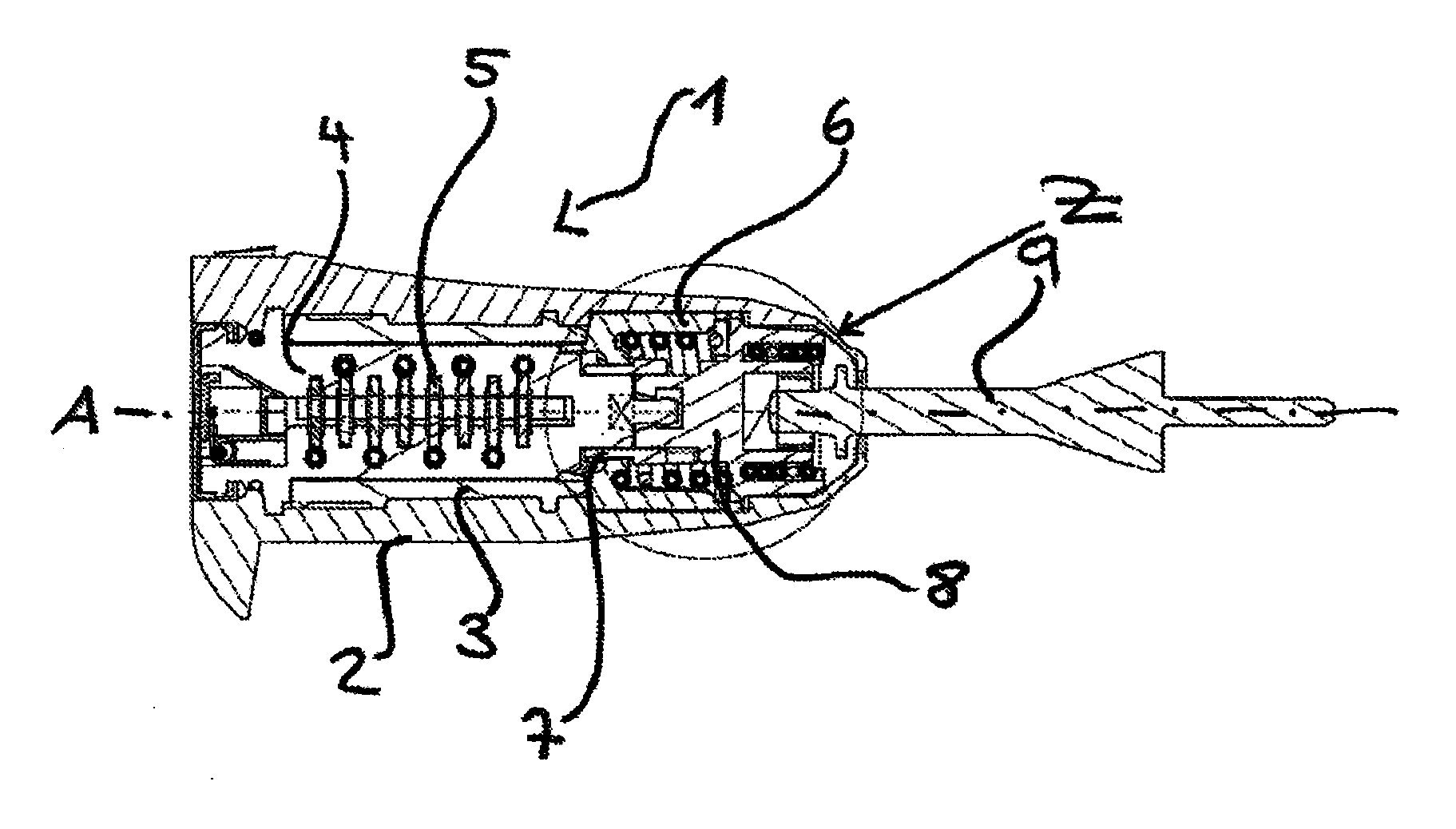
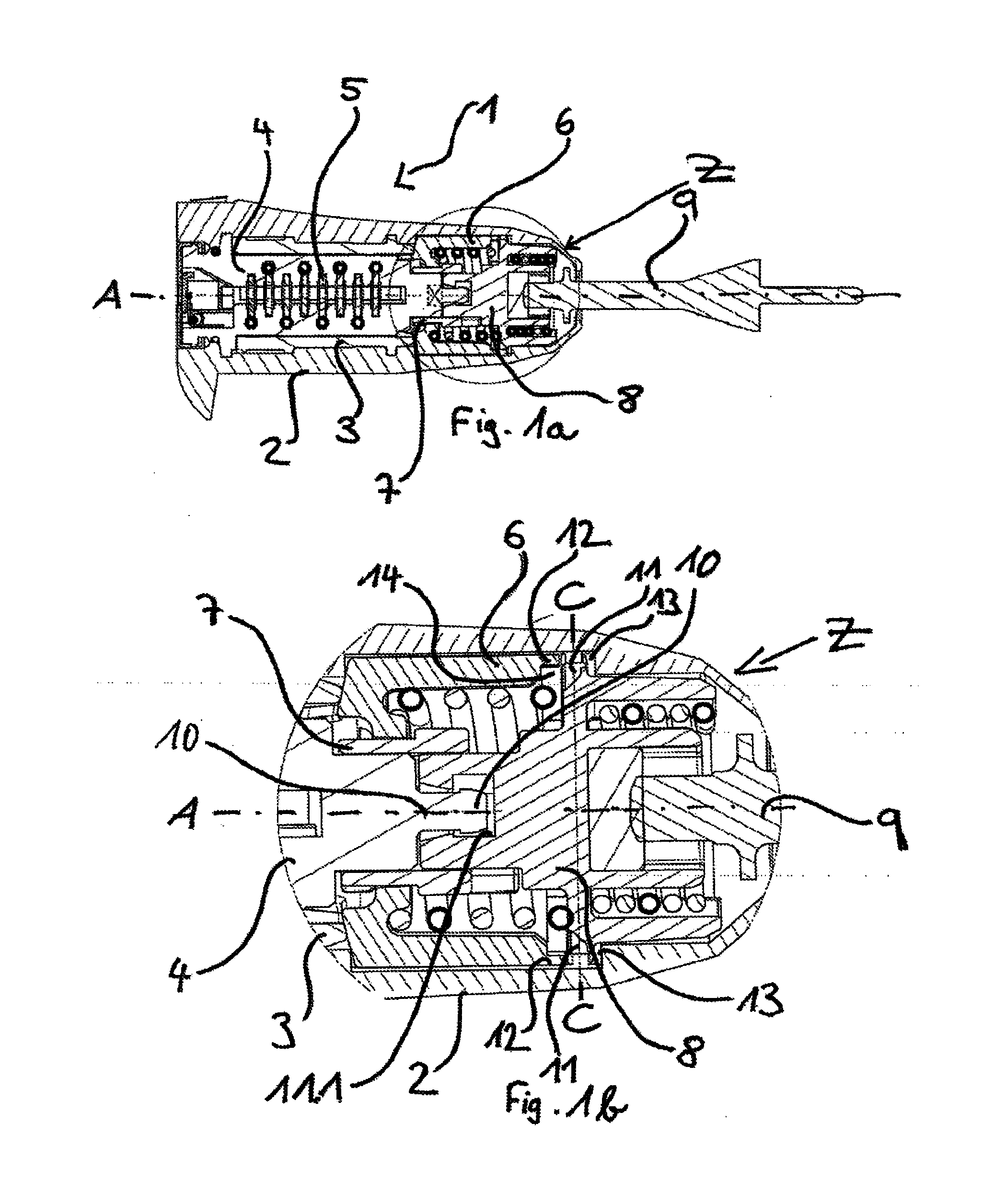
[0027]A lock cylinder 1 is represented in FIGS. 1a to 1c and 2a to 2c. In FIG. 1a, the lock cylinder 1 is shown in a proper use.

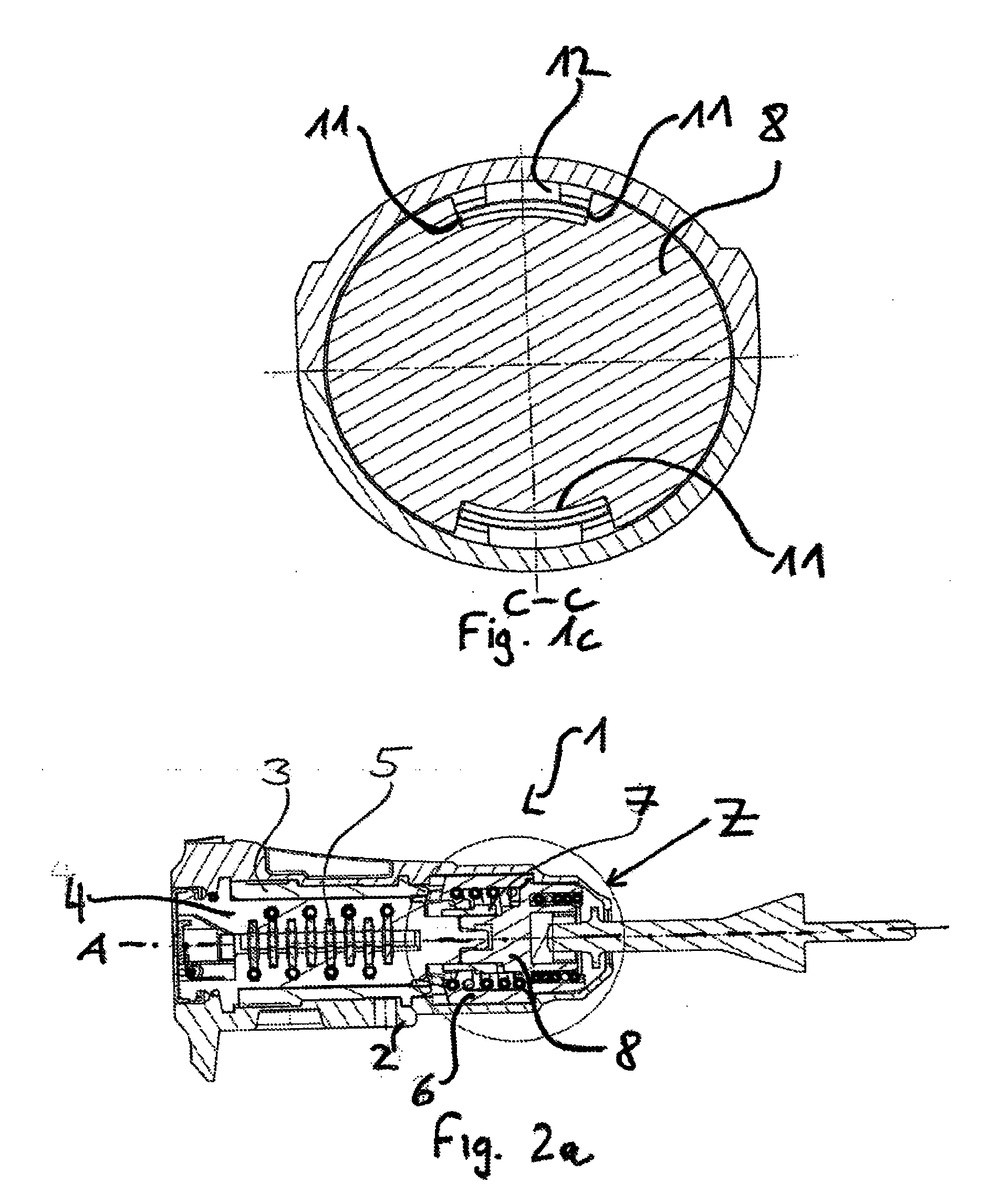
[0028]A proper use exists if a lock (not shown in detail) operatively connected to the lock cylinder 1 can be opened and closed with a proper key assigned to the lock cylinder 1. In FIG. 2a, the lock cylinder 1 according to the first embodiment is shown in an improper use. An improper use exists if the lock (not shown in detail) operatively connected to the lock cylinder 1 is attempted to be opened with a key (incorrect key) not assigned to the lock cylinder 1, or with a tool, in particular with a screwdriver.

[0029]The lock cylinder 1 shown in FIGS. 1a, 2a and 1b, 2b has a housing 2, in which a metallic sleeve 3 having a cylinder core 4 accommodated therein is rotatably mounted. The cylinder core 4 has spring-loaded tumblers 5, which, when a key (not represented in detail) is removed from the cylinder core 4, form a form closure with recesses (not shown) a...

third embodiment

[0034]In FIGS. 4a and 4b, the lock cylinder 1 is represented, which lock cylinder is essentially a combination of the first and second illustrative embodiment. In addition to that form closure between bearing 8 and coupling element 7 which is shown in FIG. 3b, a form closure between the disengaging sleeve 6 and the housing 2, and the disengaging sleeve 6 with the bearing 8, is herein disclosed.

[0035]Within the scope of said illustrative embodiments, in particular with respect to the second and third illustrative embodiment, reference is made to DE 102009050905.4.