

T-REG Cell Expansion
a technology of t-reg cells and t-regs, applied in the field of immunology, can solve the problems of relative difficulty in obtaining large numbers of t-regs, the therapeutic utilization of t-regs,
- Summary
- Abstract
- Description
- Claims
- Application Information
AI Technical Summary
Benefits of technology
Problems solved by technology
Method used
Image

Examples
example 1
Necessary but not Sufficient for the Expansion of Tregs Mediated by GM-BMDC
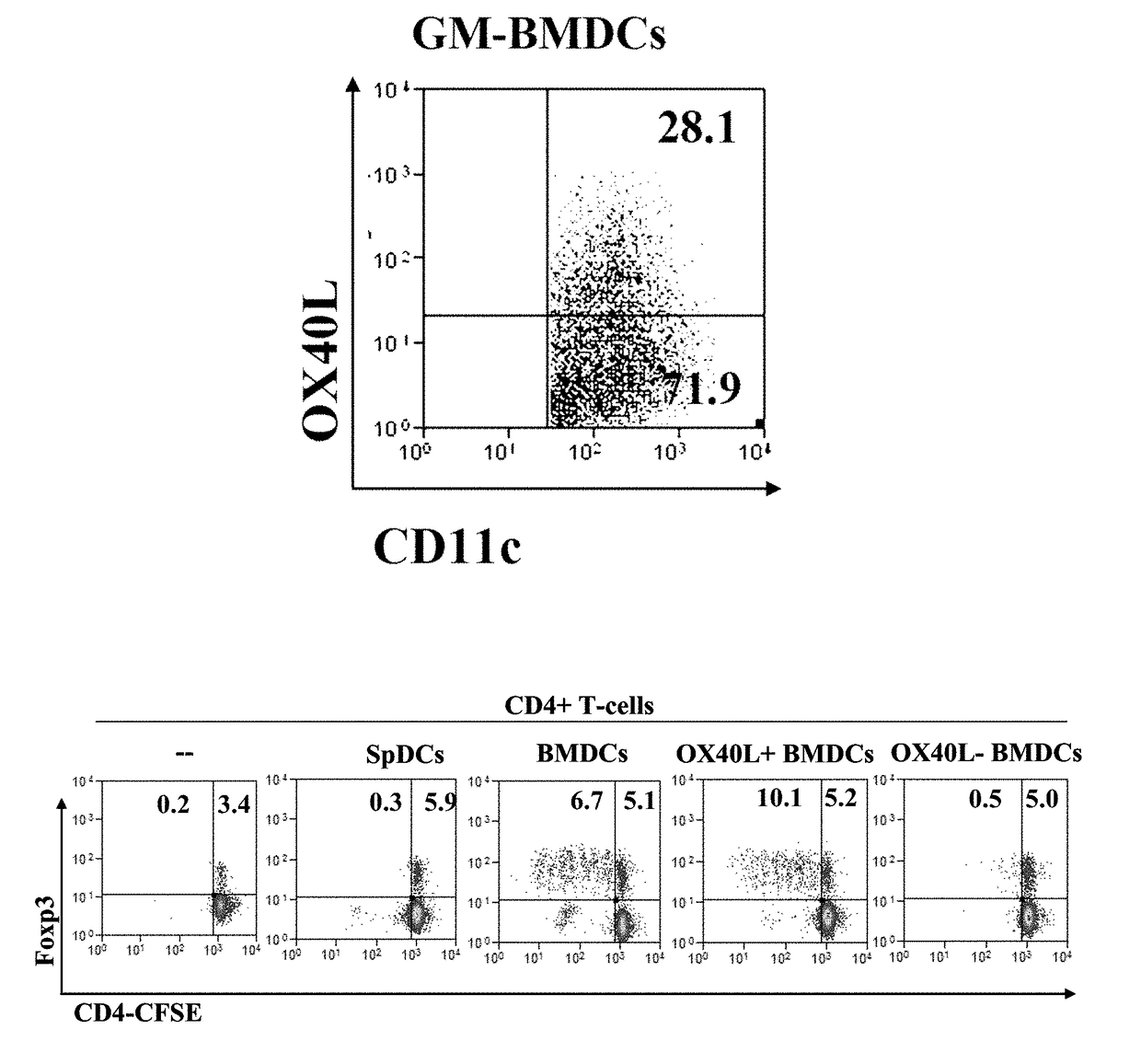
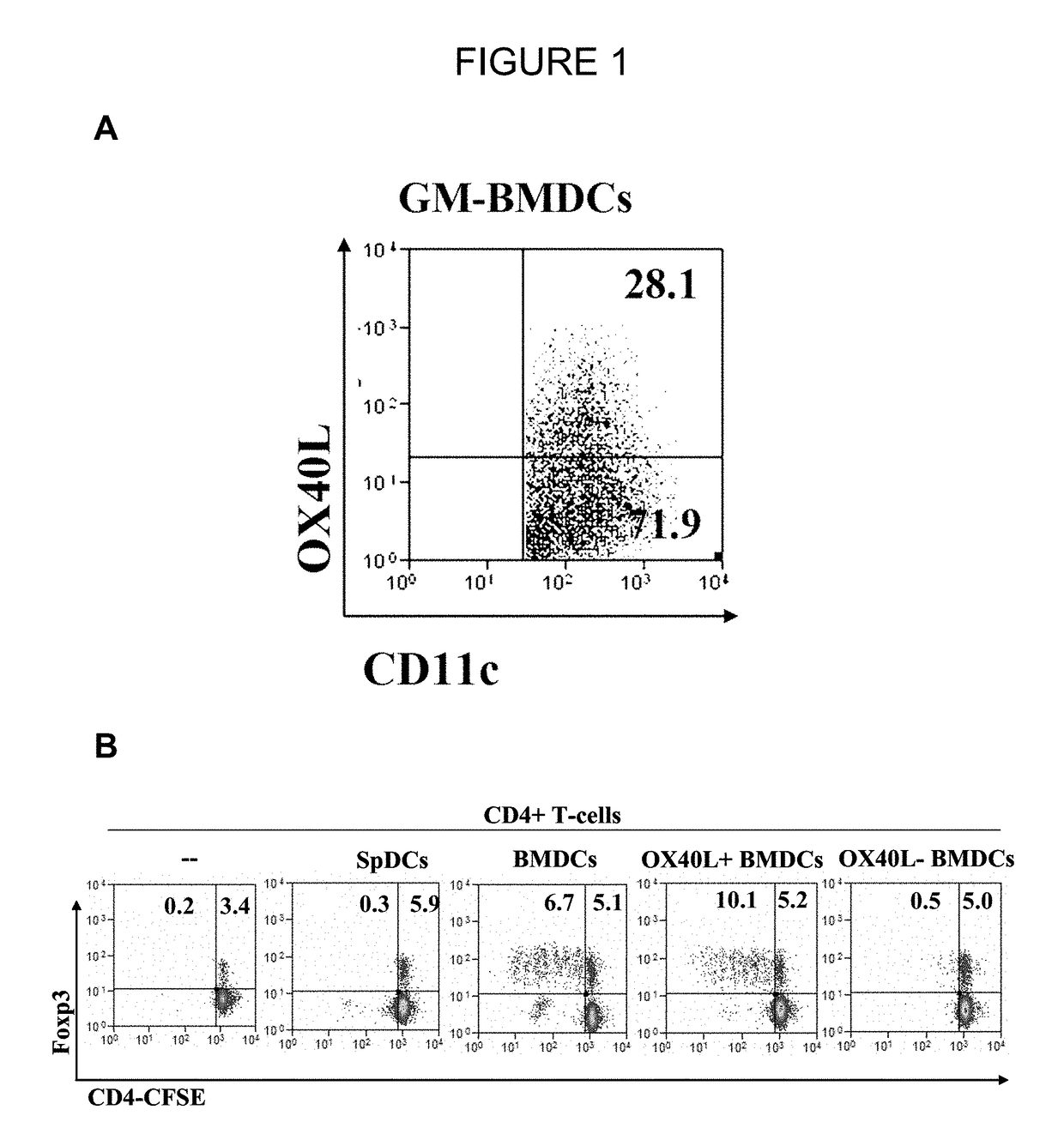
[0100]A blocking antibody against OX40L demonstrated a dose-dependent abrogation of Treg proliferation by GM-BMDC (8), which was restored upon addition of a soluble OX40 agonist. In a typical 7-day bone marrow culture with GM-CSF, ˜30% CD11c+ GM-BMDCs were OX40L+ (FIG. 1A). To determine if OX40L-induced signaling was sufficient for the expansion of Tregs, co-cultures with sorted populations of OX40L+ and OX40L− GM-BMDCs with naive CD4+ T-cells were established. Only OX40L+ GM-BMDC drove the proliferation of Foxp3+ Tregs (10.1±0.6%) relative to OX40L− GM-BMDC (0.5±0.1%, p=0.002) (FIG. 1B).
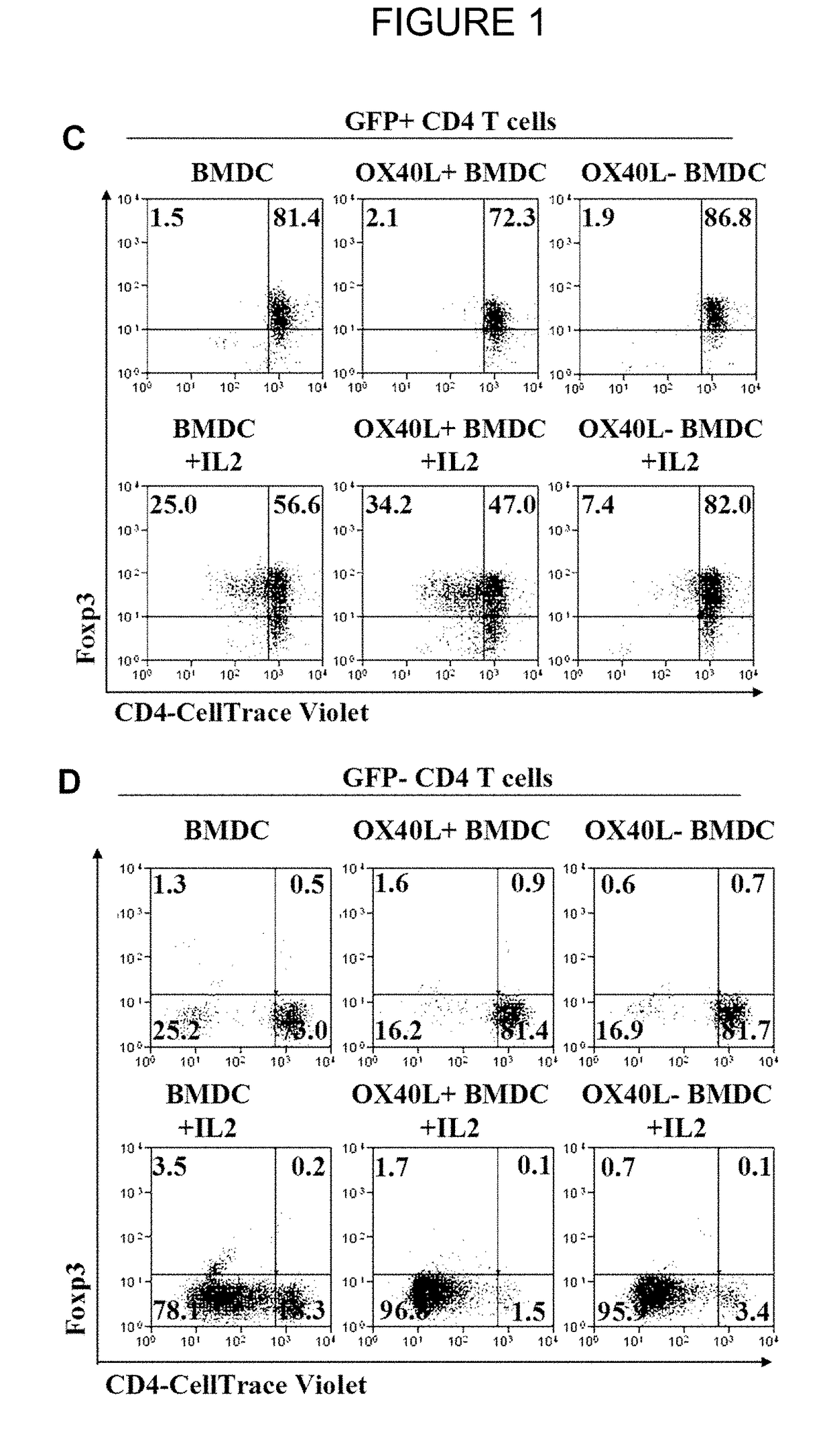
[0101]To specifically address the role of OX40L+ GM-BMDCs on Foxp3+ Tregs, Foxp3-GFP transgenic mice were used. Co-cultures of sorted OX40L+ and OX40L− GM-BMDCs (FIG. 1) with sorted and Cell-Trace Violet labelled CD4+GFP+ (FIG. 1C) or CD4+ GFP− (FIG. 1D) T cells isolated from Foxp3-GFP mice (FIG. 1), in the presence or absenc...
example 2
ound Ligands Other than the B7 Family Co-Stimulatory Molecules are Involved in GM-BMDC Induced Treg Expansion
[0103]Co-cultures of CD4+ T-cells and DCs in trans-well plates were established to determine if, in addition to OX40L expressed on GM-BMDC, co-signaling by a soluble factor from, or a surface bound molecule on, GM-BMDC is required for Treg expansion. Splenic APCs and CD4+ T-cells along with an OX40 agonist were physically separated from GM-BMDC cultured in trans-wells, which allowed for free exchange of soluble factors in culture medium. If soluble factors from GM-BMDC were contributing to Treg expansion, those factors would be expected to cross the trans-well barrier and aid in Treg expansion in the presence of OX40 agonist and splenic APCs. However, there was little or no proliferation of Tregs (0.2±0.1%) in the trans-well when compared to CD4+T-cell-GM-BMDC co-cultures (10.3±0.7%) (FIG. 2A). These results suggested that in addition to OX40L, co-signaling by other GM-BMDC s...
example 4
and OX40L are Critical for GM-BMDC Mediated Treg-Expansion
[0106]Specific antibodies to block OX40L and Jagged-1 were used to determine whether concurrent signaling by both ligands was essential for Treg expansion. Blocking either OX40L or Jagged-1, using specific antibodies, reduced Treg proliferation from 13.0% in the absence of antibody to 5.3±0.3% and 3.7±0.2% in the presence of anti-Jagged-1-Hi and anti-OX40L-Hi respectively. However, simultaneous blockade of both molecules completely prevented the GM-BMDC mediated Treg proliferation (13.0% v / s 0.5%±0.1%, p<0.01) (FIG. 4A). These data suggested that Notch signaling, likely induced by Jagged-1, along with OX40 signaling induced by OX40L were essential for GM-BMDC mediated Treg proliferation.
[0107]OX40L-mediated Treg expansion by GM-BMDC did not require TCR stimulation (8). To determine if the Jagged-1 mediated signaling was also independent of TCR signaling, CD25+ T cells were co-cultured with GM-BMDCs derived from MHC class-II− / ...
PUM
 Login to View More
 Abstract
Description
Claims
Application Information
 Login to View More