
Process for treating an aqueous system with chlorine dioxide
a technology of chlorine dioxide and aqueous system, which is applied in the direction of water/sewage treatment by oxidation, halogen oxide/oxyacid, water/treatment water by nature, etc. it can solve the problems of adversely affecting the generation efficiency, adversely affecting the environment, and prone to biological contamination of the water system, so as to minimize the formation of unwanted by-products, the effect of minimizing the waste of precursor chemicals and high efficiency yield
- Summary
- Abstract
- Description
- Claims
- Application Information
AI Technical Summary
Benefits of technology
Problems solved by technology
Method used
Image

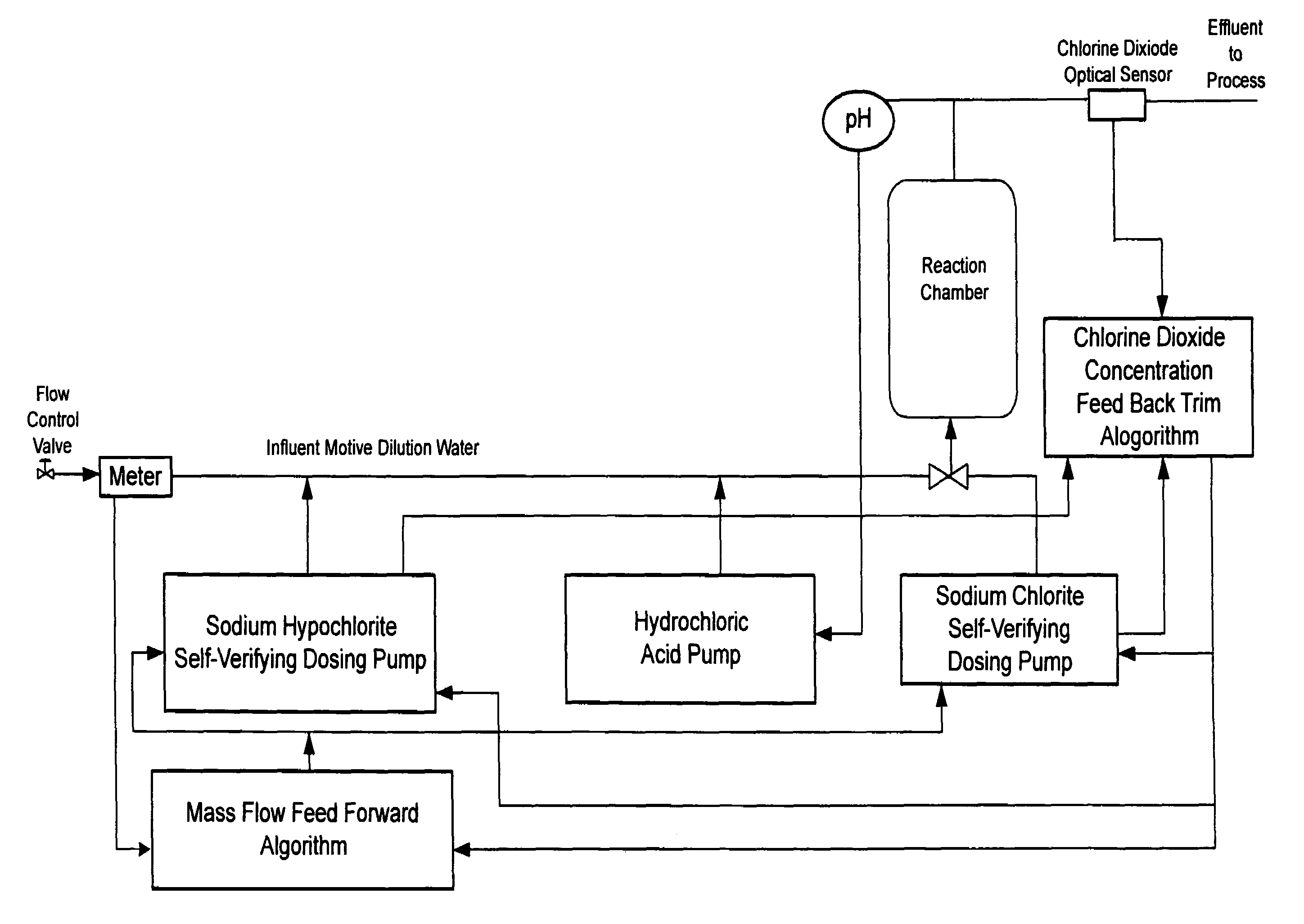
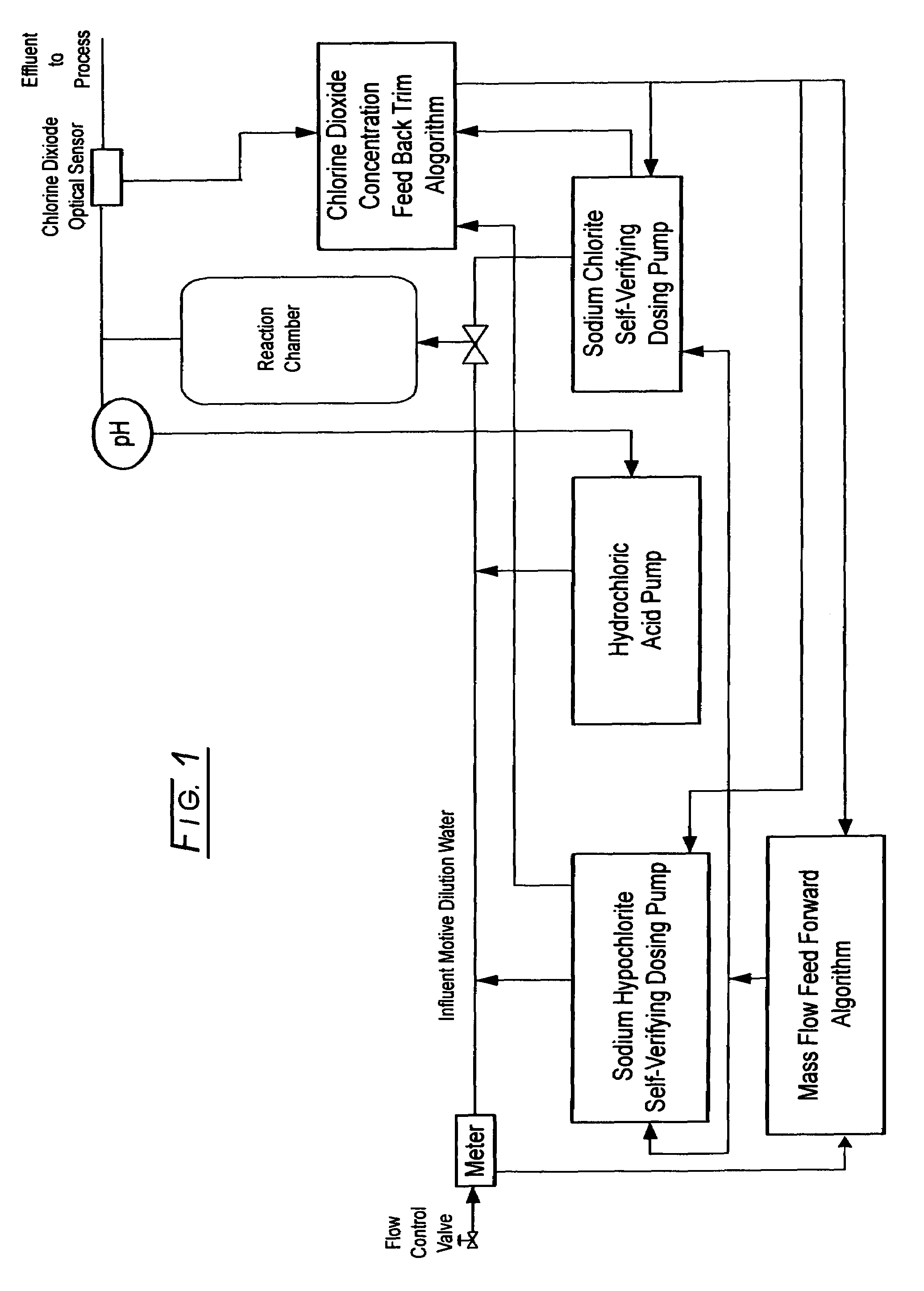
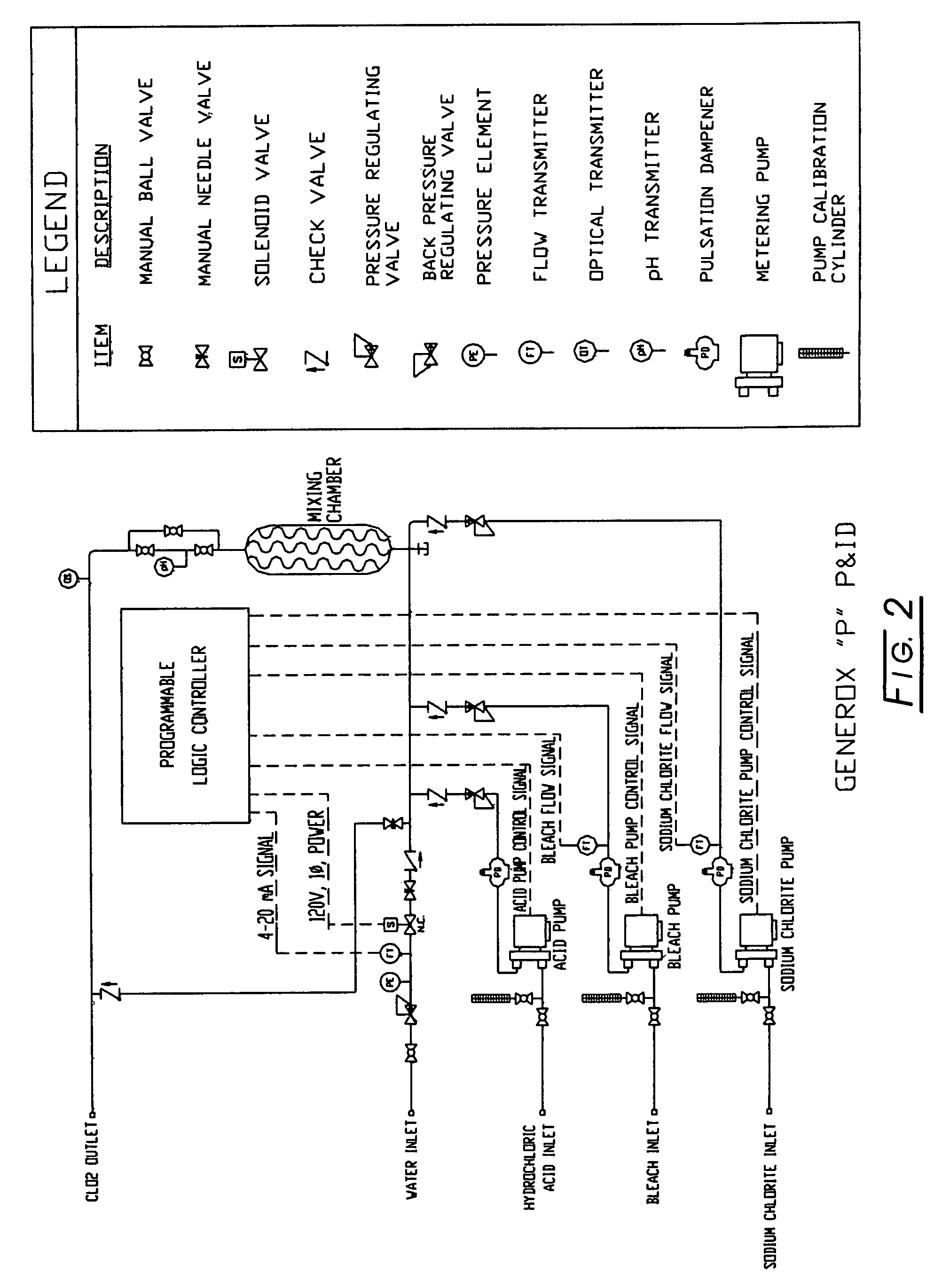
Examples
example 1
[0077](Continuous Feed of Chlorine Dioxide Generated by the Acidified Sodium Hypochlorite Method Applied to a Once-through Application)
[0078]This example illustrates how the process is used for the continuous feed of chlorine dioxide generated by the acidified sodium hypochlorite method in a once-through application. For instance, if the system to be treated were a once-through design flowing at the rate of at 10,000 U.S. gallons per minute, then the pounds per hour of chlorine dioxide required to be generated to produce 1.15 ppm ClO2 would be calculated as follows:
[0079]10,000USgpm×60minutes / hr.×8.34lb. / U.S.gal.1,000,000×1.15ppm=5.75lbs.ClO2perhourEQ8
[0080]In order to minimize over treatment and under treatment, the ClO2 is added to the water system to be treated and ClO2 level is measured utilizing either the DPD Method (Standard Method 4500-C102D) or the Amperometric Method II (Standard Method 4500-C102E). Additionally, the ORP (oxidation-reduction po...
example 2
[0091](Determining Initial Feedrate of the Self Verifying Pumps for ClO2 Application in a Recirculatory Cooling Water)
[0092]A biofilm-fouled recirculatory cooling tower water required both clean up of the biological surface films and overall disinfection. The system water had a demand of 2.1 mg / l of chlorine dioxide and a 0.25 mg / l residual was to be maintained. The ClO2 dosing is calculated as follows:
mg / l ClO2(TCD)=2.1 mg / l (SWD)+0.25 mg / l (RCD)+(0.25 mg / l×0.6) (SND)=2.5 mg / l
[0093]In dilute solutions this is equivalent to 2.5 ppm ClO2 for maintenance disinfection. In order to facilitate biofilm clean-up the (ClO2) was fed at 4 times the maintenance dosage for 7 days. That is 10 ppm ClO2 was fed.
[0094]In order to determine the initial settings on the precursor chemical pumps, the chlorine dioxide dosing rate of 10 ppm had to be converted into the required chlorine dioxide generation rate in pounds per hour (lbs. / hr). This was done on the basis of system data, mass balance and follo...
example 3
[0115](Cooling Water Used for Fertigation)
[0116]It is not difficult to envision that if only 60% chlorine dioxide generation efficiencies are obtained, then, in the case of 2.5 ppm chlorine dioxide fed, there will be 1.0 ppm chlorite in the discharge water compared to 0.125 ppm chlorite at 95% efficiency. This forty percent loss in efficiency could reduce the volumes of waters to be discharged onto fertile land by up to 30%. Therefore, maximizing chlorine dioxide efficiency and minimizing excess reactants and reactant by-products can have a significant positive impact on the allowable disposal volumes of treated water through the fertigation process.
PUM
| Property | Measurement | Unit |
|---|---|---|
| pH | aaaaa | aaaaa |
| mole ratio | aaaaa | aaaaa |
| mole ratio | aaaaa | aaaaa |
Abstract
Description
Claims
Application Information
 Login to View More