[0006]The
purchasing costs of the road finisher are lower for the user since the road finisher basically is a standard road finisher which is produced in great numbers and for this reason, at fair cost, and to which only small preparations need to be made in order to selectively or occasionally install the spraying assembly. The road finisher is universally
usable both for works with a bonding agent layer and works without a bonding agent layer and can, for this reason, be better utilized. The spraying assembly is a modularly designed
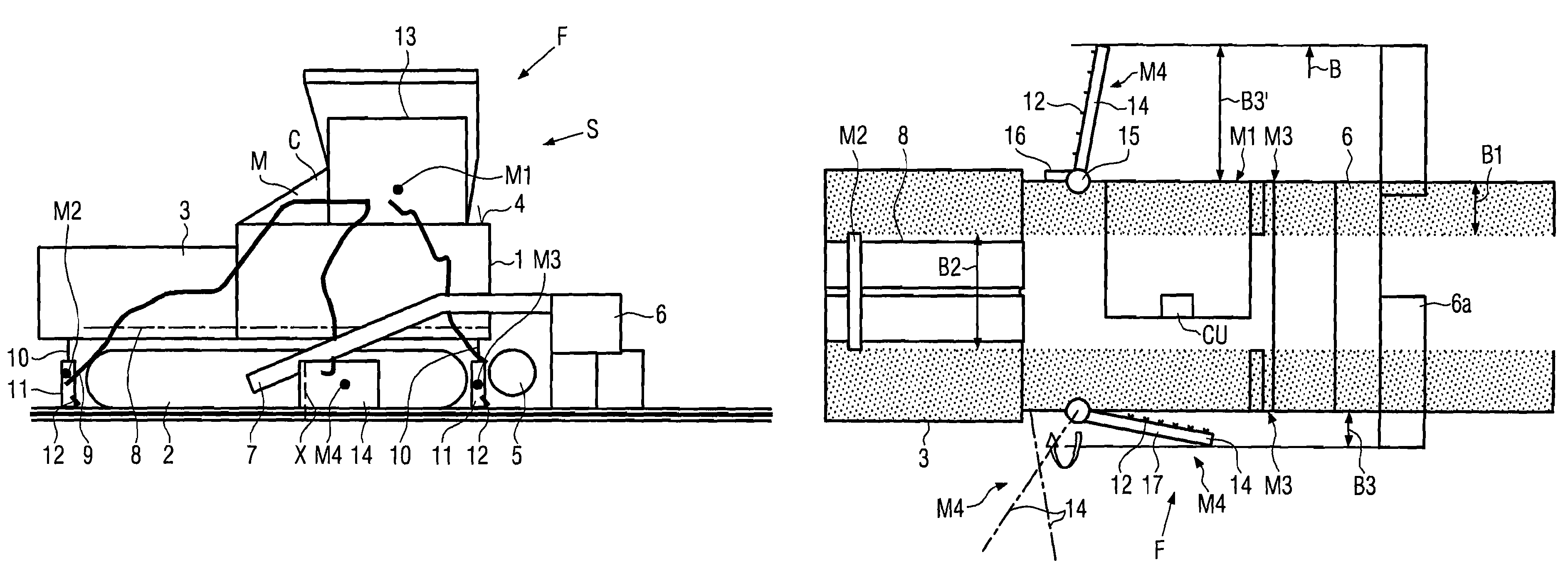
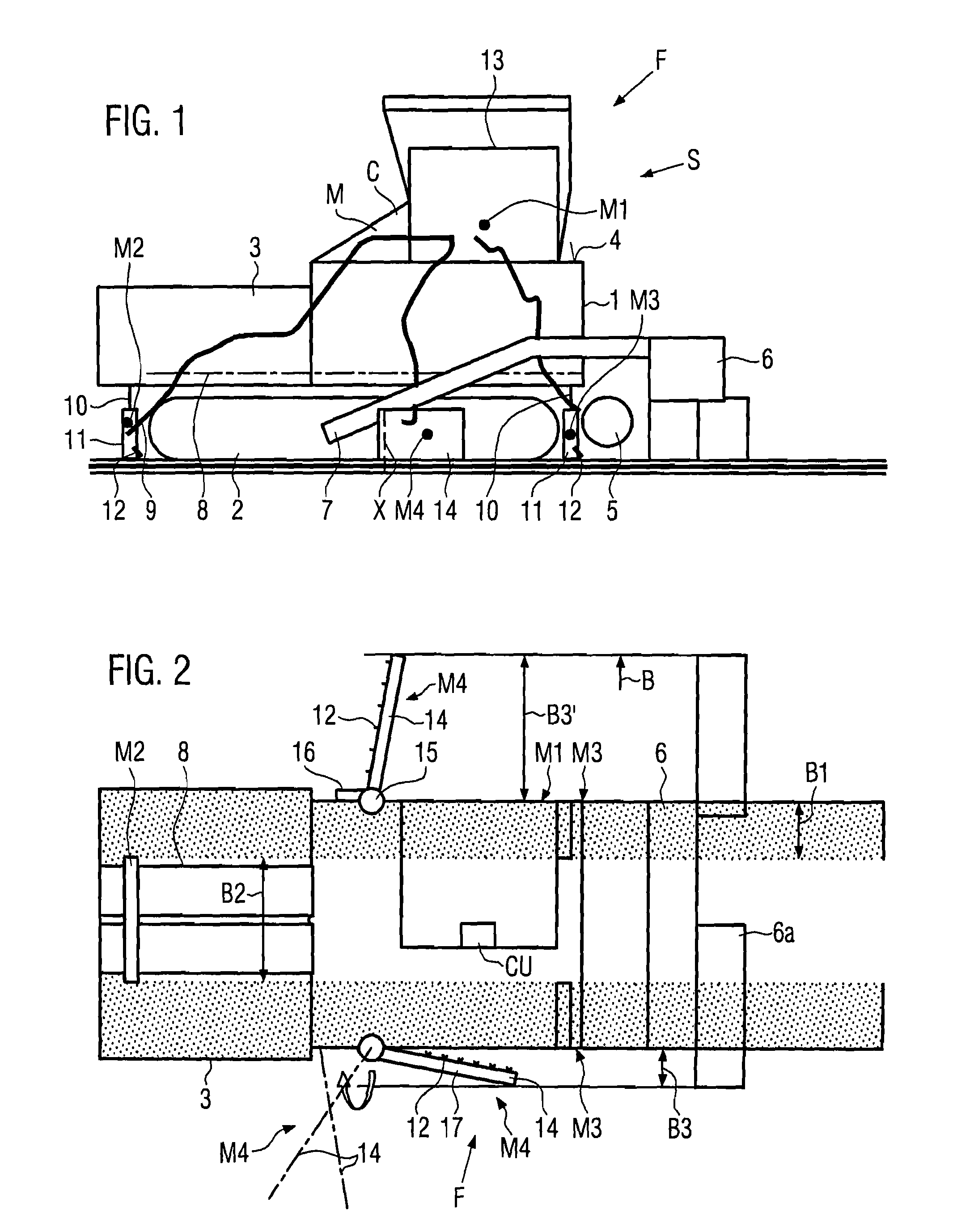
system of single spraying modules, which can be produced at a fair cost and can be mounted easily. The spraying modules may even be installed at road finishers which, basically, are not prepared for this additional purpose and which, in some cases, have already been in use for a long time. The first spraying module is arranged on the operator's platform of the finisher, where, normally, sufficient space is available and good accessability is assured. The second module is protected against
contamination and is arranged below the conveying device or the front end of the material hopper conveying device and applies the
bitumen emulsion between the traveling lanes of the
carriage, such that the carriage does not have to run in the bonding layer. The third, lower module is arranged behind the carriage so that only the traveling lanes are sprayed. In the middle, rear finisher area, which is hardly accessible, no components of the spraying assembly are provided. Since an extendable
screed, having a variable working width, is used, a fourth spraying module, including spraying ramps, is associated with the outer sides of the carriage. The fourth spraying module applies the bitumen
emulsion on those areas within the working width, which are situated on the outer sides of the traveling lanes. Expediently and simply, each spraying ramp of the fourth spraying module is structurally separated from the spraying ramps of the other modules and is pivotal about an essentially
vertical axis at the side of the carriage or on the
chassis. This is advantageous in terms of the assembly and the handling. When the spraying ramps of the fourth spraying module are pivoted inwardly, the outer dimension of the road finisher is not enlarged, or is enlarged only slightly. The pivoting motion can be easily controlled and allows coverage of the entire working width. In this connection it is to be noted, that this concept is particularly useful for road finishers having smaller working widths, i.e., working widths for narrower country roads or other narrower traffic surfaces. It is very expedient just for such smaller working widths, when the road finisher can be universally utilized, irrespective of whether or not a bonding layer has to be applied.


 Login to View More
  Login to View More