AI technical title is built by Patsnap AI team. It summarizes the technical point description of the patent document.
a technology of enterprise information and unification, applied in the field of enterprise information unification and collaborative enterprise data modeling, can solve the problems of difficult management of diversity, difficult cross-data processing, and increased difficulty in managing diversity, and achieve the effect of effective data cleansing
Inactive Publication Date: 2010-03-02
INT BUSINESS MASCH CORP
View PDF15 Cites 314 Cited by
Summary
Abstract
Description
Claims
Application Information
AI Technical Summary
This helps you quickly interpret patents by identifying the three key elements:
Problems solved by technology
Method used
Benefits of technology
Benefits of technology
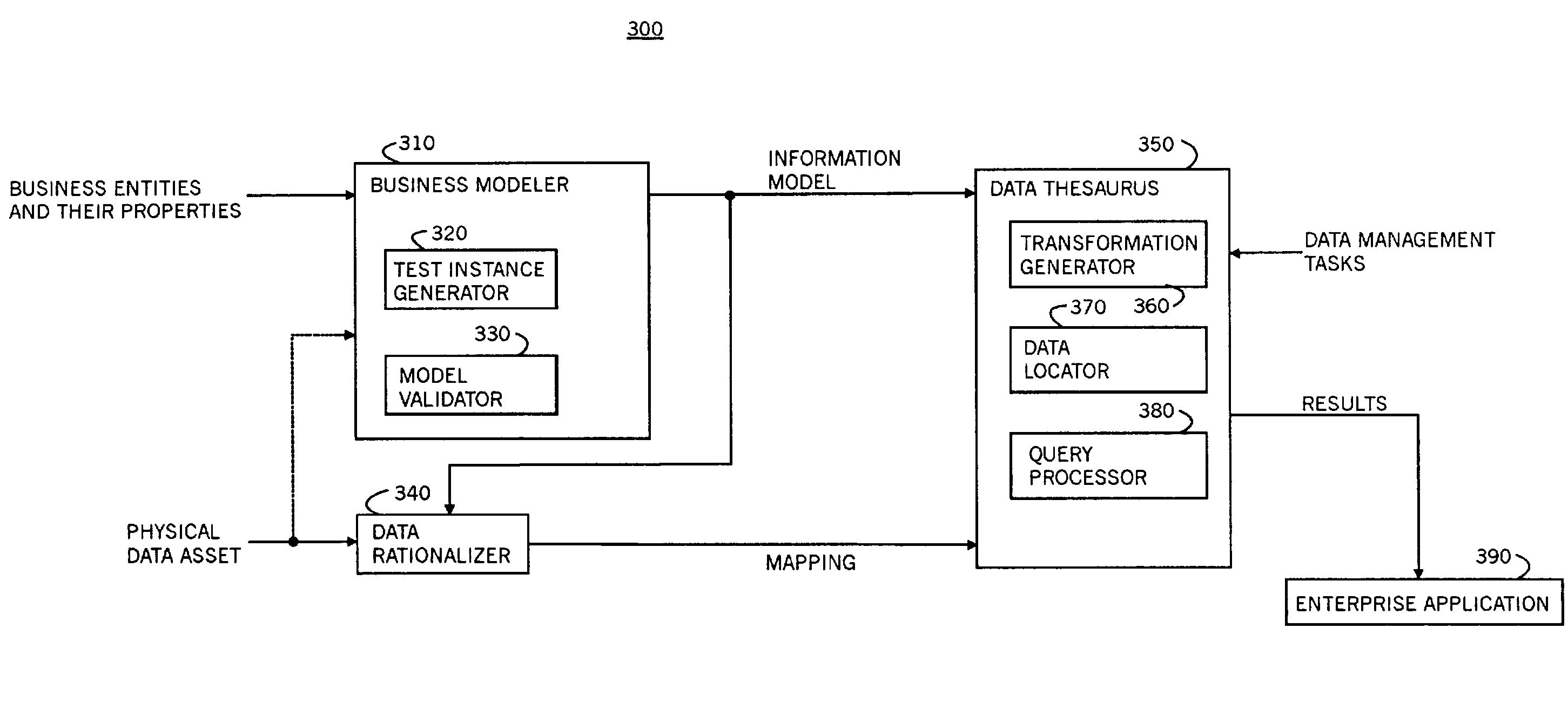
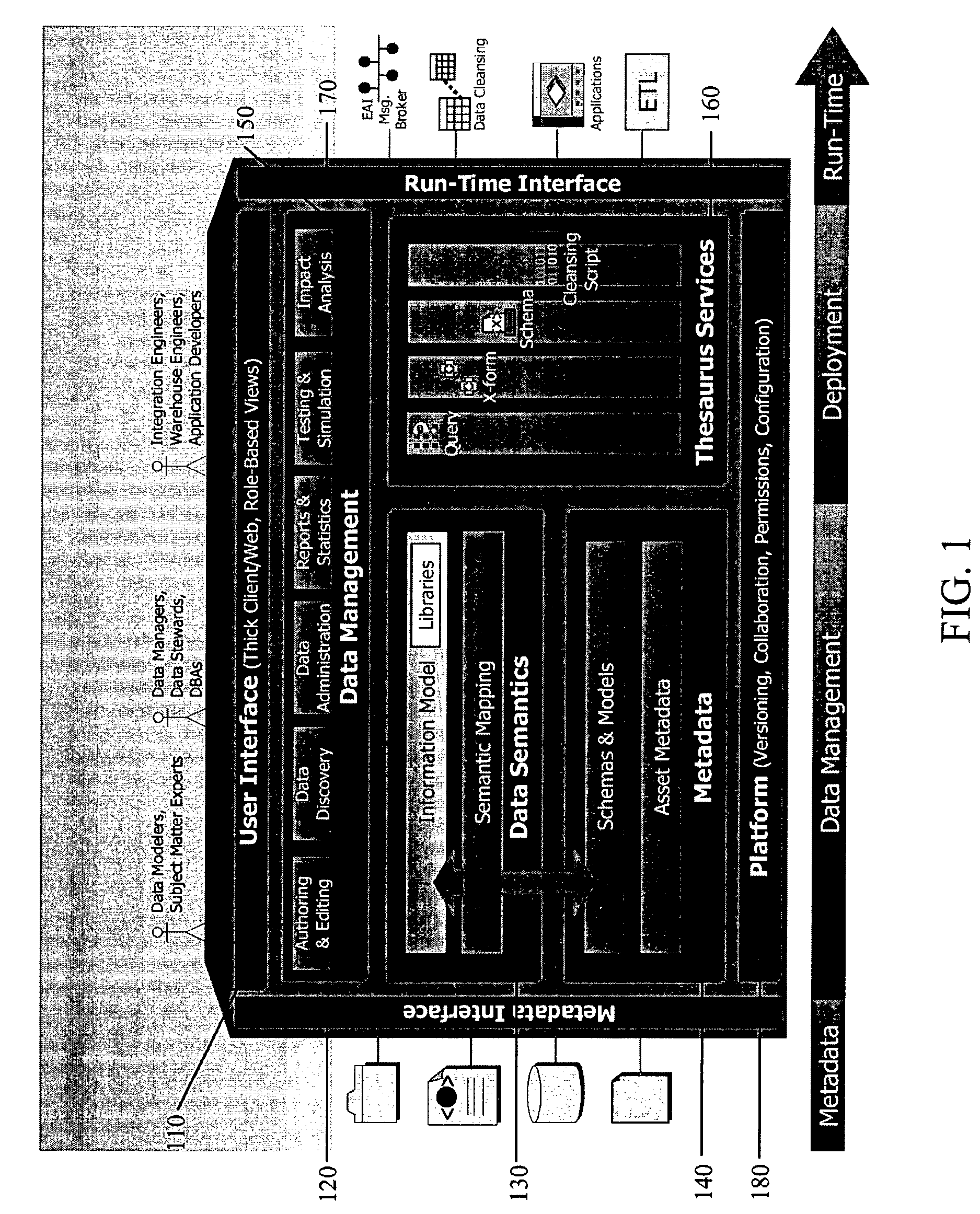
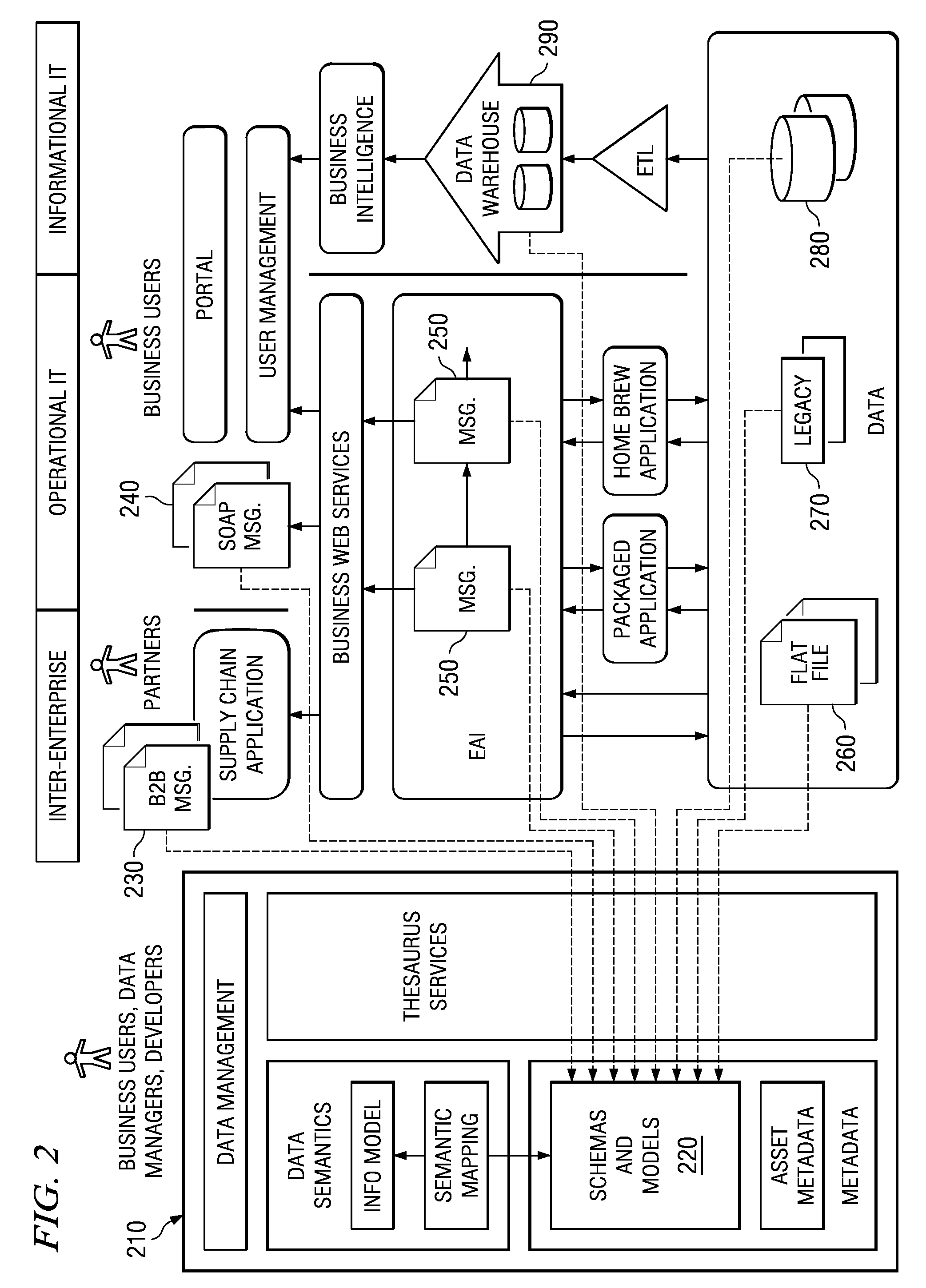
[0012]As such, the present invention serves as a unified data thesaurus, translating diverse schema and data lexicons into a common data model and lexicon, respectively. This feature of the present invention enables enterprises to visualize the totality of their data sources, thereby understanding “what's out there.” Using the present invention, enterprises can identify data overlap, data inconsistency and missing data, and perform effective data cleansing.
[0013]In addition to unifying diverse data sources, the present invention enables enterprises to perform cross-data processing tasks by translating data processing instructions from the common lexicon of the central information model to data processing instructions for each of the diverse physical data asset lexicons. For example, an enterprise can use the present invention to generate queries for its physical data sources from a central query about the central information model. Integration across the diverse physical data assets is thus made transparent—as if all of the enterprise data actually resided in a single data source conforming to the central information model.
Problems solved by technology
One of the difficult challenges faced by enterprise information technology is that of managing diversity.
Sales data, accounting data, inventory data, purchasing data, human resources data—all of these data sources inter-relate to some extent, but cross-data processing requires much manual effort and development of special purpose adaptors to bridge each pair of data sources.
Making the challenge of managing diversity even more difficult, individual data sources typically have their own lexicon for business entities.
Another challenge that arises in modeling enterprise data is collaboration.
Today, with enterprise data models becoming ever more complex and with networked computer architectures prevalent, effective collaborative data modeling is a challenge.
Method used
the structure of the environmentally friendly knitted fabric provided by the present invention; figure 2 Flow chart of the yarn wrapping machine for environmentally friendly knitted fabrics and storage devices; image 3 Is the parameter map of the yarn covering machine
View more
Image
Smart Image Click on the blue labels to locate them in the text.
Viewing Examples
Smart Image
Click on the blue label to locate the original text in one second.
Reading with bidirectional positioning of images and text.
Smart Image
Examples
Experimental program
Comparison scheme
Effect test
Embodiment Construction
[0060]The present invention concerns collaborative modeling of enterprise data and semantics therefor, and enterprise data unification. The present invention provides a method and system for generating a central information model that serves as a global central schema for an enterprise's business entities and their properties. The central information model is based on a central lexicon that crosses many diverse business units, such as sales, purchasing, manufacturing and accounting.
[0061]Schemas for physical data sources of the enterprise are rationalized within the central information model by mapping them into the central model. Such mappings identify constructs of the central model that correspond to constructs of the mapped schemas. Such mappings are used for translating between lexicons of the physical data assets and the lexicon of the central information model, and for providing thesaurus services.
[0062]The present invention uses the central information model and the mappings...
the structure of the environmentally friendly knitted fabric provided by the present invention; figure 2 Flow chart of the yarn wrapping machine for environmentally friendly knitted fabrics and storage devices; image 3 Is the parameter map of the yarn covering machine
Login to View More
PUM
Login to View More
Abstract
An enterprise information unification system including an information modeler for modeling business entities and their properties as an information model, the information model being comprised of business constructs, a data rationalizer for generating mappings from physical data assets to the information model, the physical data assets being comprised of data asset constructs, and a data thesaurus for automating tasks of data management based on the mappings. A method is also described and claimed.
Description
CROSS REFERENCES TO RELATED APPLICATIONS[0001]This application is a continuation-in-part of assignee's application U.S. Ser. No. 10 / 159,516, filed on May 31, 2002, now abandoned entitled “Data Query and Location through a Central Ontology Model,” which is a continuation-in-part of application U.S. Ser. No. 10 / 104,785, filed on Mar. 22, 2002, now U.S. Pat. No. 7,146,399 entitled “Run-Time Architecture for Enterprise Integration with Transformation Generation,” which is a continuation-in-part of application U.S. Ser. No. 10 / 053,045, filed on Jan. 15, 2002, now abandoned entitled “Method and System for Deriving a Transformation by Referring Schema to a Central Model,” which is a continuation-in-part of assignee's application U.S. Ser. No. 09 / 904,457 filed on Jul. 6, 2001, now U.S. Pat. No. 7,093,200 entitled “Instance Brower for Ontology,” which is a continuation-in-part of assignee's application U.S. Ser. No. 09 / 866,101 filed on May 25, 2001, now U.S. Pat. No. 7,099,885 entitled “Meth...
Claims
the structure of the environmentally friendly knitted fabric provided by the present invention; figure 2 Flow chart of the yarn wrapping machine for environmentally friendly knitted fabrics and storage devices; image 3 Is the parameter map of the yarn covering machine
Login to View More
Application Information
Patent Timeline
Application Date:The date an application was filed.
Publication Date:The date a patent or application was officially published.
First Publication Date:The earliest publication date of a patent with the same application number.
Issue Date:Publication date of the patent grant document.
PCT Entry Date:The Entry date of PCT National Phase.
Estimated Expiry Date:The statutory expiry date of a patent right according to the Patent Law, and it is the longest term of protection that the patent right can achieve without the termination of the patent right due to other reasons(Term extension factor has been taken into account ).
Invalid Date:Actual expiry date is based on effective date or publication date of legal transaction data of invalid patent.



 Login to View More
  Login to View More