Supercharge Your Innovation With Domain-Expert AI Agents!

Methods and devices for forming corneal channels

a technology of corneal channels and forming methods, applied in the field of methods and devices for forming corneal channels, can solve the problems of not configured methods of use and known dissecting blades

Inactive Publication Date: 2013-06-25
REVISION OPTICS
View PDF388 Cites 12 Cited by
  • Summary
  • Abstract
  • Description
  • Claims
  • Application Information

AI Technical Summary

Problems solved by technology

Known dissecting blades and methods of use are not, however, configured to easily create a corneal channel or pocket to receive a corneal implant.

Method used

the structure of the environmentally friendly knitted fabric provided by the present invention; figure 2 Flow chart of the yarn wrapping machine for environmentally friendly knitted fabrics and storage devices; image 3 Is the parameter map of the yarn covering machine
View more

Image

Smart Image Click on the blue labels to locate them in the text.
Viewing Examples
Smart Image
  • Methods and devices for forming corneal channels
  • Methods and devices for forming corneal channels
  • Methods and devices for forming corneal channels

Examples

Experimental program
Comparison scheme
Effect test

Embodiment Construction

[0047]The disclosure generally refers to devices and methods for creating channels within corneal tissue. A corneal “channel” as used herein can include what is generally known as a corneal “pocket,” and in some instances may include characteristics not generally associated with corneal pockets. In some embodiments a corneal implant is positioned within the corneal channel after the channel is created. In some embodiments the corneal implant is a corneal inlay.

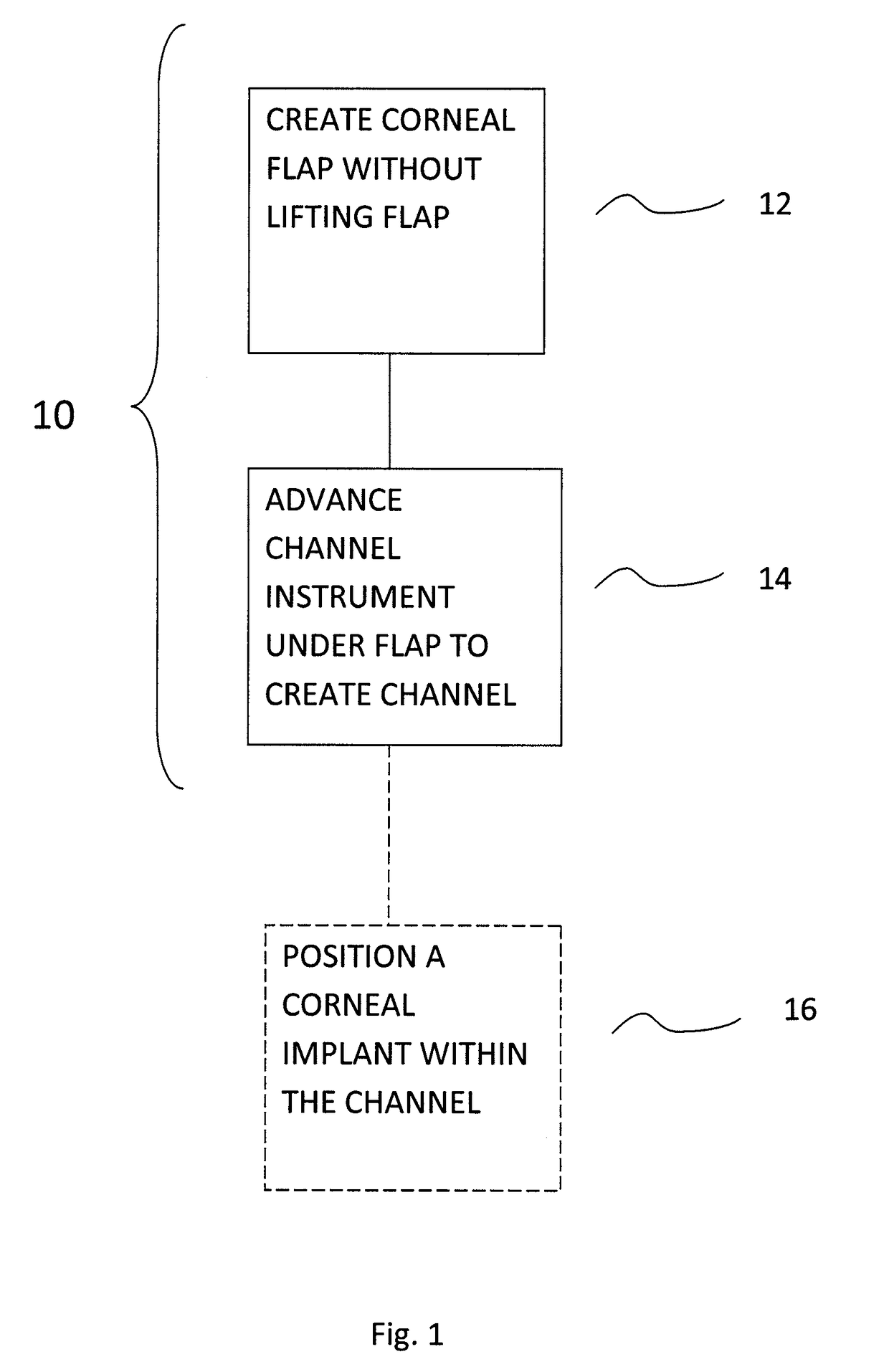
[0048]FIG. 1 illustrates an exemplary method 10 of creating a corneal channel. Method 10 includes the step of creating a corneal flap by disrupting corneal tissue, but without lifting the flap 12. Creating the corneal flap by corneal tissue disruption can be performed with a laser, such as a femtosecond laser (e.g., Intralase®). Application of the femtosecond laser to the corneal tissue creates small, closely arranged bubbles within the cornea. Upon the application of the femtosecond laser, the bubbles remain separated by corn...

the structure of the environmentally friendly knitted fabric provided by the present invention; figure 2 Flow chart of the yarn wrapping machine for environmentally friendly knitted fabrics and storage devices; image 3 Is the parameter map of the yarn covering machine
Login to View More

PUM

No PUM Login to View More

Abstract

Instruments for creating a corneal channel and methods of use.

Description

INCORPORATION BY REFERENCE[0001]All publications and patent applications mentioned in this specification are herein incorporated by reference to the same extent as if each individual publication or patent application was specifically and individually indicated to be incorporated by reference herein.BACKGROUND OF THE INVENTION[0002]Corneal implants have been developed to correct refractive errors in the eye such as presbyopia, myopia, and hyperopia. Corneal implants have traditionally been implanted within the cornea either by positioning the implant within a pocket created in the cornea, or by lifting a flap created in the cornea, positioning the implant on the exposed corneal bed, and placing the flap back over the implant. A corneal pocket can be created with a blade-like spatula, which is advanced into corneal tissue to dissect the tissue and thereby create a pocket. A corneal implant can thereafter be positioned into the corneal pocket. Known dissecting blades and methods of use...

Claims

the structure of the environmentally friendly knitted fabric provided by the present invention; figure 2 Flow chart of the yarn wrapping machine for environmentally friendly knitted fabrics and storage devices; image 3 Is the parameter map of the yarn covering machine
Login to View More

Application Information

Patent Timeline
no application Login to View More
Patent Type & Authority Patents(United States)
IPC IPC(8): A61B18/18
CPCA61F9/013A61F9/007A61F9/00827A61F9/0136
Inventor DISHLER, JONSCHNEIDER, NED
Owner REVISION OPTICS
Features
  • R&D
  • Intellectual Property
  • Life Sciences
  • Materials
  • Tech Scout
Why Patsnap Eureka
  • Unparalleled Data Quality
  • Higher Quality Content
  • 60% Fewer Hallucinations
Social media
Patsnap Eureka Blog
Learn More