Renewable polymer and method of making

Active Publication Date: 2015-05-26
TDA RES
View PDF2 Cites 0 Cited by
  • Summary
  • Abstract
  • Description
  • Claims
  • Application Information

AI Technical Summary

Benefits of technology

The patent is about a substance called glycolaldehyde dimer that can be found in large amounts in the by-products of burning forest biomass. This substance can be used as a raw material to make certain products. The technical effect is that this substance can provide a renewable and high-purity source of raw materials for various applications.

Problems solved by technology

There is a lack of high performance polymers that can be made from bio-based, renewable sources.
Materials made from these sources have good degradation profiles and are often cost-competitive for disposable packaging applications, but their mechanical properties and processing characteristics are significantly inferior to engineered thermoplastics made from petrochemicals.
However, the choice for available renewable building blocks is extremely limited when compared to petrochemical monomers.
Therefore, current synthetic renewable thermoplastics are effectively limited to polyethylene and polyesters.

Method used

the structure of the environmentally friendly knitted fabric provided by the present invention; figure 2 Flow chart of the yarn wrapping machine for environmentally friendly knitted fabrics and storage devices; image 3 Is the parameter map of the yarn covering machine
View more

Image

Smart Image Click on the blue labels to locate them in the text.
Viewing Examples
Smart Image
  • Renewable polymer and method of making
  • Renewable polymer and method of making
  • Renewable polymer and method of making

Examples

Experimental program
Comparison scheme
Effect test

example 1

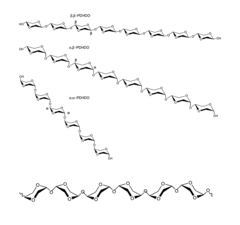
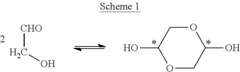
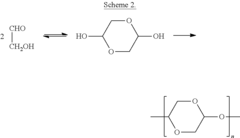
Polymerization of 2,5-dihydroxy-1,4-dioxane (DHDO) with a stoichiometric amount of trimethylsilyl trifluoromethanesulfonate (TMSOTf)

[0092]DHDO (5 mmol) was added to a rigorously dried round bottom flask and then cooled in a bath of ice and brine (−15° C.). Acetonitrile (5 mL, anhydrous) was added next via syringe. To this cold suspension of the glycolaldehyde dimer was added dropwise neat trimethylsilyl trifluoromethanesulfonate (TMSOTf, 10.5 mmol, 2.25 equiv) over a period of around 5 minutes. After the addition of the TMSOTf was complete, the solution was homogenous and began to turn yellow. The solution was stirred overnight and allowed to warm to room temperature. The solution was evaporated en vacuo to provide a brown viscous material. Proton NMR (400 MHz, DMSO-d6) indicated complete conversion of the dimer and the presence of a dioxane ring system with resonances at 5.84, 4.83, and 4.57 ppm. A small fraction of the product separated upon standing to give a semi-crystalline sol...

example 2

End-Capping of the Product of Example 1

[0093]The product of Example 1 was dissolved in acetonitrile and treated with 0.50 mL (5.3 mmol) of acetic anhydride added dropwise at ambient temperature. After stirring the reaction for 4 hours, it was evaporated to dryness under vacuum. The crude product was dissolved in CH2Cl2, washed with a 5% solution of aqueous sodium bicarbonate then with water, dried over MgSO4, and evaporated under reduced pressure to produce a solid.

[0094]The average molecular weight of both the capped polymer was measured by Gel Permeation Chromatography (GPC) in dimethylacetamide. The material had a multimodal distribution with a low molecular weight fraction centered at 2,300 Dalton and a higher molecular weight fraction centered at 73,000 Dalton ((which corresponds to about 715 monomer repeat unit) for the capped material. The Number Average Molecular Weights (Mn) was 2312 Dalton and the Weight Average Molecular Weights (Mw) was 206,000.

example 3

Polymerization of 2,5-dihydroxy-1,4-dioxane (DHDO) with molecular sieves and a catalytic amount of scandium triflate (Sc(OTf)(3) in acetonitrile under reduced pressure

[0095]Sieves were found to disintegrate while stirring in solution, therefore reactions were run where the sieves were placed in a Soxhlet cup and the solvent was refluxed under reduced pressure through the sieves and back into the reaction solution. 1.0 g (8.3 mmol) of DHDO and 0.2 g (0.41 mmol, 5%) of Sc(OTf)3 (scandium triflate) were dissolved in 50 mL anhydrous acetonitrile (MeCN) in a 100 mL round bottom flask. A Soxhlet extraction cup was filled with 4 g of 3 Å molecular sieves and the cup was placed in the Soxhlet extractor along with an additional 20 mL of anhydrous MeCN. The reaction was set up to reflux the acetonitrile through the molecular sieves under reduced pressure; the MeCN was refluxed at 150 Torr (bp ˜35° C.) overnight. Once the reaction cooled to ambient temperature, the Soxhlet extractor was remove...

the structure of the environmentally friendly knitted fabric provided by the present invention; figure 2 Flow chart of the yarn wrapping machine for environmentally friendly knitted fabrics and storage devices; image 3 Is the parameter map of the yarn covering machine
Login to View More

PUM

PropertyMeasurementUnit
Equivalent massaaaaaaaaaa
Login to View More

Abstract

A polymer, optionally made from renewable sources, comprising a specific chemical structure that is a result of the polymerization of α-hydroxycarbonyl compounds (alpha-hydroxycarbonyl compounds), particularly α-hydroxyaldehydes (alpha-hydroxyaldehydes) and α-hydroxyketones (alpha-hydroxyketones), or glycolaldehyde. A method of polymerization, the method comprising the step of reacting trimethylsilyl trifluoromethanesulfonate with the cyclic dimer of one or more α-hydroxycarbonyl compounds. A method of making said polymer, the method comprising dehydrating a cyclic dimer of one or more α-hydroxycarbonyl compounds. An end-capped polymer made from one or more α-hydroxycarbonyl compounds and terminal end-cap groups.

Description

CROSS-REFERENCE TO RELATED APPLICATIONS[0001]The present application claims the benefit of the provisional application No. 61 / 753,598, filed Jan. 17, 2013 (titled A NEW RENEWABLE POLYMER FROM BIO-OIL, by Silvia Luebben and Aaron Skaggs), which is incorporated by reference herein. Provisional application No. 61 / 753,598 is not admitted to be prior art with respect to the present invention by its mention in the background or cross-reference section.STATEMENT REGARDING U.S. GOVERNMENT SUPPORT[0002]This invention was made using U.S. government funding through the U.S. Environmental Protection Agency contract No. EP-D-11-057 and U.S. Department of Agriculture contract No. 2013-33610-20834. The government has certain rights in this invention.BACKGROUND OF THE INVENTION[0003]This invention relates to the composition of matter of a polymer made from α-hydroxycarbonyl compounds (alpha-hydroxycarbonyl compounds), particularly α-hydroxyaldehydes (alpha-hydroxyaldehydes) and α-hydroxyketones (al...

Claims

the structure of the environmentally friendly knitted fabric provided by the present invention; figure 2 Flow chart of the yarn wrapping machine for environmentally friendly knitted fabrics and storage devices; image 3 Is the parameter map of the yarn covering machine
Login to View More

Application Information

Patent Timeline
no application Login to View More
IPC IPC(8): C08G63/91C08G65/32C08G65/34C08G65/48
CPCC08G65/48C08G65/34
InventorLUEBBEN, SILVIA DEVITORAEBIGER, JAMES WILLIAMSKAGGS, AARON JEREMY
OwnerTDA RES