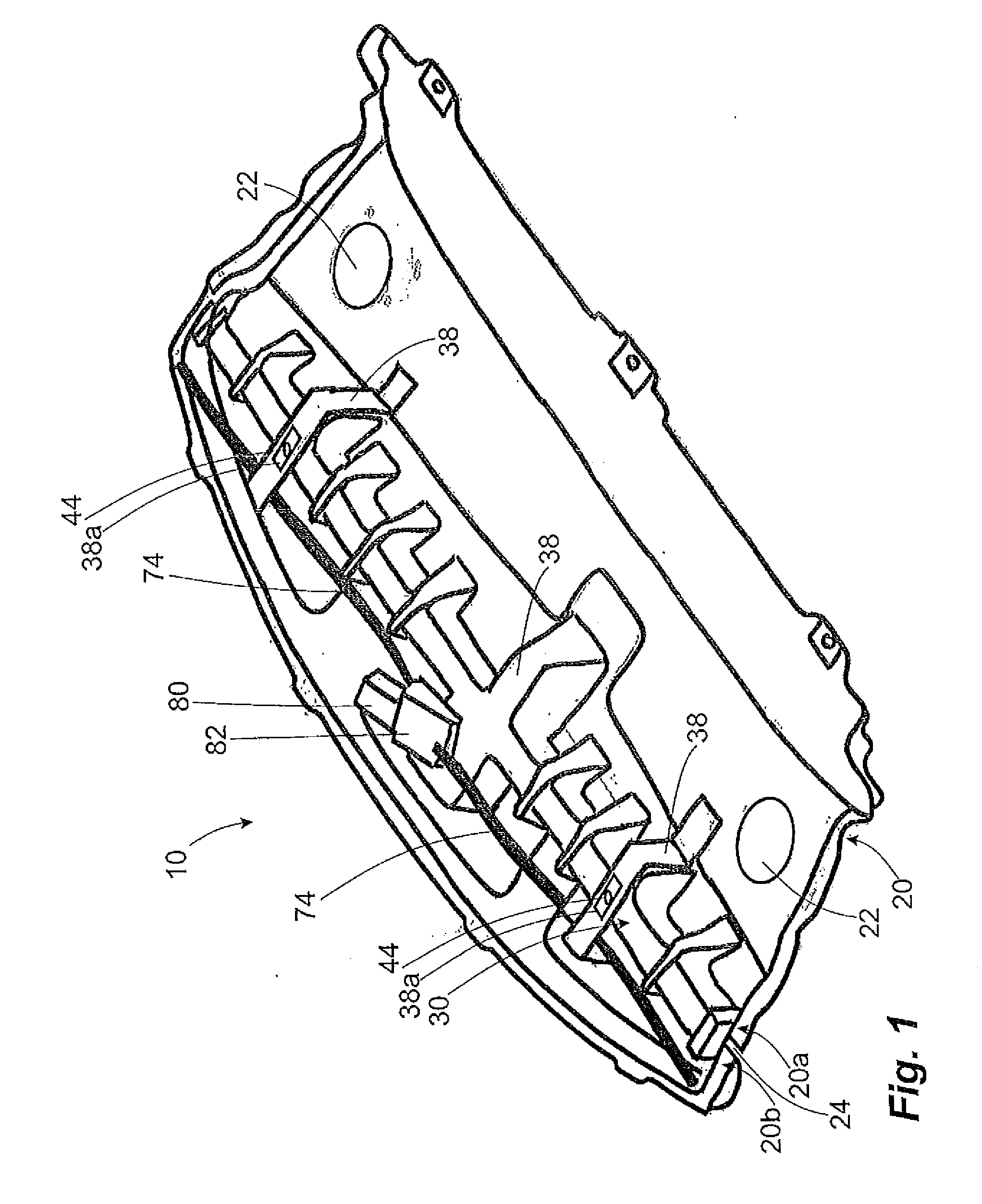
[0012]The largely closing of the vessel inner space with respect to the environment is advantageous not only with respect to the mechanical positional stability of the two shelf portions with respect to each other. In particular, it constitutes effective sound-damping. Sources of noise arranged in the environment of the vessel member can hardly be perceived any longer in the vehicle itself as a result of the closed vessel member.
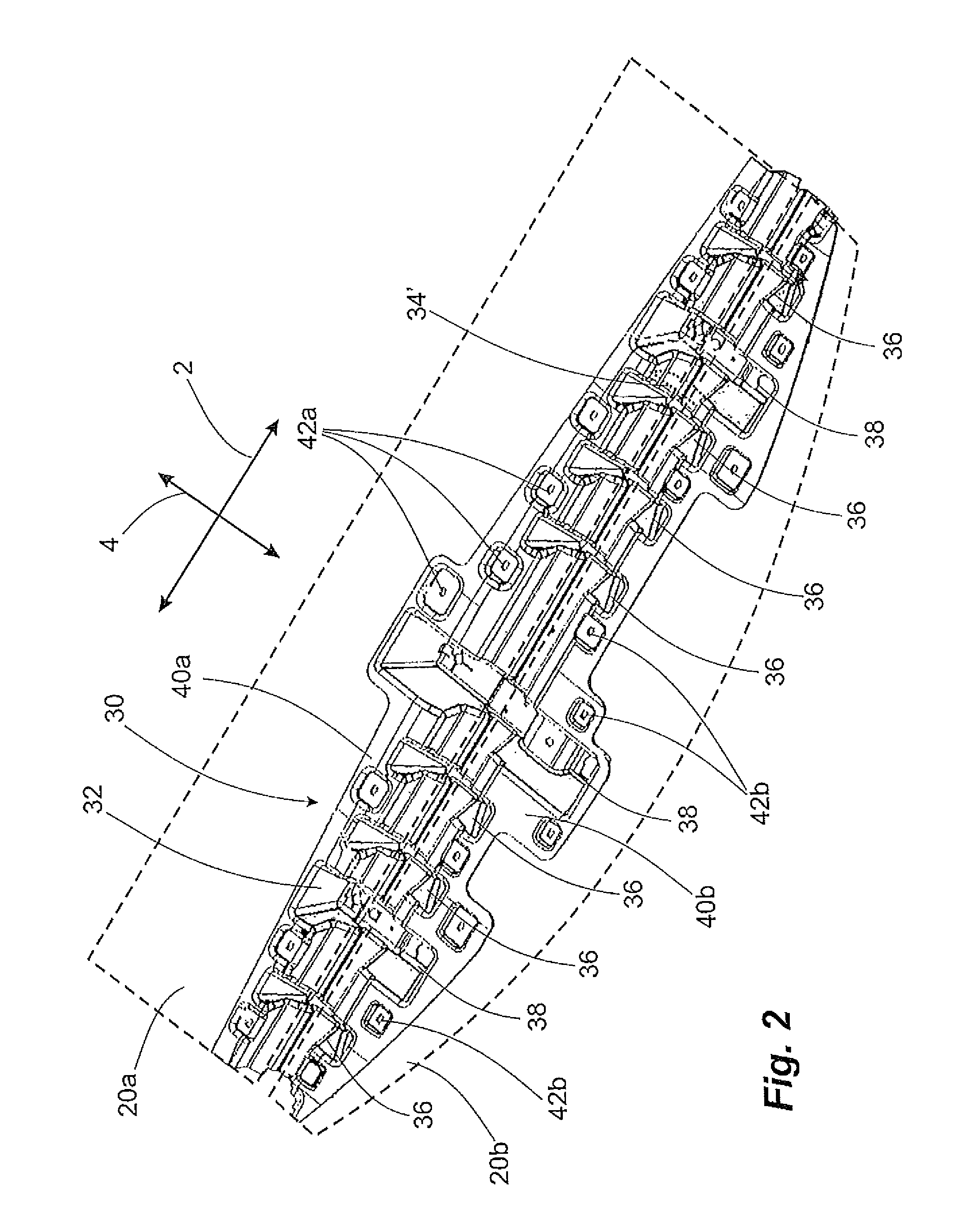
[0014]In principle, it is conceivable for the vessel member to have a cross section which does not change over the entire length thereof in the direction of the main axis. This allows simple production as an extruded profile-member. However, an embodiment in which a vessel inner space which is defined by the vessel member has a variable cross-sectional surface area with respect to the extent direction of the main axis is also advantageous. This is intended to be understood to mean that the vessel member, when viewed in the direction of the main axis, has expansions and / or contractions transversely relative to the main axis. This leads to increased inherent stability of the vessel member and consequently also to increased positional stability of the shelf portions with respect to each other. Instead of a member which is constructed in simplified terms in a two-dimensional manner, a member which is preferably shaped in a three-dimensional manner is consequently used as a vessel member.
[0016]This embodiment of the vessel member with cross section changes, in particular with local cross section expansions which are constructed in the manner of hollow ribs, leads to a high level of stability and in particular torsion resistance of the vessel member. The handling of the shelf with the fitted vessel member is thereby significantly improved.
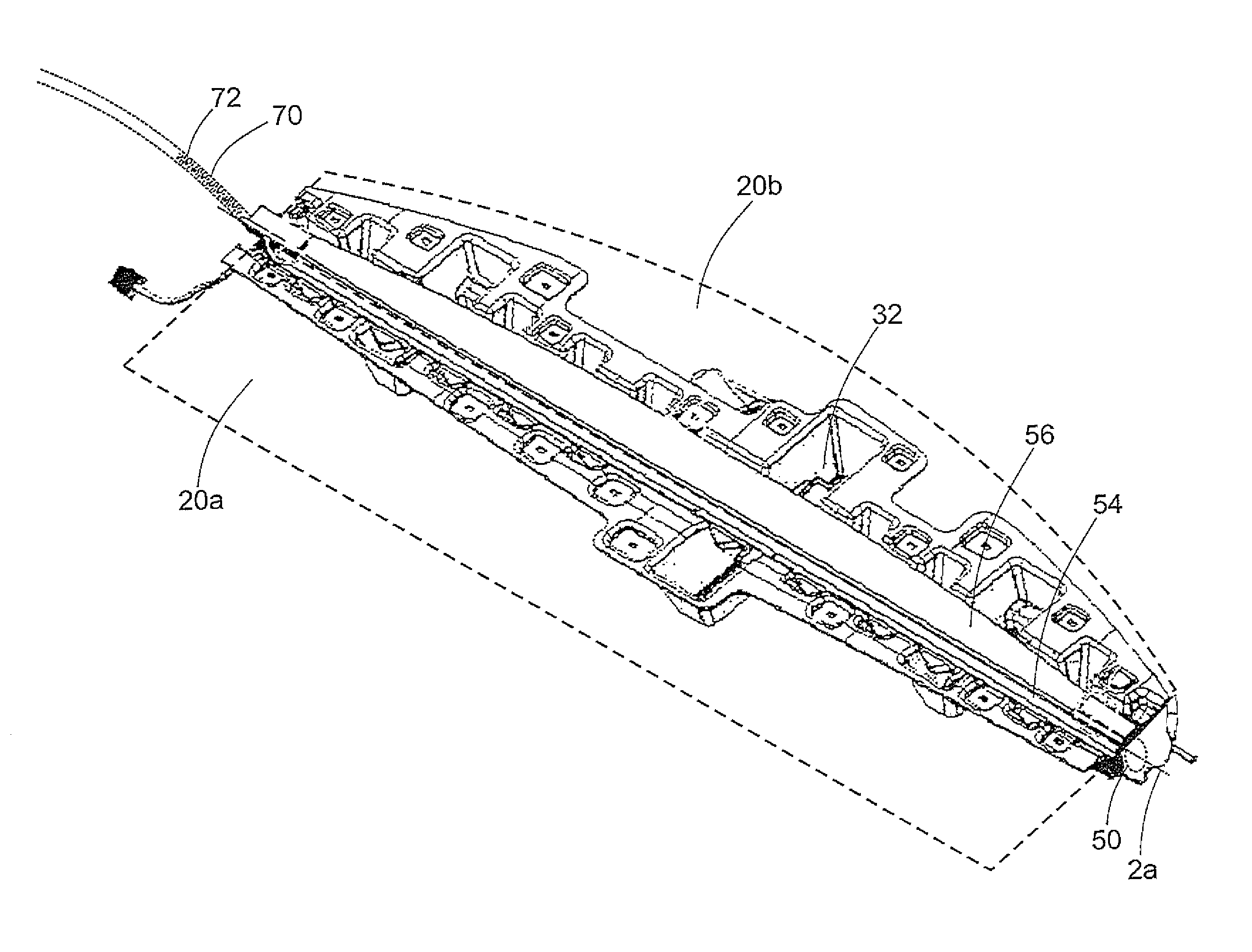
[0018]As already mentioned in the introduction, the vessel member is connected both to the front and to the rear shelf portion. In this instance, it is particularly advantageous for there to be provided on the vessel member first and second securing devices for fitting to the front and rear shelf portions, respectively, the first and / or the second securing devices being offset with respect to each other in the plane of the extent of the shelf with respect to an orthogonal direction relative to the main axis. The term with respect to the preferred installation position of the roller blind system, in which the main axis extends in the transverse vehicle direction, is intended to be understood to mean that the first or the second securing device on the front and / or the rear shelf portion are arranged offset with respect to each other with respect to the longitudinal direction of the vehicle, respectively. The risk of the respective shelf portion becoming bent along this line as a result of securing devices which are arranged so as to be linear and parallel with respect to the main axis is thus prevented. Instead, the stability of the connection of the vessel member to the front or the rear shelf portion is significantly increased. With respect to the vessel member, such an arrangement of the securing devices is in particular possible by holes in the vessel member being spaced apart from the main axis to different extents with respect to an orthogonal direction relative to the main axis. The distance between the rearmost securing device in the longitudinal vehicle direction and the foremost securing device in the longitudinal vehicle direction for the same portion of the shelf is in this instance preferably at least 15 mm, in particular preferably at least 30 mm.
[0021]The invention further also relates to a production method for producing a roller blind system of the above-described type. In this instance, this production method is characterized by the specific feature that the vessel member is produced as a plastics component starting from a planar blank by means of a thermal forming process. This forming process may in particular be a stamping process, in which the heated blank is brought into the desired three-dimensional shape. This production method is, on the one hand, cost-effective. It is further advantageous since it enables the simple production of the three-dimensional shaping, which results in a high degree of stability. The selective influence of the properties of the vessel member by means of the use of a multi-layered blank or a blank of composite material is also possible.



 Login to View More