Supercharge Your Innovation With Domain-Expert AI Agents!

Anisotropic conductive adhesive, light emitting device, and method for producing anisotropic conductive adhesive

a technology of anisotropic conductive adhesive and anisotropic conductive adhesive, which is applied in the direction of vacuum evaporation coating, semiconductor/solid-state device details, coatings, etc., can solve the problems of low light emission efficiency, and difficult to improve production efficiency. , to achieve the effect of high anti-migration properties, high reflectance and high light reliability

Active Publication Date: 2016-11-08
DEXERIALS CORP
View PDF9 Cites 3 Cited by
  • Summary
  • Abstract
  • Description
  • Claims
  • Application Information

AI Technical Summary

Benefits of technology

The solution achieves a high intensity of emitted light with improved reflectance and reduced light absorption, maintaining light emission efficiency and adhesion strength over time, even under thermal stress.

Problems solved by technology

Firstly, in the mounting method using wire bonding, light emission efficiency is low because the bonding wires 106 and 108, which are made of gold, absorb light having a wavelength of, for example, 400 nm to 500 nm.
In this method, cure time of the die bonding adhesive 110 and the die bonding adhesive 111 is long because of the use of an oven for the curing, and it is difficult to improve production efficiency.
This method also suffers from a long cure time for the sealing resin 126 and the sealing resin 127 because of the use of an oven for the curing, which makes it difficult to improve production efficiency.
The coloring causes the anisotropic conductive adhesive 134 to absorb light, which thereby degrades light emission efficiency.
However, silver is a chemically unstable material and has a problem of being susceptible to oxidation and sulfuration.
Another problem with using silver is that energization after thermal compression bonding causes migration, which leads to a breakage in wiring and to decrease in adhesion strength due to the deterioration of the adhesive.
However, the use of, for example, nickel in a base layer in combination with the Ag-based alloy thin film as the topmost layer gives rise to a problem such that the entire reflectance of the conductive particles is degraded by the reflectance of nickel, which is lower than the reflectance of Ag.
In addition, Au or Ni exposed on the surface of the conductive particles 135 causes light absorption and consequently decrease light emission efficiency.

Method used

the structure of the environmentally friendly knitted fabric provided by the present invention; figure 2 Flow chart of the yarn wrapping machine for environmentally friendly knitted fabrics and storage devices; image 3 Is the parameter map of the yarn covering machine
View more

Image

Smart Image Click on the blue labels to locate them in the text.
Viewing Examples
Smart Image
  • Anisotropic conductive adhesive, light emitting device, and method for producing anisotropic conductive adhesive
  • Anisotropic conductive adhesive, light emitting device, and method for producing anisotropic conductive adhesive
  • Anisotropic conductive adhesive, light emitting device, and method for producing anisotropic conductive adhesive

Examples

Experimental program
Comparison scheme
Effect test

examples

[0108]Samples used in measurement are described.

[0109]First, a thin nickel film is formed on each acrylic resin particle by electrolytic plating as the base layer. Next, sputtering is performed on three different sputtering targets, each containing Ag, Bi, and Nd with the content ratio of Bi set to at least 0.1 weight and at most 3.0 weight and the content ratio of Nd set to at least 0.1 weight % and at most 2.0 weight % with respect to the total weight of Ag, Bi, and Nd of 100 weight %. The light reflecting layer is formed through the sputtering on a surface of the base layer in each sputtering target, thereby producing three types of conductive particles.

[0110]The produced conductive particles of each type are dispersed in the binder resin to obtain an anisotropic conductive adhesive for each of Examples 1 to 3. The thin nickel film has a thickness of 0.10 μm, and the light reflecting layer has a thickness of 0.2 μm.

[0111]The compositions of the sputtering targets used to form the...

the structure of the environmentally friendly knitted fabric provided by the present invention; figure 2 Flow chart of the yarn wrapping machine for environmentally friendly knitted fabrics and storage devices; image 3 Is the parameter map of the yarn covering machine
Login to View More

PUM

PropertyMeasurementUnit
reflectanceaaaaaaaaaa
wavelengthaaaaaaaaaa
Login to View More

Abstract

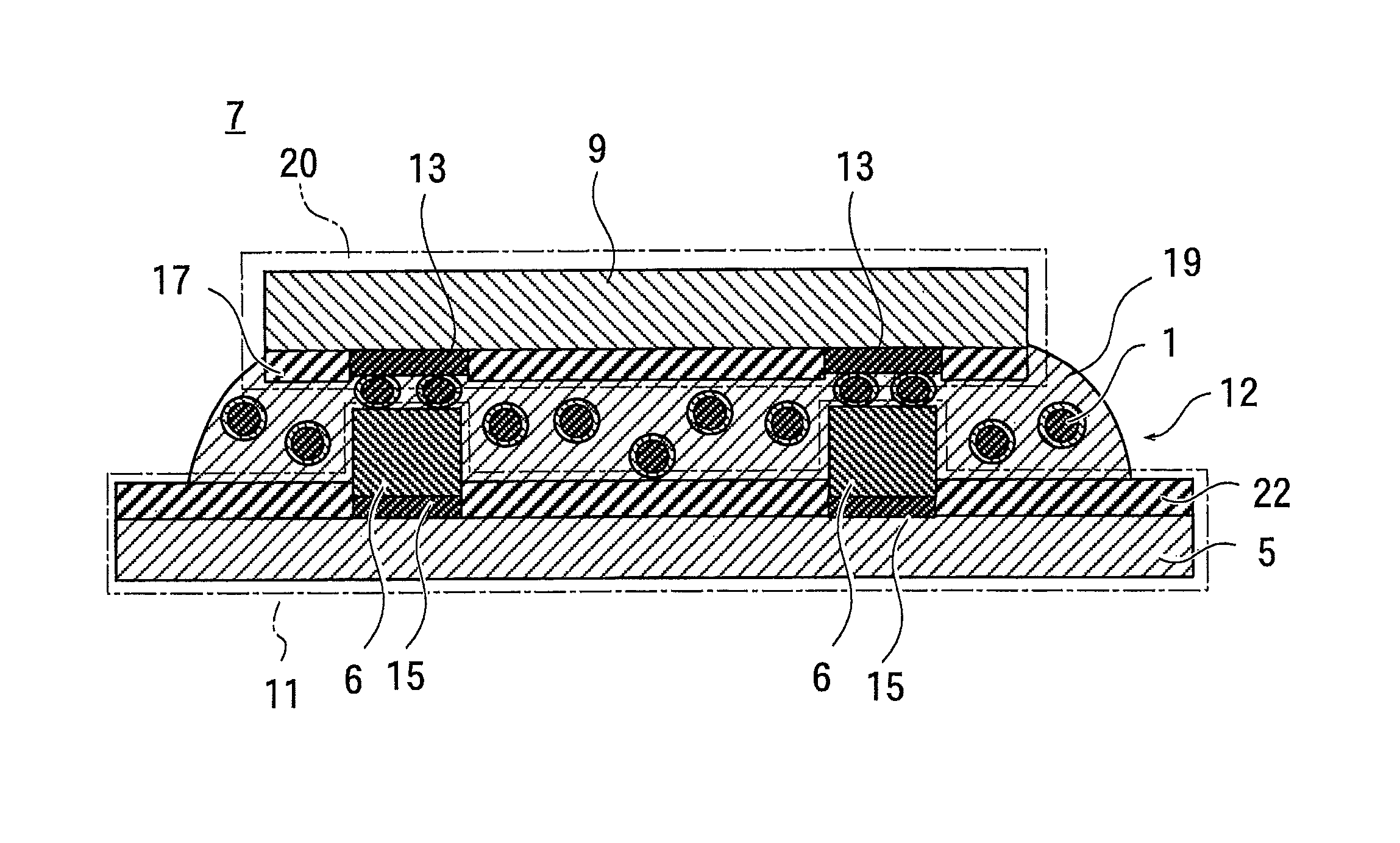
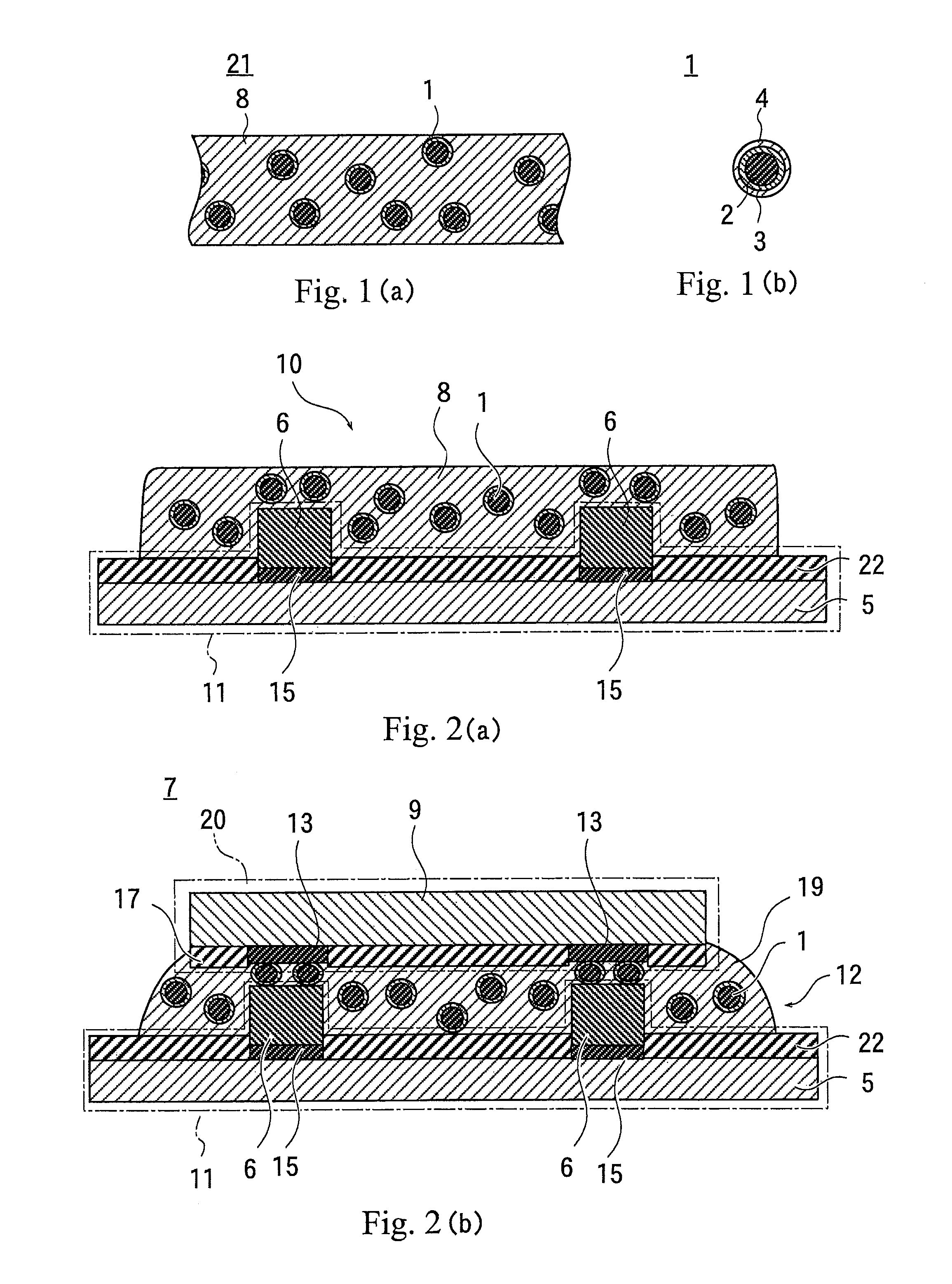
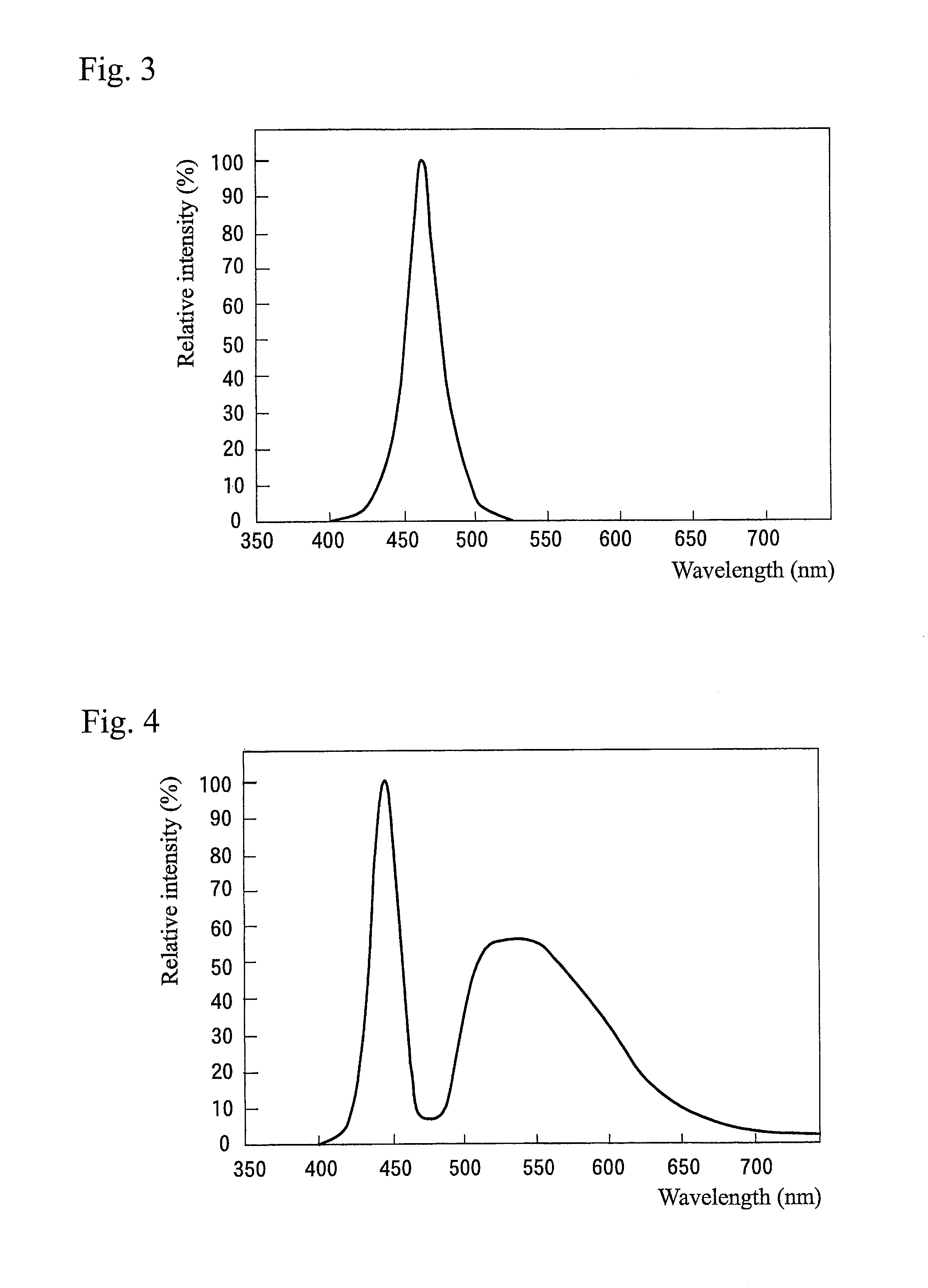
Provided is a light emitting device high in the intensity of emitted light. A blue LED chip having a peak of emitted light in a wavelength range of at least 360 nm and at most 500 nm is adhered to an electrode substrate by an anisotropic conductive adhesive. A light reflecting layer made of a silver alloy on a surface of each conductive particle contained in the anisotropic conductive adhesive, and has high reflectance with respect to blue light. The light reflecting layer is formed by sputtering of a sputtering target that contains Ag, Bi, and Nd with the content ratio of Bi set to at least 0.1 weight % (wt %) and at most 3.0 wt % and the content ratio of Nd set to at least 0.1 weight % and at most 2.0 wt % with respect to the total weight of Ag, Bi, and Nd of 100 wt %. The conductive particle has high anti-migration properties.

Description

[0001]This application is a continuation of International Application No. PCT / JP2014 / 53460, filed on Feb. 14, 2014, which claims priority to Japan Patent Application No. 2013-029868, filed on Feb. 19, 2013. The contents of the prior applications are herein incorporated by references in their entireties.BACKGROUND[0002]The present invention generally relates to an anisotropic conductive adhesive used to anisotropic conductively connect an LED element to an electrode substrate, and an LED light emitting device that has an LED element mounted on an electrode substrate using the anisotropic conductive adhesive.[0003]Optical function elements that use an LED are attracting attention in recent years.[0004]Optical function elements of this type employ flip chip mounting in which an LED chip is directly mounted on a wiring board, for the purpose of size reduction or the like.[0005]Various methods of mounting an LED chip on a wiring board by flip chip mounting have hitherto been known as sho...

Claims

the structure of the environmentally friendly knitted fabric provided by the present invention; figure 2 Flow chart of the yarn wrapping machine for environmentally friendly knitted fabrics and storage devices; image 3 Is the parameter map of the yarn covering machine
Login to View More

Application Information

Patent Timeline
no application Login to View More
Patent Type & Authority Patents(United States)
IPC IPC(8): C09J11/00C23C14/22H01L33/62H01L23/00C23C14/02C23C14/20H01L33/48H01L33/60C09J9/02C08K7/16C08K9/00
CPCC09J11/00C09J9/02C23C14/025C23C14/205C23C14/223H01L24/29H01L33/486H01L33/60H01L33/62H01L2224/29439H01L2224/29455H01L2224/73104H01L2224/73204H01L2224/81192H01L2224/81903H01L2224/8385H01L2224/83192H01L2224/83862H01L2224/9211H01L2924/07802H01L2924/12041H01L2924/181C08K7/16C08K9/00H01L24/32H01L24/83H01L2224/16225H01L2224/16227H01L2224/2929H01L2224/2939H01L2224/29413H01L2924/0665H01L2924/00014H01L2924/00H01L2224/81H01L2224/83H01L2224/05568H01L2224/05573H01L2224/06102H01L2224/1703H01L2224/05599
Inventor NAMIKI, HIDETSUGUKANISAWA, SHIYUKIUMAKOSHI, HIDEAKIAOKI, MASAHARUISHIGAMI, AKIRA
Owner DEXERIALS CORP
Features
  • R&D
  • Intellectual Property
  • Life Sciences
  • Materials
  • Tech Scout
Why Patsnap Eureka
  • Unparalleled Data Quality
  • Higher Quality Content
  • 60% Fewer Hallucinations
Social media
Patsnap Eureka Blog
Learn More