[0009]Thus, as understood herein, wireless device (and, hence, people) tracking is facilitated, however unwittingly, by network communication protocols, in which wireless devices are programmed to automatically seek out wireless access points (WAPs) using exploratory messages, colloquially referred to as “pings”. The wireless devices may continue to periodically ping the WAPs regardless of whether the WAP can be successfully accessed, e.g. the security keys are known or can be negotiated. Pinging enables the wireless device to ascertain the best WAP with which to communicate by determining e.g. signal strength, the name of the WAP, and whether or not a security key or credentials are required and available, so that a list of WAPs may be presented to the user for selection. After selecting one and entering any keys, if need be, the user of the device can browse Internet web pages, use email, send text messages and tweets, communicate by video conferencing, and so on using the WAP. The mobile device can usually be programmed to reconnect with the WAP in the future when the device comes into range of the WAP. As mentioned above, the retailer can take advantage of this fact by faking popular WAPs with SSIDs labeled with, for example, “attwifi” or “verizonwifi”. The device will see the SSID and maintain prolonged contact with the imposter WAP.
[0011]MAC addresses can be used for access control to wired local area networks (LAN) and wireless local area network (WLAN). In some corporate environments with strict security policies, every device accessing a wired or wireless network must be known. And this can be done by manually including the MAC in an access control list that the WAP checks in order to create a connection with that device. Presumably, the WAP may be able to determine if the MAC is already in use elsewhere in the corporate environment. However, often times, access control may be done at a higher software layer of functionality that can use public / private key credentials using X.509 certificates and a protocol such as Transport Layer Security (TLS). TLS allows a client device to not only authenticate a server, but for the server to authenticate a client device in a process known as “mutual authentication”. By verifying the credentials of the client, e.g. the mobile device, the WAP, acting as a server, is able to grant access to the network. This can be in addition to or instead of using the MAC for access control. In large corporate environments, there may less risk of surreptitious tracking because the physical space may be controlled and there would be no WAPs other than those installed by the corporate entity. However, many corporate environments are shared with various businesses operating side-by-side. For example, someone could be parked in a car outside a place of business and wirelessly collect information from all the smart devices from the employees of that business. People can also be tracked while travelling in cars. Surreptitious tracking can therefore extend from retail, to vehicles, to residences and even places of business. It is possible to discover where people shop, drive, live and work.
[0014]Thus, present principles recognize the desirability of having a means to prevent MAC tracking for situations when the WAP does not use the MAC for access control.
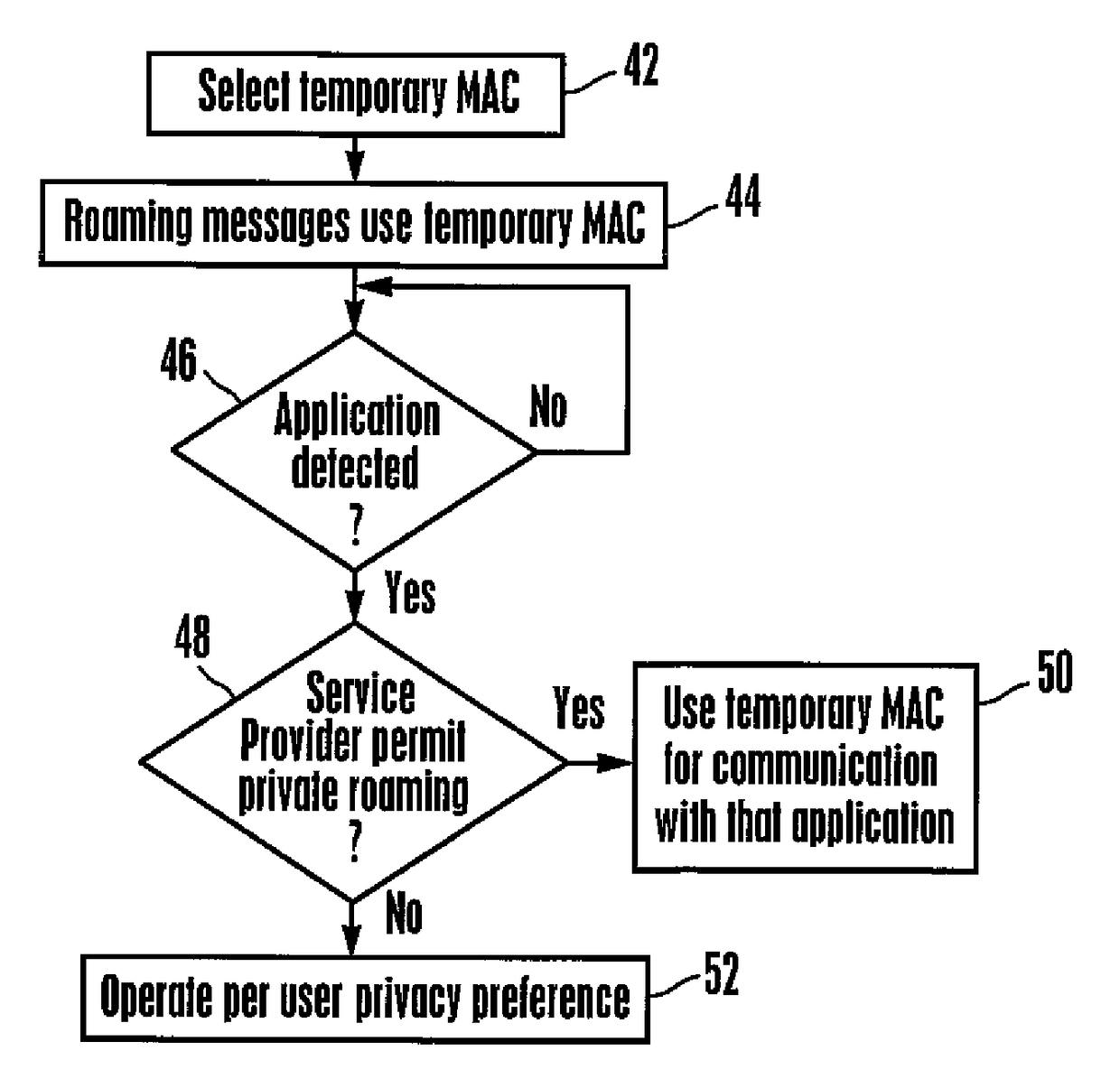
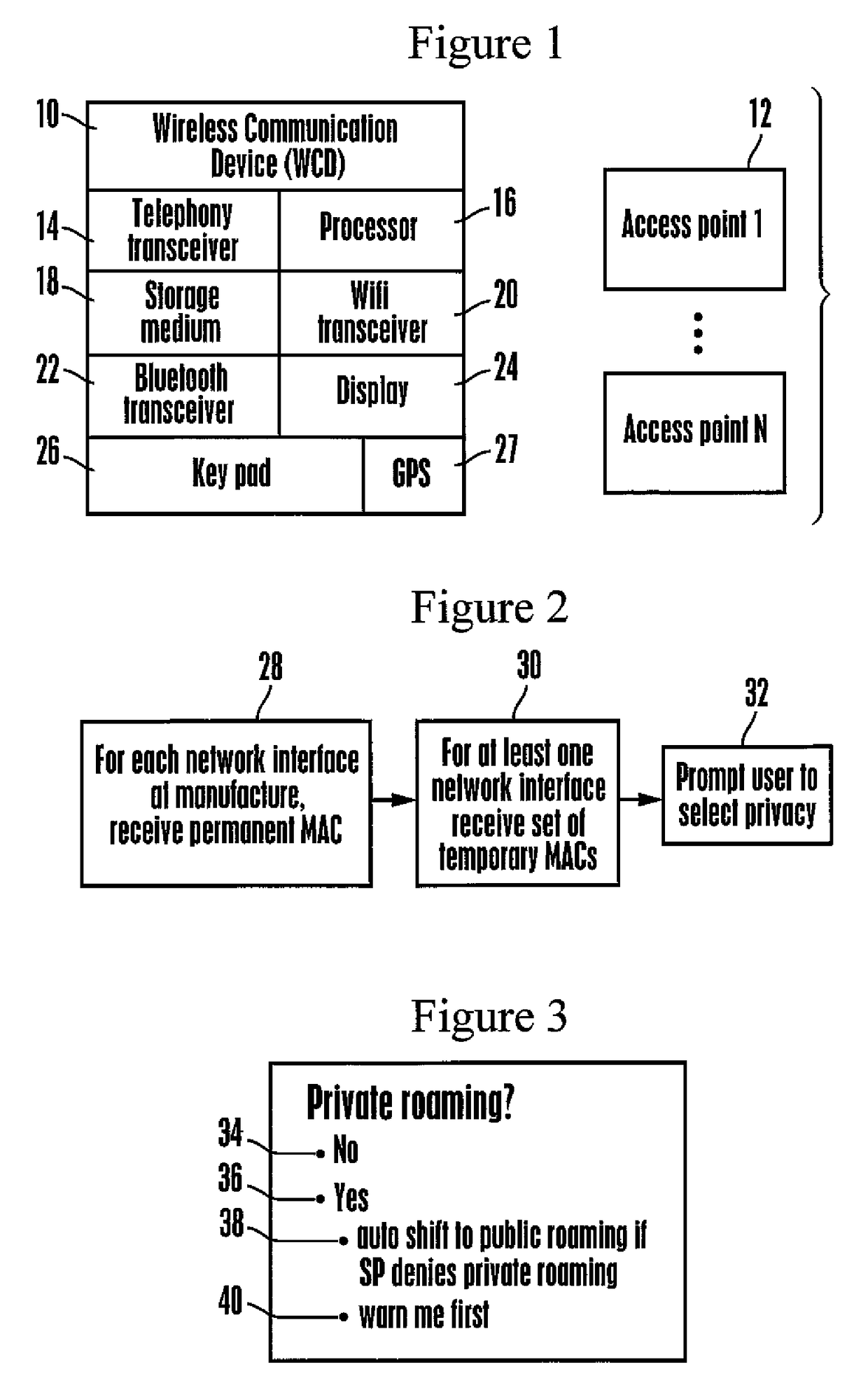
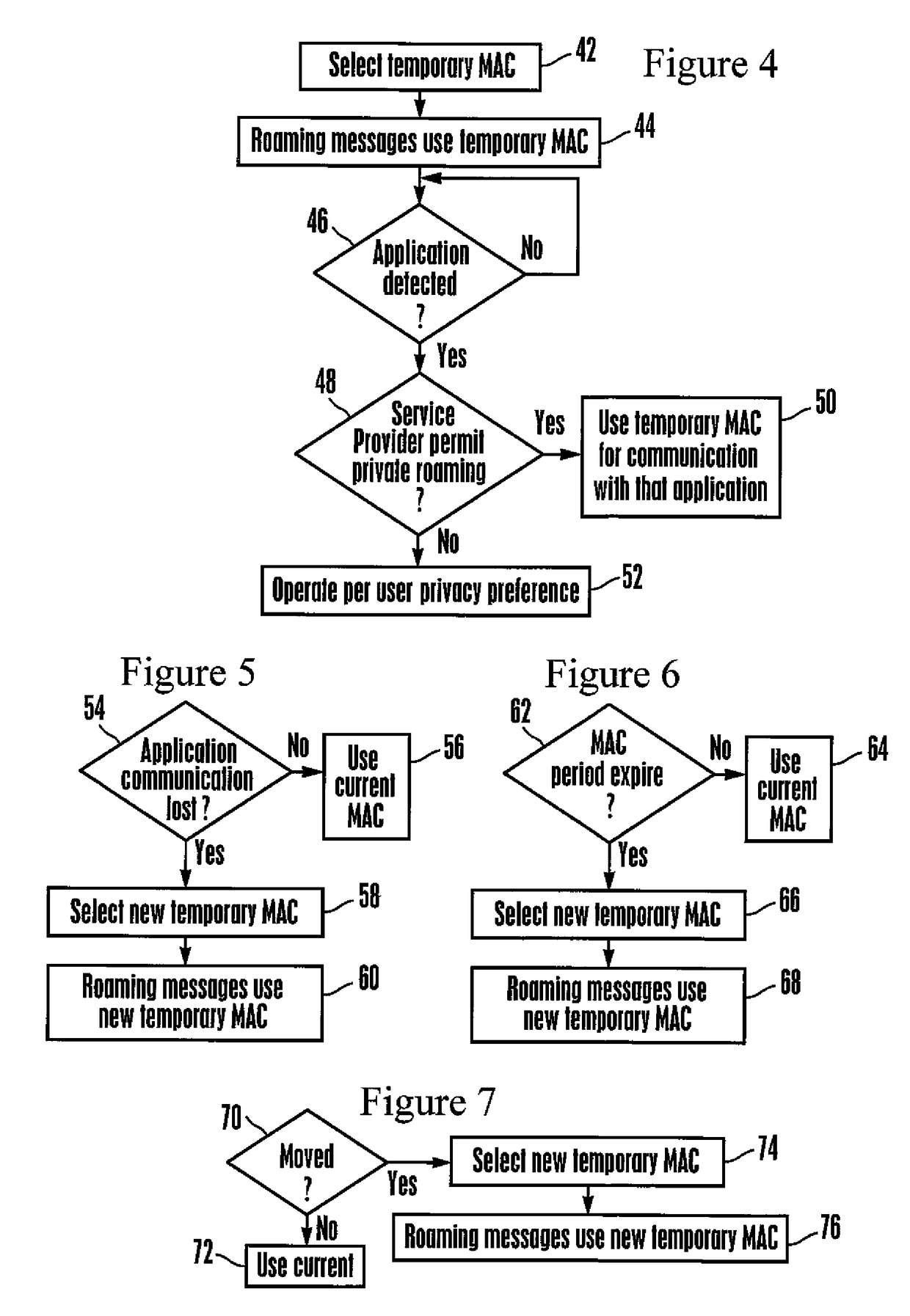
[0018]Present principles recognize a number of possible device behaviors when managing a fixed number of multiple MAC addresses. For example, whenever a public WAP is pinged while roaming around, when changing from one WAP to a different WAP, a different MAC from the group of MACs may be used. Further, the device may maintain the MAC for a period of time, e.g. 4 hours or 8 hours, before changing to another one. However, keeping the period of time short, e.g. 10 minutes, would keep a retailer from using tracking during a store visit which would typically be much long. Keeping the MAC stable may facilitate the hand-off from one WAP to another in case the device is in an active session and moving around (e.g., which may preserve the IP address). Also, if a device is in an active session, then the MAC could be made to not change during a hand-off from one WAP to another. Further still, present principles may recognize that devices may periodically log-out and back in to a WAP with a different MAC address. A device can therefore do this every 10 or 15 minutes and be hardly noticed by the user since a device can do this fairly rapidly taking a couple of seconds.
[0024]On the other hand, the instructions when executed by the processor may further configure the processor for using the permanent address for communication of user voice and / or user data messages through the wireless transceiver responsive to a signal from a WAP to use the permanent address. In this case one of the temporary addresses can be used for communication of user voice and / or user data messages through the wireless transceiver in the absence of a signal from a WAP to use the permanent address.



 Login to View More
  Login to View More