
Metallothionein gene MT18, metallothionein encoded by metallothionein gene MT18, and expression and application thereof
A technology of metallothionein and gene encoding, which is applied in the field of metallothionein and its expression and application, can solve the problems of less research on metallothionein, achieve great application potential, good tolerance to heavy metals, and obvious enrichment effect Effect
Patent Information
- Authority / Receiving Office
- CN · China
- Current Assignee / Owner
- Publication Date
- 2019-06-07
Smart Images
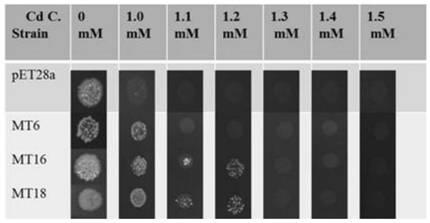
Figure 1 
Figure 2
Abstract
Description
technical field
[0001] The invention belongs to the technical field of genetic engineering, and specifically relates to a metallothionein gene, a metallothionein encoded by the gene, expression and application thereof. Background technique
[0002] Metallothionein (MT for short) is a class of metal-binding proteins ubiquitous in living organisms. Metallothionein is a low molecular weight protein with metal binding capacity and high inducibility properties. A cysteine-rich short peptide with a high affinity for various heavy metals. It is a low molecular weight protein with a very high content of cysteine residues and metals. The metals combined with it are mainly cadmium, copper and zinc, which widely exist in various organisms from microorganisms to humans, and their structures are highly conserved.
[0003] Heavy metal bioremediation is a technology that uses biological materials for heavy metal treatment, and heavy metal resistance genes are important resources for b...
Examples
Embodiment 1
[0028] The process of obtaining metallothionein gene screening:
[0029] S1. Contaminate the soil with copper solution, and cultivate it at a constant temperature of 25 degrees in the dark for 14 days;
[0030] S2. Use a commercial DNA extraction kit (DNeasy PowerMax Soil Kit) to operate in accordance with the procedures specified in its instructions to extract the whole genome of the soil, and determine the DNA quality by gel electrophoresis;
[0031] S3. Submit commercial sequencing and use the second-generation Illumia sequencing platform HiSeq to fully sequence the genome
[0032] S4. Quality inspection, filtering, and assembly of sequencing sequences by general bioinformatics methods
[0033] S5. Search all relevant metallothionein gene sequences from the public gene database UniProt and GenBank
[0034] S6. Manually check the reliability of the metallothionein gene sequence, summarize the reliable metallothionein gene sequence after numbering, and form the metallothion...
Embodiment 2
[0038] 9.1 The highly reliable metallothionein gene sequence MT18 was chemically synthesized to obtain a highly reliable suspected metallothionein sequence as shown in SEQ ID NO: 2 (completed by the commercial company GENEWIZ, Suzhou). The high reliability The suspected metallothionein sequence was directly connected to the pET28a(+) plasmid, and the plasmid was transformed into the host Escherichia coli (E.coli) BL21 (DE3) by electroporation to obtain a transformed strain;
Embodiment 3
[0040] Detailed procedure for functional verification.
[0041] 9.2 Minimum Inhibitory Concentration (MIC), evaluate the MIC value of Cd by measuring the growth ability of bacterial cells in medium with different Cd concentrations. First, MT18 containing transformed strains and its corresponding blank control (empty pET28a(+)) were grown overnight at 29° C. on Lauria Bertani (LB)-agar plates. Then, the recombinant plasmids containing the bacterial colonies were diffused into cells containing various concentrations (0-16mM) of Cd (including kanamycin (50mg / L)) and inducer (IPTG-Isopropyl-B-D-1-thiogalactopyranoside, 100mg / L ) in the LB-plate. ) to determine their MIC.
[0042] Determination of blank control Escherichia coli Escherichia coli (E.coli) BL21 (DE3), Cd minimum inhibitory concentration, the DropAssay test measures the Escherichia coli BL21 (DE3); see figure 1 , when the Cd concentration was 1.0mmol / L, the blank control Escherichia coli Escherichia coli (E.coli) BL...