
Preparation and characterization of polyethyleneglycol/polyesters as biocompatible thermo-sensitive materials
Patent Information
- Authority / Receiving Office
- US · United States
- Patent Type
- Applications(United States)
- Current Assignee / Owner
- Publication Date
- 2007-09-20
- Estimated Expiration
- Not applicable · inactive patent
Smart Images
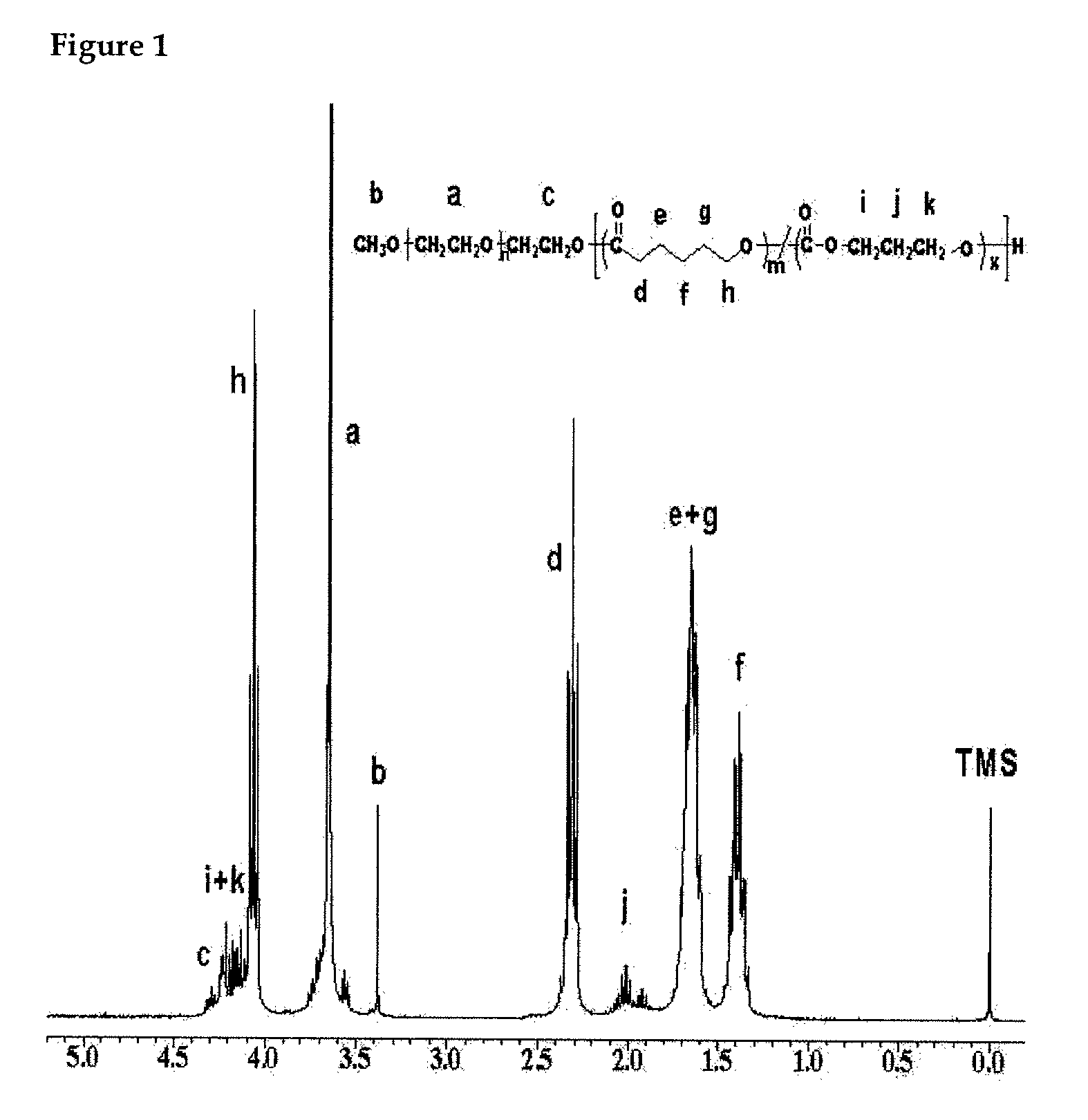
Figure 1 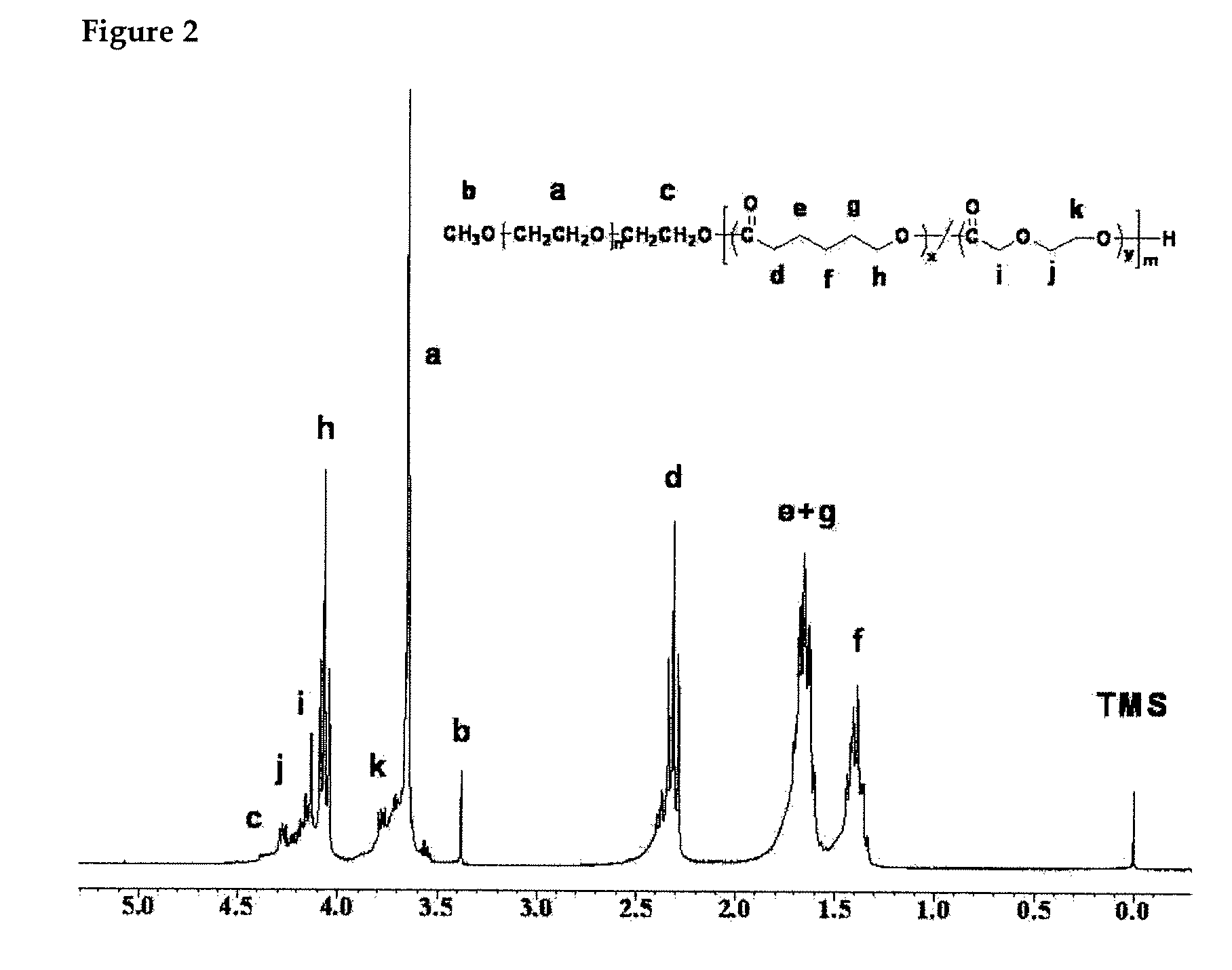
Figure 2 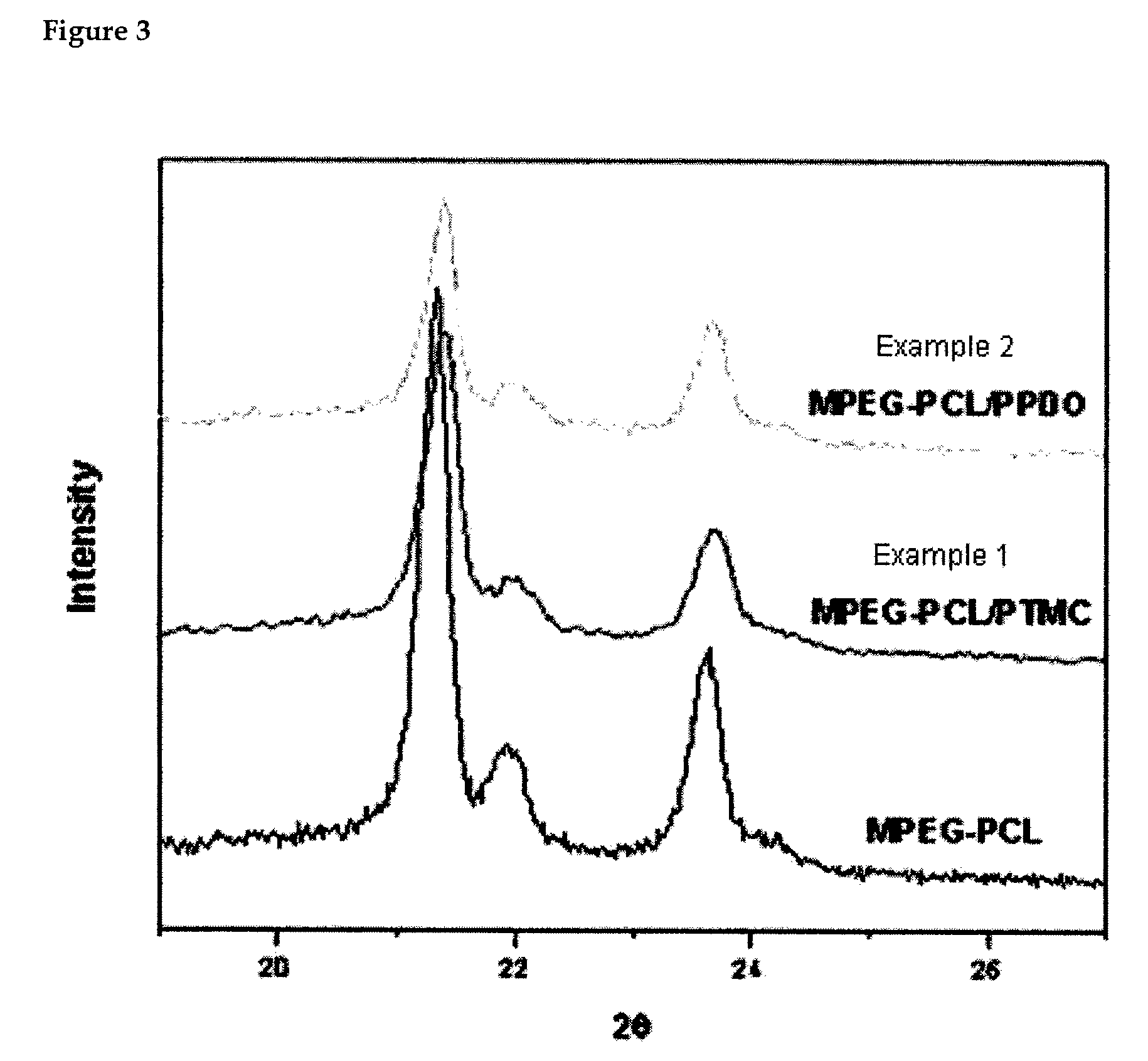
Figure 3
Abstract
Description
TECHNICAL FIELD
[0001] The present invention relates to a biocompatible and thermosensitive poly(ethylene glycol) / polyester block copolymer and the preparation method thereof, and particularly to a multi-functional intelligent hydrogel polymer comprising a hydrophilic part of a poly(ethylene glycol) (PEG) having a low molecular weight and a hydrophobic part comprising an ester-based caprolactone (CL) segment as an essential ingredient and further comprising a para-dioxanone (PDO) segment, a trimethylene carbonate (TMC) segment or a PDO / TMC copolymer containing the PDO and the TMC segments in a predetermined ratio, which easily forms a desired-shaped gel and decomposes or disperses without necessitating the operation process for removing the gel due to the temperature-dependent phase transition caused by the coagulation and the expansion of polymer micelles comprising a hydrophilic part and a hydrophobic part, thus being applicable to a drug delivery system or a porous support for tiss...
Examples
example 1
Preparation of methoxypoly(ethylene glycol)-(polycaprolactone-co-polytrimethylene carbonate) Block Copolymer [MPEG-PCL / PTMC]
[0033]For preparing MPEG-PCL / PTMC block copolymer having a molecular weight of 3,150 g / mole, 1.7 g (2.26 mmol) of methoxypoly(ethylene glycol) (MPEG) as an initiator and 80 mL of toluene were placed in a well-dried round flask (100 mL), and an azeotropic distillation was performed for 3 hours at 130° C. using a Dean-Stark trap. After the distillation, toluene was completely removed, and methoxypoly(ethylene glycol) (MPEG) was cooled down to room temperature. 5.15 Gram (2.26 mmol) of pre-distilled caprolactone (CL) and 0.27 g (2.25 mmol) of trimethylene carbonate (TMC) were added, and 25 mL of pre-distilled methylene chloride (MC) was also added as a reaction solvent. After 4 mL of HCl was added as a polymerization catalyst, the solution was stirred for 24 hours at room temperature. All the steps were performed under high purity nitrogen. After the reaction was ...
example 2
Preparation of methoxypoly(ethylene glycol)-(polycaprolactone-co-polypara-dioxanone) block copolymer [MPEG-PCL / PPDO]
[0035]For preparing MPEG-PCL / PPDO block copolymer having a molecular weight of 3,150 g / mole, 1.67 g (2.24 mmol) of methoxypoly(ethylene glycol) (MPEG) as an initiator and 80 mL of toluene were placed in a well-dried round flask (100 mL), and an azeotropic distillation was performed for 3 hours at 130° C. using a Dean-Stark trap. After the distillation, toluene was completely removed, and methoxypoly(ethylene glycol) (MPEG) was cooled down to room temperature. 5.11 Gram (2.24 mmol) of pre-distilled caprolactone (CL) and 0.38 mL (2.24 mmol) of para-dioxanone (PDO) were added, and 25 mL of pre-distilled methylene chloride (MC) was also added as a reaction solvent. After 4 mL of HCl was added as a polymerization catalyst, the solution was stirred for 24 hours at room temperature. All the steps were performed under high purity nitrogen. After the reaction was completed, to ...
example 3
Measurement of Sol-Gel Phase Transition Behavior of poly(ethylene glycol) / biodegradable Polyester Block Copolymer as a Function of Time in an Aqueous Solution
[0037]To observe the phase transition behavior of poly(ethylene glycol) / biodegradable polyester copolymer as a function of temperature, each of the synthesized copolymer was dissolved in distilled water into the concentration of 20 wt %, and cold-stored at 4° C. for a day to maintain the equilibrium of uniformly dispersed polymer. The sol-gel phase transition behavior of thus prepared polymer solution was measured with a viscometer by elevating the temperature (1° C. per 3 minutes) from 10° C. to 55° C. at a fixed spin rate of 0.2 rpm (FIG. 5).