Method for preparing citronellyl by bioconversion in non-aqueous phase system

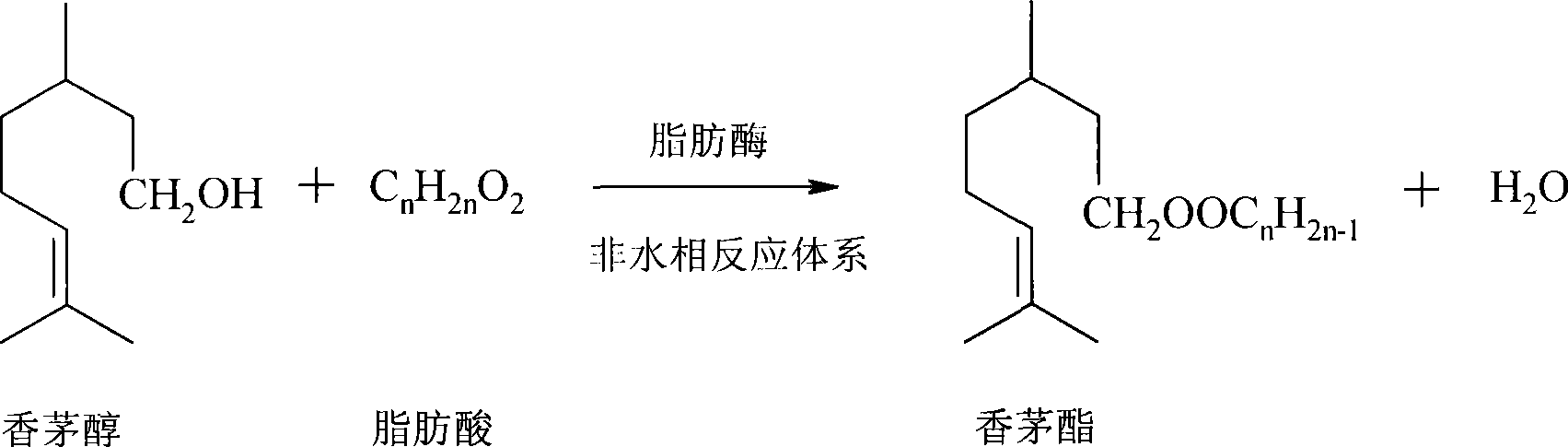
A citronellyl ester and non-aqueous phase technology is applied in the fields of biocatalysis and biosynthesis of fragrance esters, which can solve the problems of difficult separation of products, high energy consumption, environmental problems, etc., and achieves simple operation procedures, high reaction selectivity, and strong environmental protection. effect of concept

CN101457240AInactive Publication Date: 2009-06-17JIANGNAN UNIV
3 Cites 4 Cited by

Patent Information

Authority / Receiving Office
CN · China
Patent Type
Applications(China)
Current Assignee / Owner
Publication Date
2009-06-17
Estimated Expiration
Not applicable · inactive patent

Smart Images

  • Figure 1
    Figure 1
Patent Text Reader

Abstract

steps: employing an organic phase reaction system when reacted substrate fatty acids are saturation short chain fatty acids with a carbone chain length of C2-C4 and C12 high boiling long chain fatty acids, employing an non-solvent reaction system when reacted substrate fatty acids are saturation middle chain fatty acids with a carbone chain length of C5-C10, conversing and preparing a plurality of citronellyl esters materials by changing the ratio of alcohol to acid and the system water activity methods, obtaining products with a yield of 95 0n a short time. The invention has advantages of novel products, mild reaction temperature and environment friendly, moreover the reaction has selectivity and controllability, the reaction process is easy, the outcomes are easy to separate and the product quality is higher. The method of the invention has positive social benefit and economic value.
Need to check novelty before this filing date? Find Prior Art

Description

technical field

[0001] A method for preparing citronellyl esters through biotransformation in a non-aqueous phase system, which involves the technology of producing citronellyl esters efficiently catalyzed by Rhizopus chinensis CCTCC M 201021 lipase with independent intellectual property rights in a non-aqueous phase reaction system. The invention belongs to the technical field of biocatalysis and biosynthesis of perfume esters. Background technique

[0002] Citronellol, a terpene compound, is a very important essence and fragrance substance, which exists in many kinds of essential oils in nature. Its series of esters have their unique floral and fruity aroma (for example, citronellyl acetate has a lemon-like fresh fruit aroma, and citronellyl caproate has a more elegant rose aroma), and is widely used in food, beverage, cosmetic and pharmaceutical industries. It has important application value and broad application prospect in this field.

[0003]

[0004] Traditionall...

Examples

Embodiment 1

[0022] 0.20 g of lipase (180 U) was added into 10 mL of heptane containing equimolar 0.4 mol / L citronellol and acetic acid, and reacted at 40° C. for 48 hours, and the reaction conversion rate reached 98%. After vacuum distillation at -0.08MPa pressure, the product citronellyl acetate was obtained.

Embodiment 2

[0024] 0.20 g of lipase (180 U) was added into 10 mL of heptane containing equimolar 0.8 mol / L citronellol and propionic acid, and reacted at 40° C. for 48 h, the reaction conversion rate reached 98%. The product citronellyl propionate was obtained by vacuum distillation under the pressure of -0.08MPa.

Embodiment 3

[0026] Add 0.20 g of lipase (180 U) into 10 mL of heptane containing citronellol and butyric acid at an equimolar concentration of 1.2 mol / L, and react at 40° C. for 48 h, and the reaction conversion rate reaches 98%. The product citronellyl butyrate was obtained by vacuum distillation under the pressure of -0.08MPa.