
On-stream method of residual oil hydrogenation process
A technology for residual oil hydrogenation and process, which is applied in the directions of chemical instruments and methods, catalyst activation/preparation, physical/chemical process catalysts, etc., and can solve the problems of on-time start-up of residual oil hydrogenation units, increased production costs, and increased processing costs, etc. problems, to achieve the effect of reducing human body damage, reducing usage, and uniform pre-vulcanization process
- Summary
- Abstract
- Description
- Claims
- Application Information
AI Technical Summary
Problems solved by technology
Method used
Image

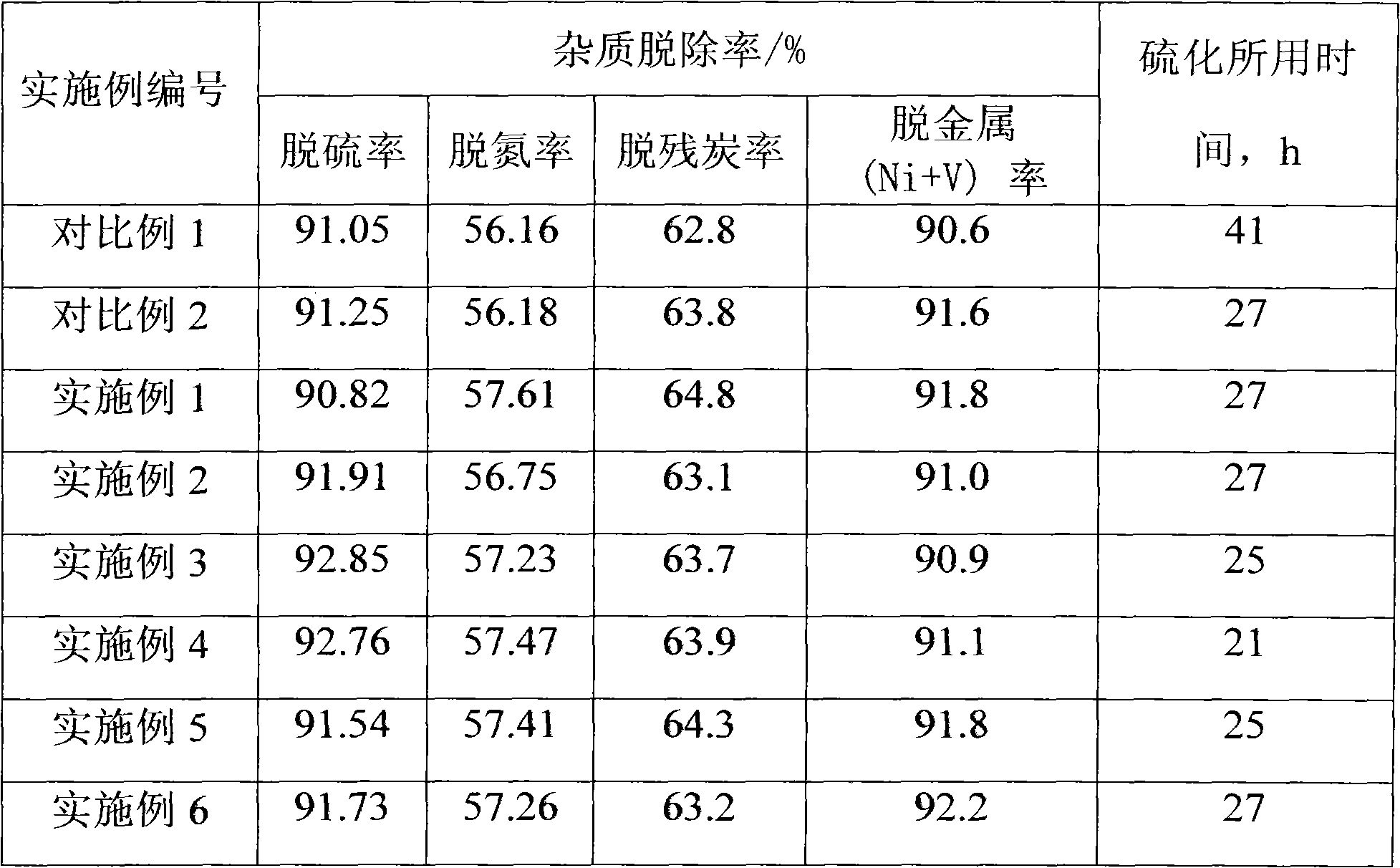
Examples
Embodiment 1
[0050] 50g of FZC-102 and 100g of FZC-30 are respectively immersed in 10g and 15g of organic solvent (organic solvent is coking kerosene fraction), the proportion of carbon atoms in the organic solvent is not less than 50%, and the immersion time is 1 hour. The vulcanizing agent used in the FZC-102 catalyst is 10g of elemental sulfur and 2.5g (NH 4 ) 2 S mixture, the vulcanizing agent that FC-30 catalyst uses is elemental sulfur 20g and 5g (NH 4 ) 2 S mixture. The impregnated FZC-102 and FZC-30 were mixed with corresponding vulcanizing agents respectively, and treated at 170°C for 3 hours, and cooled naturally. The obtained presulfurized catalyst, presulfurized FZC-102 catalyst and presulfurized FZC-30 catalyst, oxidized state FZC-20 and oxidized state FZC-40 catalyst are divided into small-sized reactors (contact FZC-102 earlier by reaction materials, Then contact with FZC-20 and contact with FZC-30, and finally contact with FZC-40 in the order of filling, other embodimen...
Embodiment 2
[0052] 50g of FZC-102 and 100g of FZC-40 are respectively immersed in 10g and 15g of organic solvent (organic solvent is coking kerosene fraction), the ratio of carbon number 9 to 12 in the organic solvent is not less than 50%, and the immersion time is 1 hour. The vulcanizing agent used in the FZC-102 catalyst is 10g of elemental sulfur and 2.5g (NH 4 ) 2 S mixture, the vulcanizing agent that FC-40 catalyst uses is the (NH 4 ) 2 S mixture. The impregnated FZC-102 and FZC-40 were mixed with corresponding vulcanizing agents respectively, and treated at 170°C for 3 hours, and cooled naturally. The obtained presulfided catalyst, presulfurized FZC-102 catalyst and presulfided FZC-40 catalyst, oxidized state FZC-20 and oxidized state FZC-30 catalyst are divided into small reactors according to the order of embodiment 1, and the airtightness is qualified. Start to raise the temperature at 20°C / h, rise to 220°C, and keep the temperature constant for 8 hours. End the constant tem...
Embodiment 3
[0054] 50g of FZC-102 and 100g of FZC-30 are respectively immersed in 15g and 20g of organic solvents (organic solvents are coking kerosene fractions), the proportion of carbon atoms 9-12 in the organic solvents is not less than 50%, and the immersion time is 1 hour. The vulcanizing agent that FZC-102 catalyst uses is elemental sulfur 15g and 3.5g (NH 4 ) 2 S mixture, the vulcanizing agent that FC-30 catalyst uses is elemental sulfur 15g and 4g (NH 4 ) 2 S mixture. The impregnated FZC-102 and FZC-30 were mixed with corresponding vulcanizing agents respectively, and treated at 170°C for 3 hours, and cooled naturally. The obtained presulfided catalyst, the presulfurized FZC-102 catalyst, the presulfided FZC-30 catalyst, the oxidized state FZC-20 and the oxidized state FZC-40 catalyst are divided into small reactors according to the order of Example 1, and the airtightness is qualified , start to raise the temperature at 20°C / h, rise to 220°C, and keep the temperature constan...
PUM
| Property | Measurement | Unit |
|---|---|---|
| diameter | aaaaa | aaaaa |
Abstract
Description
Claims
Application Information
 Login to View More