
Method for detecting quality of large-diameter tubular pile at low strain
A quality inspection method and technology for large-diameter pipes, which can be used in infrastructure testing, construction, and infrastructure engineering, etc., can solve the problem of low-quality large-diameter pipe piles, achieve high measurement accuracy, low measurement costs, and eliminate high-frequency interference The effect of the wave problem
- Summary
- Abstract
- Description
- Claims
- Application Information
AI Technical Summary
Problems solved by technology
Method used
Image

Examples
Embodiment Construction
[0027] A method for detecting the low-strain quality of large-diameter pipe piles, comprising the following technical steps:
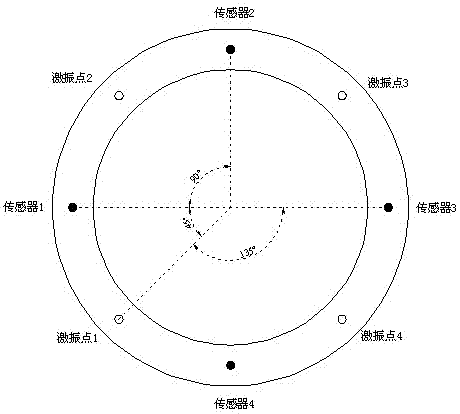
[0028] (1) if figure 1 As shown, four acceleration sensors are evenly arranged on the top of the pipe pile. The included angle between the central angles corresponding to the adjacent acceleration sensors is 90°.
[0029] (2) Connect each acceleration sensor to a multi-channel low-strain measuring instrument.
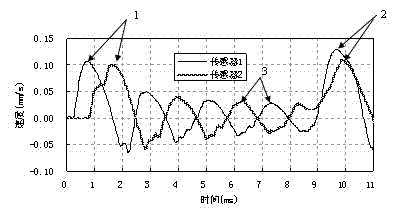
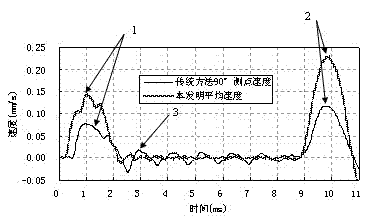
[0030] (3) Apply the exciting force at a position where the angle between the center angle of one acceleration sensor is 45° and the angle between the center angle of the other acceleration sensor is 135°, such as figure 1 The location of the excitation point 1, the excitation point 1 generates a stress wave after being subjected to the excitation force, and the stress wave propagates symmetrically in clockwise and counterclockwise directions along the circumference of the pile wall.
[0031] (4) The stress wave first reaches the position o...
PUM
 Login to View More
 Abstract
Description
Claims
Application Information
 Login to View More