

Symbolic execution method, device and system
A technology of symbolic execution and execution strategy, applied in multi-program installation, resource allocation, platform integrity maintenance, etc., can solve problems such as resource exhaustion and path explosion, achieve less memory resources, solve path explosion, and solve resource consumption full effect
- Summary
- Abstract
- Description
- Claims
- Application Information
AI Technical Summary
Problems solved by technology
Method used
Image



Examples
Embodiment 1
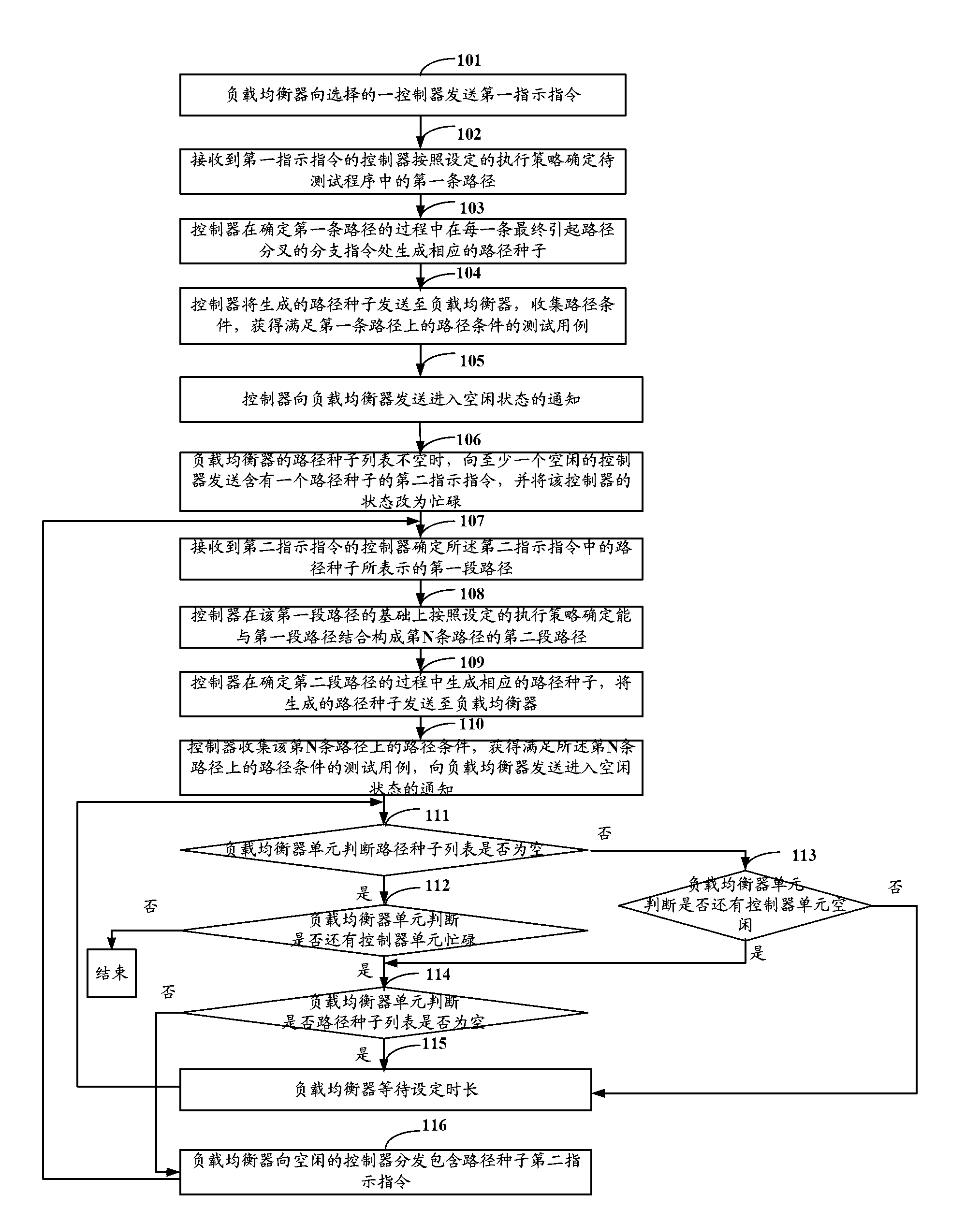
[0045] Such as figure 1 As shown, it is a flow chart of the symbolic execution method in Embodiment 1 of the present invention. The method is applied to a system including a load balancer and at least two controllers, and includes the following steps:
[0046] Step 101: The load balancer sends a first instruction to a selected controller.
[0047] Specifically, at the initial stage, one of the activated controllers receives a first instruction from the load balancer.
[0048] It should be noted that each controller actively establishes a communication channel with the load balancer when starting, and the load balancer marks its state as idle, and in step 101 all controllers do not need to be started at the beginning.
[0049] Step 102: The controller that receives the first indication instruction determines the first path in the program to be tested according to the set execution strategy.
[0050] Specifically, the controller that receives the first instruction can create a...
example 2
[0061]
example 3
[0063] Wherein: Example 2 is a multi-way branch instruction, and Example 3 is a chain of linked two-way branch instructions that equivalently converts the multi-way branch instruction in Example 2, that is, converted into multiple two-way branch instructions.
[0064] Generally, a branch instruction may or may not cause a path fork. In step 103, since there is no need to generate a path seed at a branch instruction that does not cause a path fork, only each branch instruction that eventually causes a path fork does not need to generate a path seed. The corresponding path seeds are generated at the branch instruction of the fork.
[0065] The path seed is a sequential byte stream composed of a set number of elements;
[0066] The element is an orientation representing each branch instruction encountered sequentially in the program path.
[0067] If the symbolic executor process converts the multi-branch instruction into a two-branch instruction, then in step 103, a correspondi...
PUM
 Login to View More
 Abstract
Description
Claims
Application Information
 Login to View More