Novel N-acetylneuraminic acid-producing escherichia coli engineering bacteria as well as construction method and application thereof
A technology of acetylneuraminic acid and Escherichia coli, which is applied in the field of bioengineering, can solve the problems of restricting large-scale promotion and application, inability to apply food and health products, and being expensive
- Summary
- Abstract
- Description
- Claims
- Application Information
AI Technical Summary
Problems solved by technology
Method used
Image

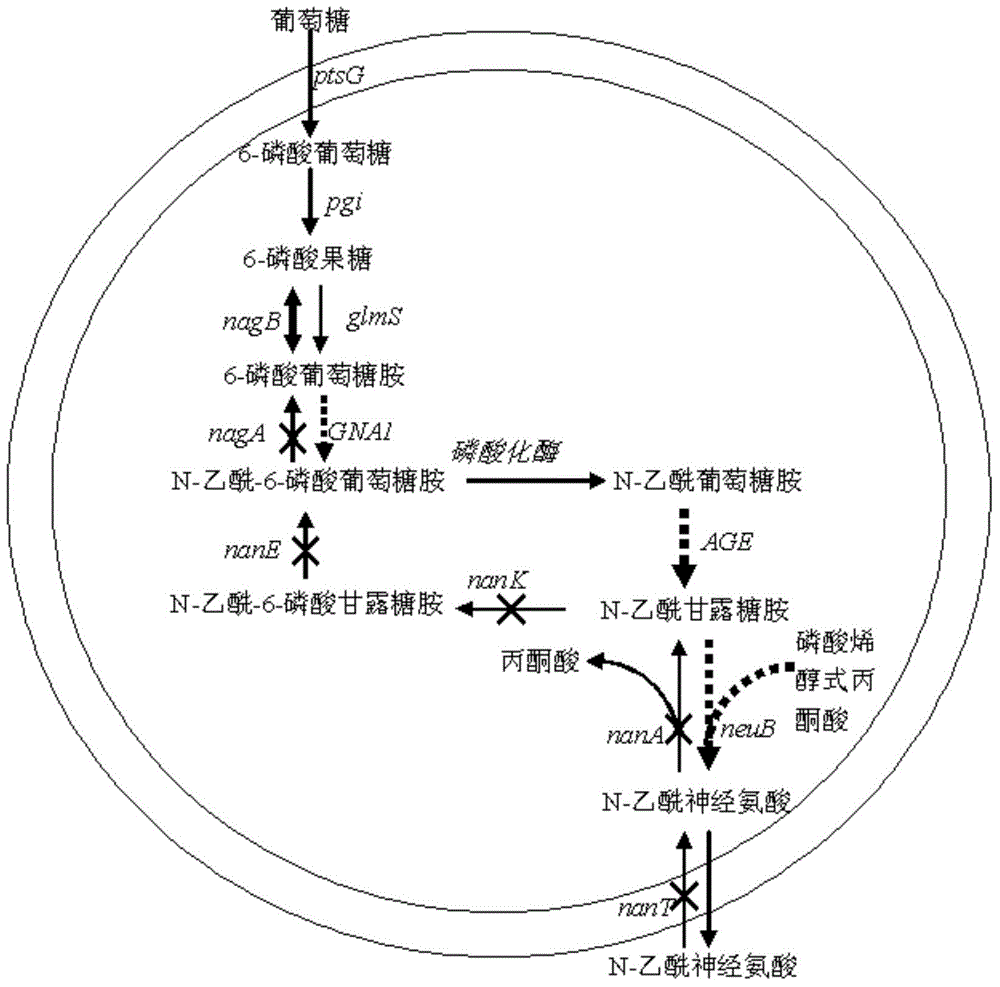


Examples
Embodiment 1
[0040] Embodiment 1: Construction of high-yield N-acetylneuraminic acid genetically engineered bacteria
[0041] 1. Using the RED recombination method to inactivate the nagA gene and nanATEK gene cluster in the strain, the specific
[0042] Proceed as follows:
[0043] 1. Knockout of nagA gene
[0044] 1) According to the sequence of Escherichia coli BL21(DE3) (Invitrogen Company) genome (Genbank No.CP001509), design primers: upstream primer F-KO-nagA:
[0045] TATGCATTAACCCAGGGCCGGATCTTTACCGGCCACGAAATTCCGGGGATCCGTCGACC (shown in SEQ ID NO.1) and downstream primer R-KO-nagA:
[0046] TTGAGTTACGACCTCGTTACCGTTAACGATGGTCCTGGTTGTAGGCTGGAGCTGCTTCG (shown in SEQ ID NO. 2).
[0047] Using the primers F-KO-nagA and R-KO-nagA, using the plasmid pIJ773 as a template, and using commercial PCR reagents, the DNA fragments were amplified by PCR and purified for future use.
[0048] 2) The RED recombinase expression plasmid vector pKD46 was transformed into Escherichia coli BL21(DE3) by ...
Embodiment 2
[0089] Example 2 Glucose is used as carbon source to ferment and produce N-acetylneuraminic acid
[0090] 1. Seed and fermentation medium (1L):
[0091] (NH 4 ) 2 SO 4 4g / L; KH 2 PO 4 6g;K 2 HPO 4 ·3H 2 O 8g; MgSO 4 ·7H 2 O 0.25g; glucose 5g, trace elements 10ml.
[0092] Among them, trace elements are: manganese sulfate 100mg / L; zinc chloride 70mg / L; sodium molybdate 35mg / L; boric acid 60mg / L; cobalt chloride 200mg / L; copper sulfate 29.28mg / L; L; concentrated hydrochloric acid (37%) 0.9ml / L.
[0093] Feed solution: 500g / L glucose.
[0094] 2. Fermentation process:
[0095] 1) Pick a single colony and place it in a 4ml LB test tube, and incubate at 37°C for 8 hours.
[0096] 2) Inoculate 2ml of primary seeds into 200ml of seed culture medium and culture at 37°C for 8-10 hours.
[0097] 3) Secondary seeds are inoculated in a fermenter with a liquid volume of 3.5 L at 37° C., stirring speed is 300-800 rpm, dissolved oxygen is kept above 30%, and pH is controlled a...
Embodiment 3
[0101] Example 3 Glycerol is used as carbon source to ferment and produce N-acetylneuraminic acid
[0102] Replace glucose with glycerol of 20g / L, other components of fermentation medium are the same as embodiment 2, and feeding medium is 600g / L glycerol;
[0103] The fermentation process is the same as in Example 2.
[0104] Finally, after about 80 hours of fermentation, the concentration of N-acetylneuraminic acid produced by CASOV-1 can reach 30g / L; the concentration of N-acetylneuraminic acid produced by CASOV-2 can reach 5g / L.
[0105] The above culture results show that the genetically engineered bacteria constructed by metabolic engineering technology, especially CASOV-1, has the ability to produce N-acetylneuraminic acid and has the potential for industrialization.
[0106]
[0107]
[0108]
[0109]
PUM
 Login to View More
 Abstract
Description
Claims
Application Information
 Login to View More