
Water-soluble paper light stabilizer and preparation and applications thereof
A technology of light stabilizer and hindered amine light stabilizer, which is applied in the field of high-yield pulp light stabilizer, can solve the problem of complex synthesis method of naphthalene imide fluorescent whitening agent, less improvement of initial whiteness of paper, and problems of fluorescent whitening Insufficient effect and other problems, to achieve the effect of good thermo-oxidative stability, simple synthesis method, and strong quenching effect
- Summary
- Abstract
- Description
- Claims
- Application Information
AI Technical Summary
Problems solved by technology
Method used
Image

Examples
Embodiment 1
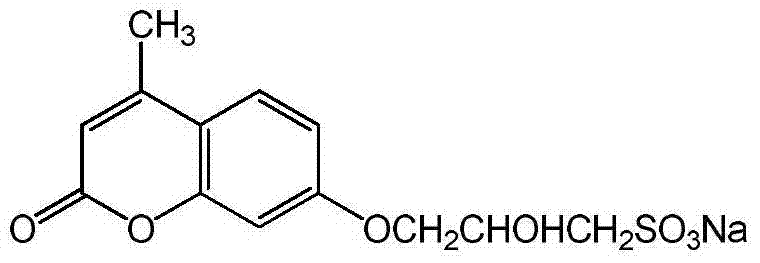
[0025] The light stabilizer synthesized by the present embodiment is a single water-soluble coumarin type optical brightener, and its structural formula is:
[0026]
[0027] The specific steps of synthesizing the photostabilizer of above formula structure are:
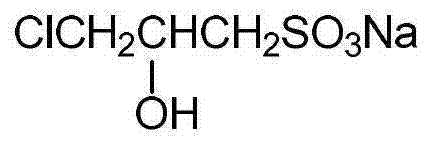
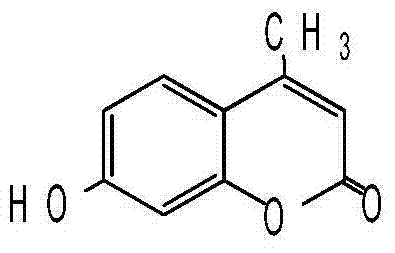
[0028] Add 3-chloro-2-hydroxypropyl sodium sulfonate and 7-hydroxyl-4-methylcoumarin fluorescent whitening agent in the amount of the same substance in the three-necked flask, adjust the pH to 10-11 with sodium hydroxide, React at 35-45°C for 5-7 hours to obtain a mixed solution. After cooling the mixed solution to room temperature, pour it into acetone and let it stand for precipitation. Suction filter the precipitate and dry it in vacuum to obtain a powdery compound with a yield of 82.9%.
[0029] The above-mentioned 3-chloro-2-hydroxypropyl sodium sulfonate can be purchased, and can also be made by yourself: feed sodium bisulfite and epichlorohydrin according to a certain ratio of substances, and adjust it with ...
Embodiment 2
[0035] The light stabilizer synthesized in this embodiment is a single water-soluble hindered amine light stabilizer, and its structural formula is:
[0036]
[0037] The specific steps for synthesizing the light stabilizer with the above formula structure are: add a certain amount of 3-chloro-2-hydroxypropyl sodium sulfonate aqueous solution and 1,2,2,6,6- Pentamethylpiperidinamine, adjust the pH to 9-10 with sodium hydroxide, react at 25-35°C for 4-6h to obtain a mixed solution, cool the mixed solution to room temperature, pour it into acetone and let it settle, and pump the precipitate After filtration and vacuum drying, the powdery compound was obtained with a yield of 83.3%.
[0038] The infrared identification results of the synthetic product are as follows: From the infrared spectrum of the synthetic product, it can be seen that the characteristic peak of the functional group in the molecular structure of the target product is 3347cm -1 The stretching vibration peak...
Embodiment 3
[0040] The light stabilizer synthesized in this embodiment is a water-soluble hindered amine light stabilizer, and its structural formula is:
[0041]
[0042] The specific steps for synthesizing the light stabilizer with the above formula structure are: add a certain amount of 3-chloro-2-hydroxypropyl sodium sulfonate aqueous solution and 1,2,2,6,6- Pentamethylpiperidinol, adjust the pH to 10-11 with sodium hydroxide, react at 35-45°C for 5-6h to obtain a mixed solution, cool the mixed solution to room temperature, pour it into acetone and let it stand for precipitation, and pump the precipitate After filtration and vacuum drying, the powdery compound was obtained with a yield of 80.6%.
[0043] The infrared identification results of the synthetic product are as follows: From the infrared spectrum of the synthetic product, it can be seen that the characteristic peak of the functional group in the molecular structure of the target product, 3361cm -1 The stretching vibratio...
PUM
 Login to View More
 Abstract
Description
Claims
Application Information
 Login to View More