A Prestressed Tendon Element with Inelastic Shrinkage
A prestressed tendon, inelastic technology, applied in the field of mechanics, can solve problems such as inability
- Summary
- Abstract
- Description
- Claims
- Application Information
AI Technical Summary
Problems solved by technology
Method used
Image

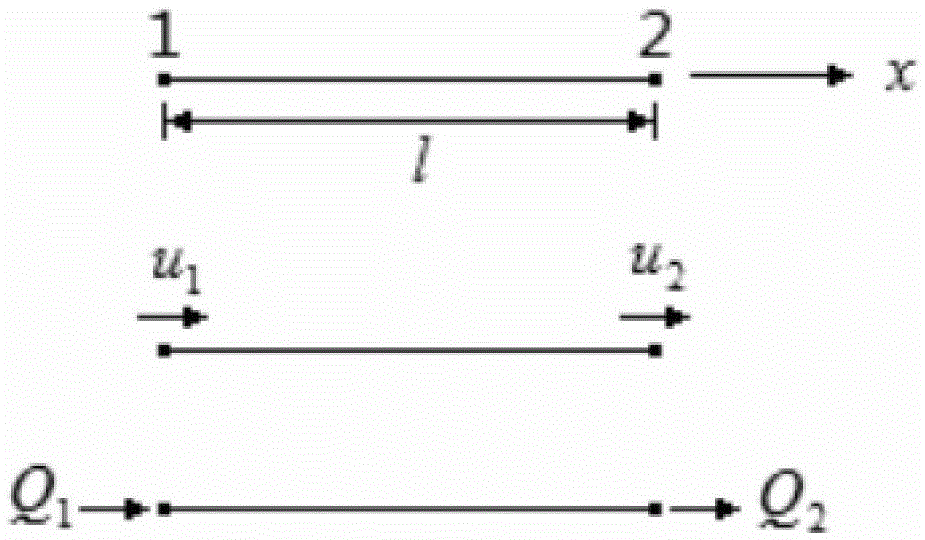


Examples
Embodiment 1
[0109] Statically indeterminate truss:
[0110] for image 3 For the planar truss structure shown, the cross-sectional area of each rod is A=0.002m 2 , elastic modulus E=200GPa, fixed hinge support at node 1, and movable hinge support with vertical constraints at node 2. Now it is desired to stretch a prestressed tendon with the same cross-sectional area and material as other rods between nodes 1 and 5, and between nodes 2 and 3 (such as Figure 4 ), and the tensile stress is 100MPa. After the prestress is applied, a vertical downward concentrated force of 1000kN is applied to nodes 3, 5, and 6.
[0111] Using two-node truss elements, different methods are used to simulate the mechanical state of the structure plus prestressed tendons after tension.
[0112] (1) Using the equivalent load method, the calculation model is image 3 , a relative tensile force equivalent to the prestress can be applied between nodes 1 and 5, and between nodes 2 and 3: F=Aσ=200kN. The calcula...
Embodiment 2
[0127] plane problem
[0128] Such as Figure 5 and Figure 6 The simply supported beam of the planar problem shown, the structural size is 1.2x0.2m, the thickness is 0.01m, and the modulus of elasticity of concrete is E c =2e10Pa, Poisson's ratio μ c =0.1667, now it is desired to stretch a prestressed tendon at a distance of 0.02m from the lower boundary, and the cross-sectional area of the tendon is A=0.0001m 2 , the steel elastic modulus E s =2e11Pa, Poisson's ratio μ s =0.3, the thermal expansion coefficient of the material is α=1.0e-5 / ℃, the rib unit is divided into 6 equal parts, and the tensile stresses of each section from left to right are 200MPa, 210MPa, 220MPa, 20MPa, 240MPa, 250MPa, in the prestress After the application is completed, continue to apply a vertical downward concentrated force of 10kN on each node of the upper boundary. Three methods are used (four-node elements are used for planar elements) to simulate the mechanical state of the structure pl...
Embodiment 3
[0150] space problem
[0151] Such as Figure 7 and Figure 8 The simply supported beam shown in the plane problem has a structural size of 1.2x0.2m, a thickness of 0.01m, and a concrete modulus of elasticity E c =2e10Pa, Poisson's ratio μ c =0.1667, now it is desired to stretch a prestressed tendon at a distance of 0.02m from the lower boundary, and the cross-sectional area of the tendon is A=0.0001m 2 , the steel elastic modulus E s =2e11Pa, Poisson's ratio μ s =0.3, the thermal expansion coefficient of the material is α=1.0e-5 / ℃, and the tensile stresses of the 01, 12, 23, 34, 45, and 56 sections are 200MPa, 210MPa, 220MPa, 20MPa, 240MPa, respectively. 250MPa; After the prestress tension is completed, a vertically downward concentrated load of 10kN is applied to each of the three nodes on the upper surface of the beam span that is equally divided along the thickness. The concrete adopts 20-node space unit, and the prestressed tendon is divided into 12 units equally ...
PUM
 Login to View More
 Abstract
Description
Claims
Application Information
 Login to View More