AI technical title is built by PatSnap AI team. It summarizes the technical point description of the patent document.
A collaborative optimization and blind equalization technology, applied in the field of signal processing, can solve problems such as reduced convergence speed and slow convergence speed
Inactive Publication Date: 2017-02-15
NANJING UNIV OF INFORMATION SCI & TECH
View PDF3 Cites 0 Cited by
Summary
Abstract
Description
Claims
Application Information
AI Technical Summary
This helps you quickly interpret patents by identifying the three key elements:
Problems solved by technology
Method used
Benefits of technology
Problems solved by technology
However, this method also has some shortcomings in practical applications: (1) the convergence speed is slow when optimizing in large-scale search areas or changing flat search areas; (2) when searching complex spaces, the initial search convergence speed is fast, and the search The late convergence speed is greatly reduced; (3) In the search process of high-dimensional large-scale complex spaces, it is easy to fall into "premature" local extreme points
Method used
the structure of the environmentally friendly knitted fabric provided by the present invention; figure 2 Flow chart of the yarn wrapping machine for environmentally friendly knitted fabrics and storage devices; image 3 Is the parameter map of the yarn covering machine
View more
Image
Smart Image Click on the blue labels to locate them in the text.
Viewing Examples
Smart Image
Click on the blue label to locate the original text in one second.
Reading with bidirectional positioning of images and text.
Smart Image
Examples
Experimental program
Comparison scheme
Effect test
specific Embodiment approach
[0043] Below in conjunction with accompanying drawing, technical scheme of the present invention is described in further detail:
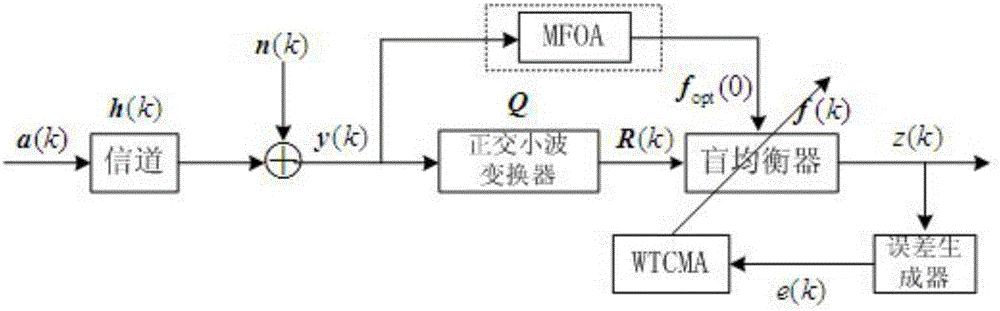
[0044] like figure 1 As shown, the principle of a multi-fruit fly swarm collaborative optimization wavelet norm blind equalization method, MFOA (Multi-fruitFliesOptimization Algorithm) is a multi-fruit fly swarm collaborative optimization method. The MFOA part is removed in the figure, and the rest is the wavelet norm blind equalization method WTCMA. The invention firstly provides the single fruit fly swarm optimization method SFOA and analyzes its performance; secondly, introduces co-evolution into SFOA, and proposes a multi-drosophila swarm cooperative optimization method MFOA; thirdly, uses MFOA to optimize the wave norm blind equalization method WTCMA.
[0046] like figure 1 As shown, a(k) is the transmitted signal, h(k) is the channel impulse response, n(k) is the channel noise, y(k) is ...
Embodiment
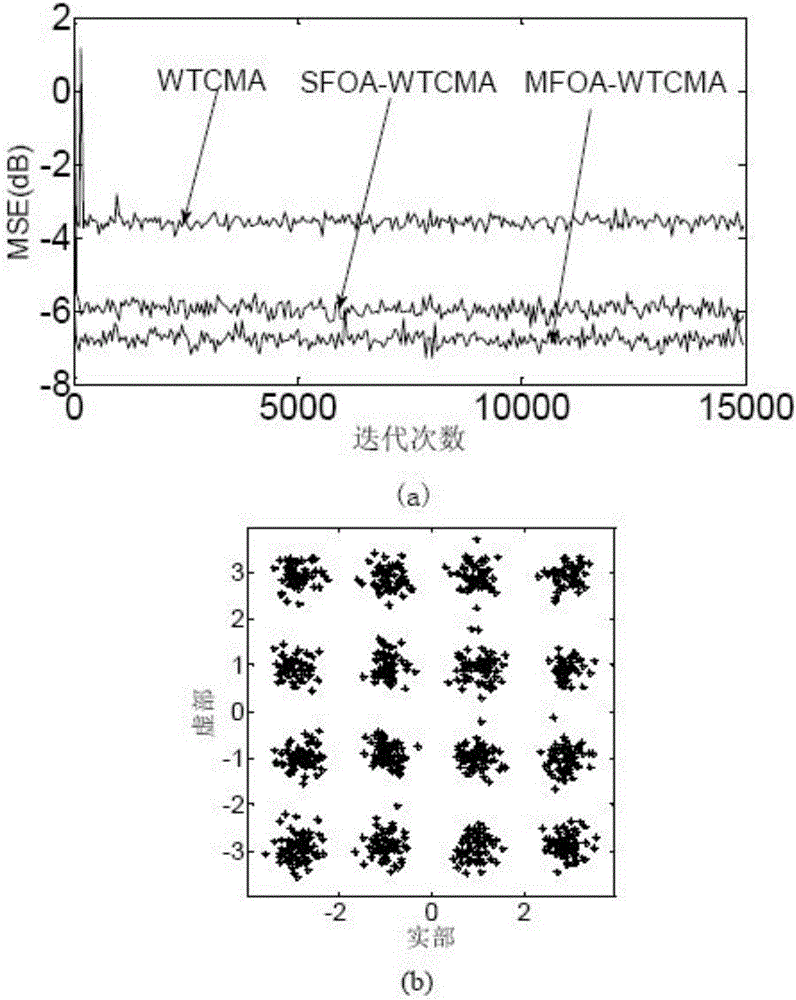
[0100] In order to test the performance of the method MFOA-WTCMA of the present invention, the minimum mean square error curve (MSE) is used as the performance index, and the simulation experiment is carried out with WTCMA and SFOA-WTCMA as comparison objects.
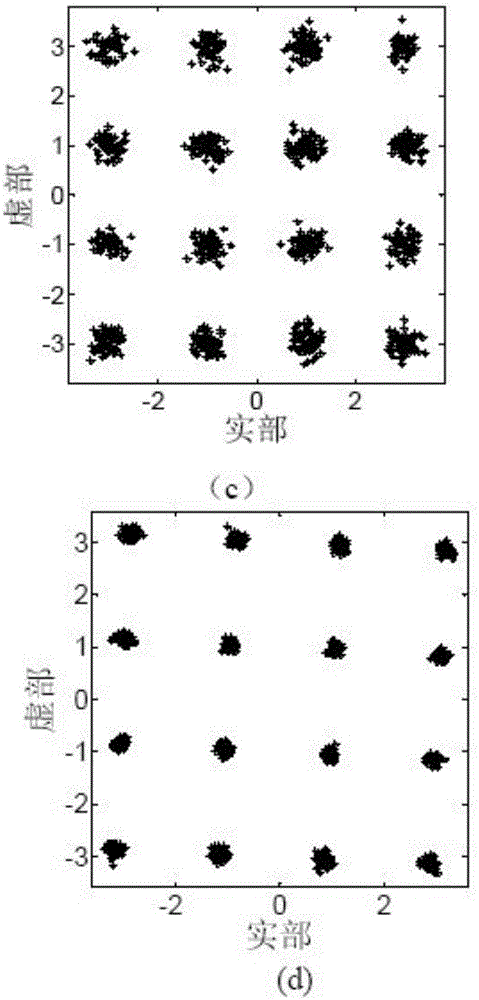
[0101] The transmitted signal is 16QAM, the equalizer weight length is 16, the signal-to-noise ratio is 25dB, and the minimum phase underwater acoustic channel h=[0.9656,-0.0906,0.0578,0.2368] is used; the fruit fly population is 2, and the fruit fly population size is 100. Drosophila initialization position [-0.1,0.1], Drosophila population iteration step value [-0.05,0.05], the maximum evolutionary generation is 200; the step size of SFOA-WTCMA μSFOA-WTCMA =0.0035, step size of MFOA-WTCMA μMFOA-WTCMA =0.0035; use DB2 wavelet to decompose, the number of decomposition layers is 2; the initial power is set to 8, the forgetting factor β=0.99, 600 Monte Carlo simulations, the results are as follows figure 2 shown.
[0...
the structure of the environmentally friendly knitted fabric provided by the present invention; figure 2 Flow chart of the yarn wrapping machine for environmentally friendly knitted fabrics and storage devices; image 3 Is the parameter map of the yarn covering machine
Login to View More
PUM
Login to View More
Abstract
The invention discloses a multi-drosophila-group collaborative optimization wavelet norm blind equalization method. According to the method, coevolution is introduced into a drosophila optimization method to provide a multi-drosophila-group collaborative optimization method, and the multi-drosophila-group collaborative optimization wavelet norm blind equalization method MFOA-WTCMA is invented; the initial weight vector optimization problem of the wavelet norm blind equalization method WTCMA is converted into the problem of using multiple drosophila groups for collaboratively searching for the lowest food taste concentration, and the drosophila group finding the lowest food taste concentration is the optimal drosophila group; the current position vector of the drosophila group is taken as the initial optimal weight vector of the WTCMA. Simulation results show that compared with the WTCMA and a single-drosophila-group optimization wavelet norm blind equalization method SFOA-WTCMA, the MFOA-WTCMA is highest in convergence rate, smallest in error of mean square and optimal in global performance and has high practical value in the field of communication technologies.
Description
technical field [0001] The invention relates to the technical field of signal processing, in particular to a multi-drosophila swarm cooperative optimization wavelet norm blind equalization method. Background technique [0002] The bandwidth of wireless communication channels is limited, and the communication environment is complex and changeable, which will cause signal distortion and intersymbol interference, which will seriously affect the quality of communication. In order to overcome the impact of complex channels on communication quality, it is more effective to use adaptive equalization technology to compensate channel characteristics at the receiving end to eliminate intersymbol interference. However, the traditional adaptive equalization technology needs to continuously send periodic training sequences, which greatly occupies the already limited bandwidth resources, making it difficult to improve bandwidth utilization. Compared with the traditional adaptive equaliza...
Claims
the structure of the environmentally friendly knitted fabric provided by the present invention; figure 2 Flow chart of the yarn wrapping machine for environmentally friendly knitted fabrics and storage devices; image 3 Is the parameter map of the yarn covering machine
Login to View More
Application Information
Patent Timeline
Application Date:The date an application was filed.
Publication Date:The date a patent or application was officially published.
First Publication Date:The earliest publication date of a patent with the same application number.
Issue Date:Publication date of the patent grant document.
PCT Entry Date:The Entry date of PCT National Phase.
Estimated Expiry Date:The statutory expiry date of a patent right according to the Patent Law, and it is the longest term of protection that the patent right can achieve without the termination of the patent right due to other reasons(Term extension factor has been taken into account ).
Invalid Date:Actual expiry date is based on effective date or publication date of legal transaction data of invalid patent.



 Login to View More
  Login to View More