Process for reducing reaction of directional solidification titanium-aluminum alloy castings and casting mold coatings

A technology of directional solidification, titanium-aluminum alloy, applied in self-solidification, crystal growth, single crystal growth, etc., can solve problems such as low drawing rate, improve surface quality and dimensional accuracy, reduce internal pollutants, and interface reaction Good results
CN105543618AActive Publication Date: 2016-05-04CHINA UNIV OF MINING & TECH

Patent Information

Authority / Receiving Office
CN · China
Patent Type
Applications(China)
Current Assignee / Owner
CHINA UNIV OF MINING & TECH
Publication Date
2016-05-04

Smart Images

  • Figure 1
    Figure 1
  • Figure 2
    Figure 2
  • Figure 3
    Figure 3
Patent Text Reader

Abstract

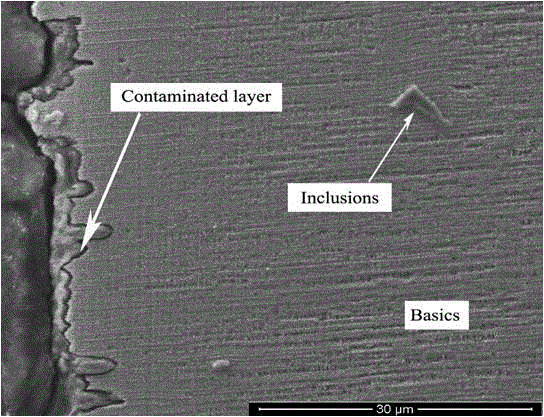
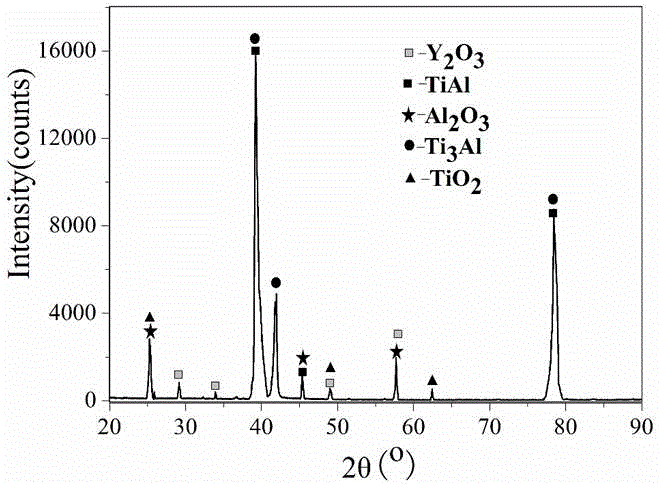
The invention researches a process for reducing the reaction of directional solidification titanium-aluminum alloy castings and casting mold coatings, and belongs to a directional solidification casting method of a high-temperature structural alloy. The invention aims at providing optimal process parameters during titanium-aluminum alloy preparation achieved through directional solidification, the interface reaction between an alloy melt and casting mold materials is weakened to be minimum when the heat preservation time is 30 minutes and the drawing speed is 60 micrometers per second by means of design of directional solidification parameters of a Ti-48Al-7Nb-2.5V-1.0Cr alloy, the reaction layer thickness is reduced to be less than 10 micrometers, the surfaces of the castings are smooth, and internal contamination is little. The process is characterized in that the time of contact between the melt and casting molds is shortened, and the problems that when the drawing speed is high, the number of crystalline grains is increased and the deviation between the direction of the crystalline grains and the axial direction is large are solved. The process is reasonable and low in cost, can not influence the directional solidification structure orientation of a titanium-aluminum alloy, and can be applied to the directional solidification process of the titanium-aluminum alloy.
Need to check novelty before this filing date? Find Prior Art

Description

technical field

[0001] The invention relates to an optimization for reducing the reaction between a directional solidified titanium-aluminum alloy casting and a mold coating, which belongs to an interface reaction optimization process for a high-temperature structural alloy. Background technique

[0002] As a light-weight high-temperature structural material, titanium-aluminum alloy not only has low density, high specific strength, and high elastic modulus, but also has good high-temperature oxidation resistance and creep resistance. It is one of the research hotspots of engine materials. , biomedicine and automobile manufacturing and other fields have been widely used. Made of TiAl (γ phase) and a small amount of Ti 3 Al(α 2 phase) has better mechanical properties than other forms of tissue, and obviously presents anisotropy. When the applied load is consistent with the lamellar direction, the yield strength, elongation, fracture toughness and The creep performance has b...

Claims

the structure of the environmentally friendly knitted fabric provided by the present invention; figure 2 Flow chart of the yarn wrapping machine for environmentally friendly knitted fabrics and storage devices; image 3 Is the parameter map of the yarn covering machine
Login to View More