
OLED miniaturized display constant-brightness modulation method
A microdisplay, constant brightness technology, applied in static indicators, cathode ray tube indicators, instruments, etc., can solve the problems of OLED devices not being able to maintain a fixed brightness well, increasing the number of adjustments, and overmodulation.
- Summary
- Abstract
- Description
- Claims
- Application Information
AI Technical Summary
Problems solved by technology
Method used
Image

Examples
Embodiment 1
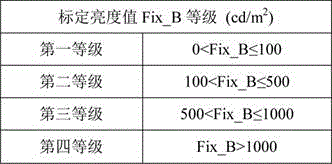
[0020] Example 1: (1) The OLED microdisplay needs to be at 100 cd / m 2 Work under the brightness of 100 cd / m 2 . Because 0
[0021] (2) The measured current brightness value Cur_B is 103 cd / m 2 , then the difference between the measured current luminance value and the calibrated luminance value B_degree=103-100=3 cd / m 2 ;
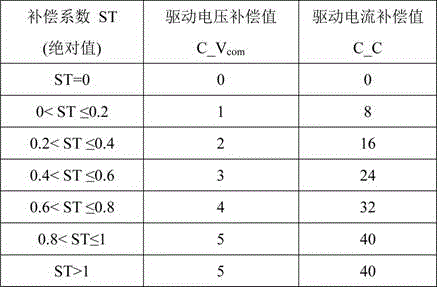
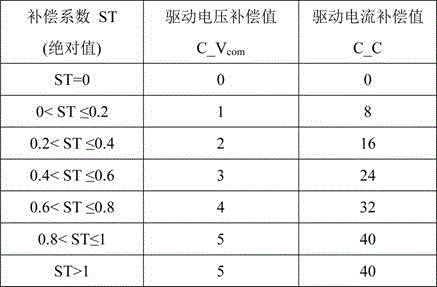
[0022] (3) Calculate the compensation coefficient ST=(Cur_B-Fix_B) / Dif_B=3 / 5=0.6;
[0023] (4) According to ST=0.6, the corresponding driving voltage compensation value C_V com is 3;
[0024] (5) Modulate with the current driving voltage value plus the compensation value, and finally realize the brightness of the OLED microdisplay to work at 100 cd / m 2 Down.
Embodiment 2
[0025] Example 2: (1) The OLED microdisplay needs to be at 1100 cd / m 2 Work under the brightness of 1100 cd / m 2 . Because 500
[0026] (2) The measured current brightness value Cur_B is 918 cd / m 2 , then the difference between the measured current luminance value and the calibrated luminance value B_degree=918-1100= -182 cd / m 2 ;
[0027] (3) Calculate the compensation coefficient ST=(Cur_B-Fix_B) / Dif_B= -182 / 15= -12.13;
[0028] (4) According to︱ST︱=12.13 and the difference between the current brightness value and the calibration brightness value is a negative value, the corresponding driving voltage compensation value C_V com is -5;
[0029] (5) Modulate with the current driving voltage value plus the compensation value, and finally realize the brightness of the OLED microdisplay to work at 100 cd / m 2 Down.
PUM
 Login to View More
 Abstract
Description
Claims
Application Information
 Login to View More