Unlock instant, AI-driven research and patent intelligence for your innovation.

A method for identifying magnetizing inrush current based on zero-sequence current

A zero-sequence current and excitation inrush current technology, which is applied in the field of excitation inrush current identification based on zero-sequence current, can solve the problems of second harmonic content reduction, transformer differential protection misoperation, etc., and achieve the effect of preventing misoperation

Active Publication Date: 2018-09-25
NANJING GUODIAN NANZI POWER GRID AUTOMATION CO LTD
View PDF5 Cites 0 Cited by
  • Summary
  • Abstract
  • Description
  • Claims
  • Application Information

AI Technical Summary

Problems solved by technology

[0003] At present, the identification of inrush current for transformer protection is calculated and judged based on the differential current after filtering out the zero-sequence current, and the second harmonic content or waveform symmetry in the differential current after filtering out the zero-sequence current is judged. Current, it is easy to cause the differential current to be a symmetrical waveform after filtering out the zero-sequence current, the second harmonic content is reduced, and it is lower than the second harmonic braking threshold, which will cause the transformer differential protection to malfunction due to the excitation inrush current

Method used

the structure of the environmentally friendly knitted fabric provided by the present invention; figure 2 Flow chart of the yarn wrapping machine for environmentally friendly knitted fabrics and storage devices; image 3 Is the parameter map of the yarn covering machine
View more

Image

Smart Image Click on the blue labels to locate them in the text.
Viewing Examples
Smart Image
  • A method for identifying magnetizing inrush current based on zero-sequence current
  • A method for identifying magnetizing inrush current based on zero-sequence current
  • A method for identifying magnetizing inrush current based on zero-sequence current

Examples

Experimental program
Comparison scheme
Effect test

Embodiment Construction

[0021] The technical solutions of the present invention will be further described in detail below in conjunction with specific examples, so that those skilled in the art can better understand the present invention and implement it, but the examples given are not intended to limit the present invention.

[0022] A method for identifying inrush current based on zero-sequence current, comprising the following steps:

[0023] Step 1. Sampling the zero-sequence current I on the airdrop side 0 ;

[0024] Step 2, data processing, including:

[0025] Calculate the zero sequence current I 0 The fundamental wave value I 01 , Zero-sequence current second harmonic value I 02 and the second harmonic content K, where the second harmonic content K is the second harmonic value I 02 and the fundamental value I 01 The ratio of , namely:

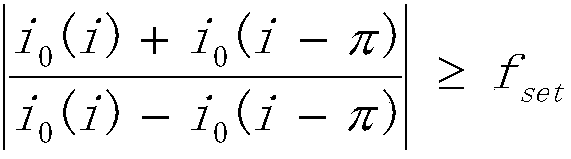
[0026] Calculate the zero sequence current I 0 Waveform asymmetry points N in half cycle:

[0027] Calculate the following formula for each samplin...

the structure of the environmentally friendly knitted fabric provided by the present invention; figure 2 Flow chart of the yarn wrapping machine for environmentally friendly knitted fabrics and storage devices; image 3 Is the parameter map of the yarn covering machine
Login to View More

PUM

No PUM Login to View More

Abstract

The invention discloses a zero-sequence current-based excitation surge current recognition method. The excitation surge current recognition method comprises the steps of 1, sampling no-load-input side zero-sequence current I<0>; 2, calculating a fundamental wave value I<01> of the zero-sequence current I<0>, a zero-sequence current secondary harmonic value I<02> and a secondary harmonic content K, wherein the secondary harmonic content K is a ratio of the secondary harmonic value I<02> to the fundamental wave value I<01>; and calculating waveform asymmetry number of points N in a half cycle of the zero-sequence current I<0>; and 3, performing excitation surge current recognition: when the secondary harmonic content K is higher than a set threshold value K<set> or the waveform asymmetry number of points N is higher than a set threshold value N<set>, determining as excitation surge current, and closing differential protection; and when the secondary harmonic content K is lower than the set threshold value K<set> and the waveform asymmetry number of points N is lower than the set threshold value N<set>, determining as a failure, and opening differential protection. The excitation surge current recognition is more reliable and can more effectively prevent from misoperation of differential protection in no-load input of a transformer.

Description

technical field [0001] The invention relates to a method for identifying excitation inrush current based on zero-sequence current. Background technique [0002] As long as the system voltage changes and the excitation voltage is affected, an excitation inrush current will be generated. The differential is to calculate the differential current by using the current of the primary side and the secondary side of the transformer. When the transformer is in normal operation, the excitation current is very small. When the excitation inrush current occurs, the influence of the excitation current should not be ignored. The usual practice is Rely on various discrimination conditions to discriminate the excitation inrush current. [0003] At present, the identification of inrush current for transformer protection is calculated and judged based on the differential current after filtering out the zero-sequence current, and the second harmonic content or waveform symmetry in the differen...

Claims

the structure of the environmentally friendly knitted fabric provided by the present invention; figure 2 Flow chart of the yarn wrapping machine for environmentally friendly knitted fabrics and storage devices; image 3 Is the parameter map of the yarn covering machine
Login to View More

Application Information

Patent Timeline
no application Login to View More
Patent Type & Authority Patents(China)
IPC IPC(8): H02H7/045G01R19/00
CPCG01R19/0092H02H7/045
Inventor 郭晓胡兵行武王哲
Owner NANJING GUODIAN NANZI POWER GRID AUTOMATION CO LTD
Features
  • R&D
  • Intellectual Property
  • Life Sciences
  • Materials
  • Tech Scout
Why Patsnap Eureka
  • Unparalleled Data Quality
  • Higher Quality Content
  • 60% Fewer Hallucinations
Social media
Patsnap Eureka Blog
Learn More