
Method and device for transmitting and receiving timestamp information
A technology for sending time stamps and receiving time stamps, applied in the field of mobile communications, can solve problems such as low compression efficiency, and achieve the effect of fast compression time and improved processing speed
- Summary
- Abstract
- Description
- Claims
- Application Information
AI Technical Summary
Problems solved by technology
Method used
Image

Examples
Embodiment approach 1
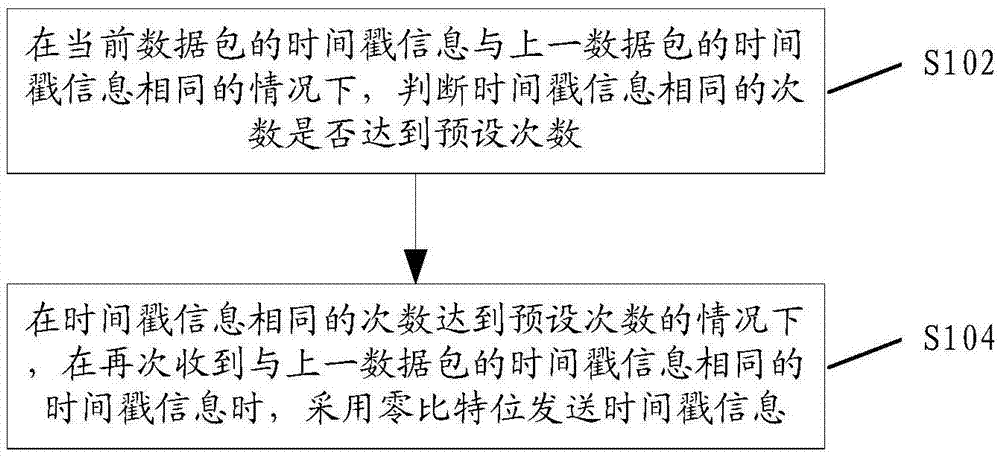
[0047] This embodiment is implemented by carrying 3 types of extension headers, which can be applied to U / O mode, because in U / O mode, the compression end can think that the decompression end automatically maintains the relationship between TS_STRIDE and TS_OFFSET in the context, and only sends the original Timestamp to Maintain the relationship between TS_STRIDE and TS_OFFSET. The following describes the process in detail through the two aspects of the compression end and the decompression end. The workflow of the compression end is as follows: Figure 7 As shown, the steps are as follows:
[0048] step 1:
[0049] Compression side: The Timestamp value of the incoming packet is the same as that of the previous packet; use 3 types of extension headers to carry the Timestamp, and maintain NEW_TS_STRIDE=0 at the compression side.
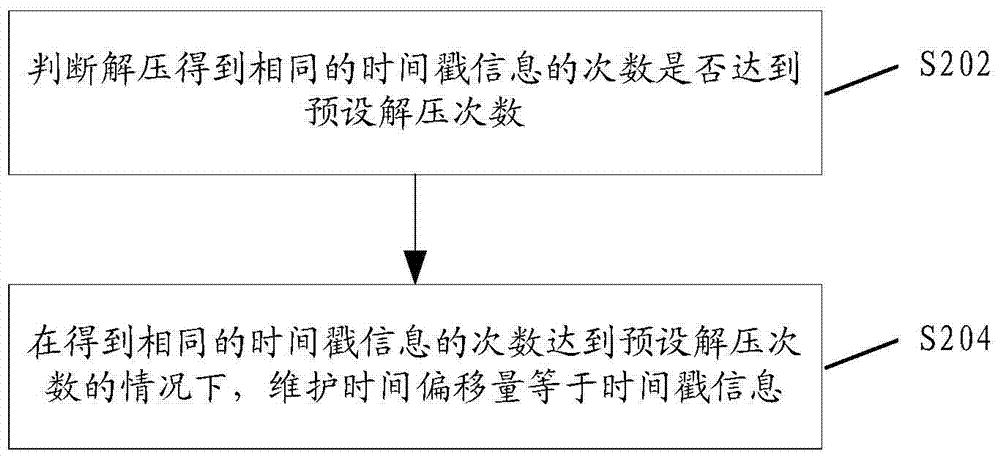
[0050] Decompression end: Do the same processing when receiving, decompress the Timestamp carried by the 3 types of extension headers, which is the...
Embodiment approach 2
[0058] This implementation mode is implemented by sending the compressed package of the initialization context through state reversion, which can be applied to the O / R mode, and maintains the relationship between TS_STRIDE and TS_OFFSET by sending a message with the initialization context of Timestamp and TS_STRIDE through state reversion. The following describes the process in detail through the two aspects of the compression end and the decompression end. The workflow of the compression end is as follows: Figure 8 As shown, the steps are as follows:
[0059] step 1:
[0060] Compression side: The Timestamp value of a packet is the same as that of the previous packet; use IR or IR-DYN packets to carry Timestamp and TS_STRIDE. Here, Timestamp is the actual value, and TS_STRIDE is 0.
[0061] Decompression end: do the same processing when receiving, decompress the IR or IR-DYN message carrying Timestamp and TS_STRIDE, and maintain TS_STRIDE=0.
[0062] Step 2:
[0063] Comp...
PUM
 Login to View More
 Abstract
Description
Claims
Application Information
 Login to View More