System and method for determining a sufficient cause from multiple outcomes
What is AI technical title?
AI technical title is built by PatSnap AI team. It summarizes the technical point description of the patent document.
A cause-observation technique applied in the field of systems to determine sufficient causes under circumstances
Active Publication Date: 2021-05-07
BAIDU USA LLC
View PDF6 Cites 0 Cited by
Summary
Abstract
Description
Claims
Application Information
AI Technical Summary
This helps you quickly interpret patents by identifying the three key elements:
Problems solved by technology
Method used
Benefits of technology
Problems solved by technology
If a patient describes a fever, the question becomes: "How can a doctor determine if a patient has pneumonia or the flu or something else?" is a sufficient condition to trigger an alarm; therefore, the question might be asked: "How do I determine if this is a false alarm?
Method used
the structure of the environmentally friendly knitted fabric provided by the present invention; figure 2 Flow chart of the yarn wrapping machine for environmentally friendly knitted fabrics and storage devices; image 3 Is the parameter map of the yarn covering machine
View more
Image
Smart Image Click on the blue labels to locate them in the text.
Viewing Examples
Smart Image
Click on the blue label to locate the original text in one second.
Reading with bidirectional positioning of images and text.
Smart Image
Examples
Experimental program
Comparison scheme
Effect test
Embodiment 1
[0031] Example 1 - Variational Inference and then Exact Inference: In an embodiment, a variational inference process can be used to compute the posterior, which is used in the exact inference process. As an example, consider the following:
[0032]
[0033] where a variational inference method is used to find the first positive result set that has been identified via the above-assigned index In case of inferred disease d i (d i represents the probability of the i-th disease).
[0034] In an embodiment, the posterior of the variational inference process may be used as input for exact inference. As an example, consider the following:
[0035]
[0036] where the exact inference method is used for a given second positive result set that has been identified via the assigned index as described above Posterior and Negative Observation Sets F from Variational Inference - Inferred disease in case of d i The probability.
[0037] It should be noted that in an embodiment,...
Embodiment 2
[0038] Example 2 - Exact Inference and Then Variational Inference: In an embodiment, the exact inference process can be used to compute the posterior, which is used in the variational inference process. As an example, consider the following:
[0039]
[0040] where the exact inference method is used to find the second set of positive results and the set of negative results F – Inferred disease in case of d i The probability.
[0041] In an embodiment, the exact inferred posterior may be used as input for variational inference. As an example, consider the following:
[0042]
[0043] where a variational inference method is used to generate the first set of positive results that have been identified via the indices assigned as described above and infer the disease d in the case of the posterior from the exact inference i The probability.
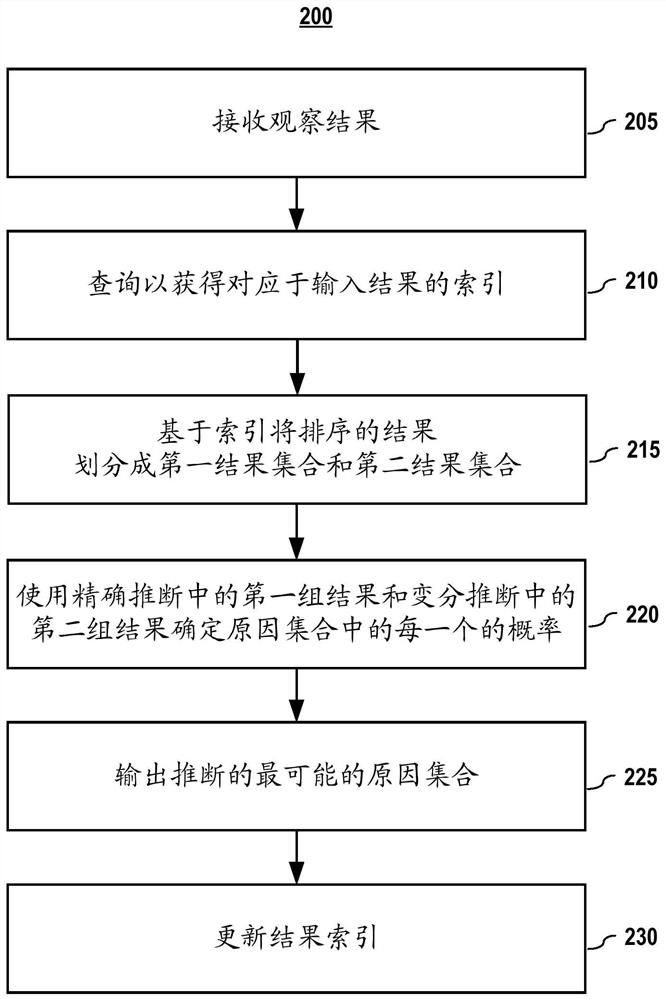
[0044] In an embodiment, in step 225, the results of the inference process are used to output the most likely cause. In the e...
the structure of the environmentally friendly knitted fabric provided by the present invention; figure 2 Flow chart of the yarn wrapping machine for environmentally friendly knitted fabrics and storage devices; image 3 Is the parameter map of the yarn covering machine
Login to View More
PUM
Login to View More
Abstract
The present invention relates to systems and methods for determining sufficient cause from multiple outcomes for inferring the most likely cause from observable outcomes and known Noisy-OR causality. In an embodiment, the results are sorted by index according to an order including but not limited to natural frequency order of the results, order of expert marks, order obtained by machine learning, and the like. In an embodiment, according to their assigned indices, observations with lower indices are assigned for exact inference, while observations with higher indices are assigned for variational inference. In an embodiment, the results of exact inference and variational inference are combined to predict the most likely cause. The unique combination of exact and variational inference based on outcome indexing makes the process of inferring possible causes much faster.
Description
technical field [0001] The present invention generally relates to providing systems and methods for assisting in determining a sufficient cause given multiple outcomes. Background technique [0002] Causality is the principle that there is a relationship between a cause and an effect or outcome. In some cases, the result may be the result of one of many causes. Various models and theories exist for attempting to formalize causality. One such ensemble of models is called independence of causal influence (ICI), which addresses the problem of exponential growth of parameters when dealing with conditional probabilities by assuming independence of causal influence (ICI). Accepting this assumption allows defining parametric models of conditional probability distributions using only parameters that are linear in multiple causes. [0003] ICI models such as Noisy-OR and Noisy-AND gates have been widely used. The Noisy-OR model is a causal independent formalism that models relati...
Claims
the structure of the environmentally friendly knitted fabric provided by the present invention; figure 2 Flow chart of the yarn wrapping machine for environmentally friendly knitted fabrics and storage devices; image 3 Is the parameter map of the yarn covering machine
Login to View More
Application Information
Patent Timeline
Application Date:The date an application was filed.
Publication Date:The date a patent or application was officially published.
First Publication Date:The earliest publication date of a patent with the same application number.
Issue Date:Publication date of the patent grant document.
PCT Entry Date:The Entry date of PCT National Phase.
Estimated Expiry Date:The statutory expiry date of a patent right according to the Patent Law, and it is the longest term of protection that the patent right can achieve without the termination of the patent right due to other reasons(Term extension factor has been taken into account ).
Invalid Date:Actual expiry date is based on effective date or publication date of legal transaction data of invalid patent.



 Login to View More
  Login to View More