high-precision Gabor time-frequency analysis method based on a signal sparse representation theory
A signal sparse, time-frequency analysis technology, applied in the field of signal and information processing, can solve problems such as blank, the influence of window function window width, and the basis function is not orthogonal.
- Summary
- Abstract
- Description
- Claims
- Application Information
AI Technical Summary
Problems solved by technology
Method used
Image



Examples
Embodiment
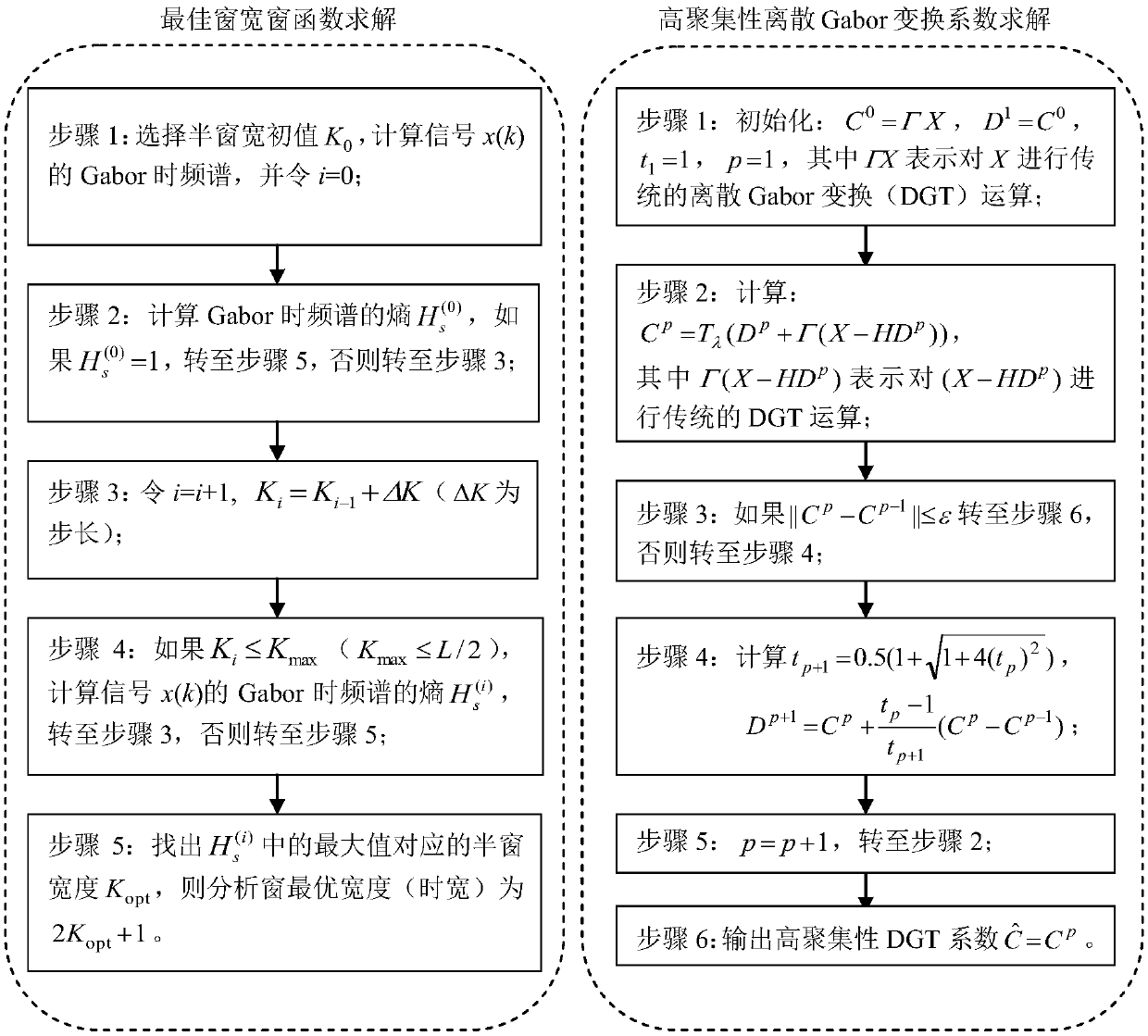
[0094] The concrete steps of this embodiment are as follows:
[0095] Suppose x(t)=cos(50cos(πt)+10πt 2 +70πt)+cos(25πt 2 +130πt) is a signal whose frequency varies with time. The signal contains two cosine functions. In theory, the frequency of the two cosine functions in the time spectrum corresponds to a straight line and a curve that vary with time.
[0096] Discrete Gabor transform is performed on it, and the Gabor time spectrum generated by using a smaller time-width window function is as follows figure 2 As shown, the time resolution accuracy is better but the frequency resolution accuracy is poor.
[0097] The Gabor time spectrum generated by using a larger time-width window function is as follows image 3 As shown, the time resolution accuracy is poor but the frequency resolution accuracy is good.
[0098] If both the time resolution accuracy and the frequency resolution accuracy are not too bad (that is, the best time-frequency accuracy), a moderate (best) time-...
PUM
 Login to View More
 Abstract
Description
Claims
Application Information
 Login to View More