Computer vision stereo matching method
A computer vision and stereo matching technology, which is applied in the field of stereo matching of computer vision, can solve the problems of inability to process three-dimensional images and poor image effects, and achieve the effects of good processing, improved visual effects, and improved effects.
- Summary
- Abstract
- Description
- Claims
- Application Information
AI Technical Summary
Problems solved by technology
Method used
Image

Examples
Embodiment 1
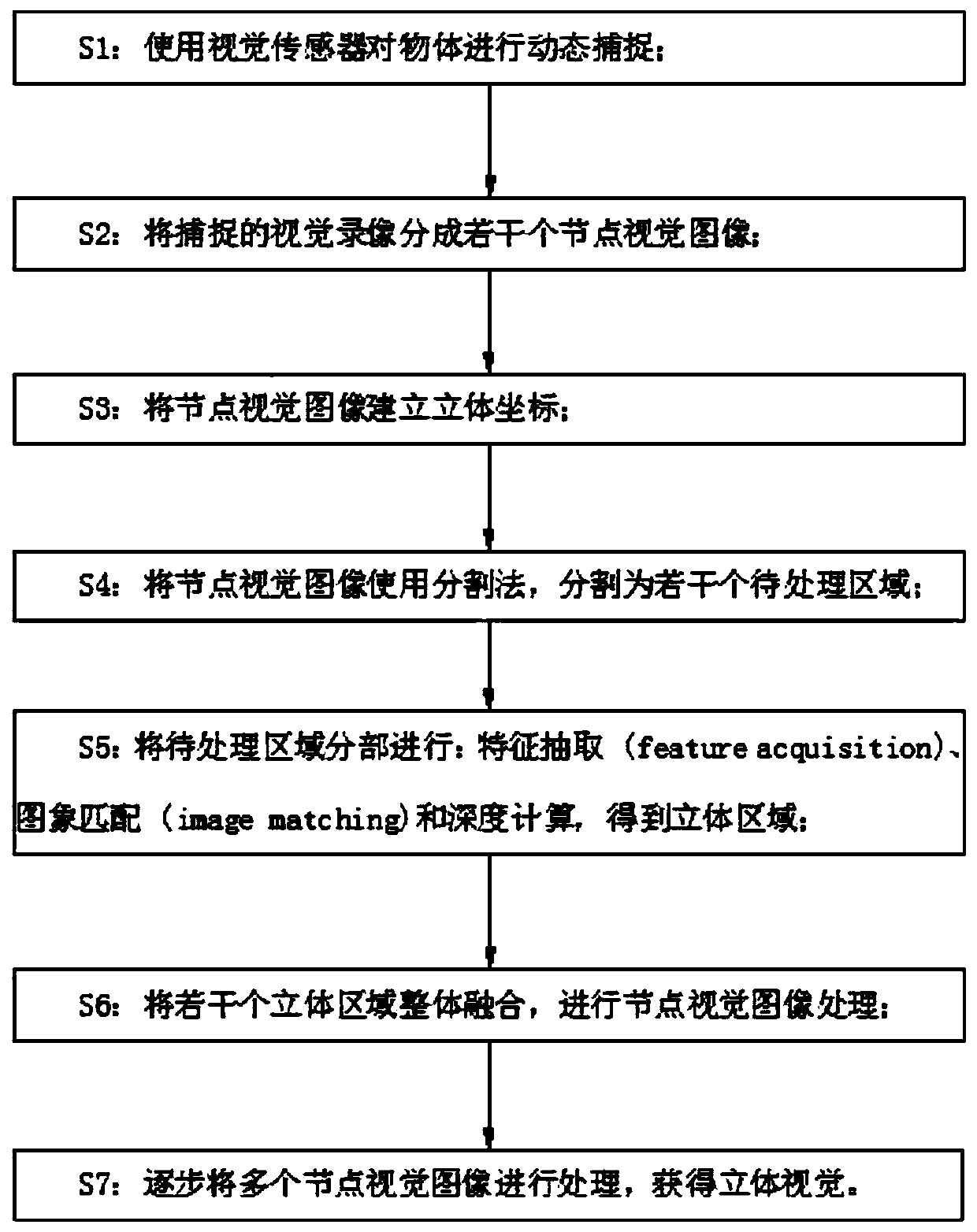
[0029] Embodiment one: refer to figure 1 , a stereo matching method for computer vision, comprising the following steps:
[0030] S1: Use visual sensors to dynamically capture objects;
[0031] S2: dividing the captured visual video into several node visual images;
[0032] S3: establish the stereoscopic coordinates of the node visual image;
[0033] S4: Divide the visual image of the node into several regions to be processed using the segmentation method;
[0034] S5: Divide the area to be processed into: feature acquisition, image matching and depth calculation to obtain a three-dimensional area;
[0035] S6: integrate several three-dimensional areas as a whole, and perform node visual image processing;
[0036] S7: Process multiple node visual images step by step to obtain stereoscopic vision.
[0037] In this embodiment, the visual sensor in S1 is a left and right binocular visual sensor, which can simulate the way human eyes perceive stereoscopic images, and the visu...
Embodiment 2
[0047] Embodiment two: a kind of stereo matching method of computer vision, comprises the following steps:
[0048] S1: Use the visual sensor to dynamically capture the object, and the visual sensor can be moved according to the usage;
[0049] S2: Divide the captured visual video into several node visual images, and the conversion of the node visual images is to convert the moving picture into a static picture;
[0050] S3: Generate two-dimensional coordinates from the visual image of the node;
[0051] S4: Use the segmentation method to divide the visual image of the node into several regions to be processed, which can be easily processed by dividing into regions;
[0052] S5: Divide the area to be processed into parts: feature acquisition, image matching and depth calculation to obtain a two-dimensional area;
[0053] S6: Combine several two-dimensional areas as a whole, process the node visual image, build a three-dimensional model of the node visual image, and perform t...
PUM
 Login to View More
 Abstract
Description
Claims
Application Information
 Login to View More