Double-cavity calculus removing balloon

A stone ball and balloon technology, applied in the field of double-cavity stone extraction balloon, can solve the problems of increased surgical risk, cumbersome clinical use, prolonging operation time, etc., and achieve the effect of low production process and material requirements

CN111297438APending Publication Date: 2020-06-19SHANGHAI EAST HOSPITAL EAST HOSPITAL TONGJI UNIV SCHOOL OF MEDICINE
0 Cites 0 Cited by

Patent Information

Authority / Receiving Office
CN · China
Current Assignee / Owner
Publication Date
2020-06-19

Smart Images

  • Figure 1
    Figure 1
  • Figure 2
    Figure 2
  • Figure 3
    Figure 3
Patent Text Reader

Abstract

The invention provides a double-cavity calculus removing balloon. The calculus removing balloon comprises a catheter body, a balloon part arranged at the front end of the catheter body and a handle part arranged at the rear end of the catheter body. A first channel and a second channel are formed in the catheter body, the first channel and the second channel are respectively connected to a first handle and a second handle, the first channel is used for inflating the balloon part, the second channel is used for injecting a contrast medium for cholangiography, the front end of the balloon part is provided with a head part, the head part is a single-channel tube, and the tube wall of the tube is provided with a guide wire through hole for a guide wire to pass through. During use, the tail endof the guide wire sequentially penetrates through the front end of the head part and the guide wire through hole, the contrast medium is injected through the second handle for cholangiography, and the balloon is filled with gas injected through the first handle for calculus removal. According to the invention, a guide wire side hole is formed in a catheter in front of the balloon, the balloon anda body part are not provided with guide wire channels but only provided with an injection channel and a balloon channel, and therefore a balloon bile duct can be made thinner, and the requirements ofa manufacturing process and materials are lower.
Need to check novelty before this filing date? Find Prior Art

Description

Technical field

[0001] The invention relates to the technical fields of minimally invasive medical technology and surgical instruments, in particular to a double-cavity stone extraction balloon. Background technique

[0002] Common bile duct stones are a common disease and frequently-occurring disease in my country. Blocking the common bile duct by stones can lead to poor bile excretion, which in turn induces complications such as acute cholangitis, obstructive jaundice, liver damage, chills, fever, abdominal pain, and jaundice. Severe cases can even lead to shock. Long-term stone stimulation has the risk of bile duct cancer, which is an important disease endangering human health. The current treatment options for choledocholithiasis include open bile duct exploration, laparoscopic biliary exploration, endoscopic retrograde cholangiopancreatography (ERCP) stone retrieval, percutaneous transhepatic cholangiography (PTCD) + fistula dilation + percutaneous transhepatic biliary tract ...

Examples

Embodiment Construction

[0028] In order to make the objectives, technical solutions, and advantages of the embodiments of the present invention clearer, the technical solutions in the embodiments of the present invention will be described clearly and completely in conjunction with the accompanying drawings in the embodiments of the present invention. Obviously, the described embodiments It is a part of the embodiments of the present invention, not all the embodiments. Based on the embodiments of the present invention, all other embodiments obtained by those of ordinary skill in the art without creative work shall fall within the protection scope of the present invention.

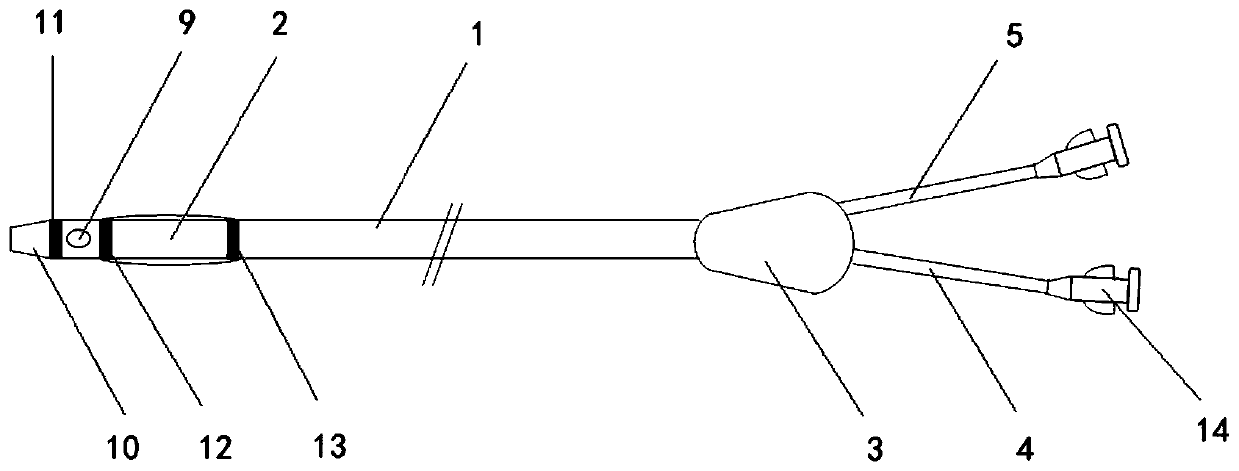
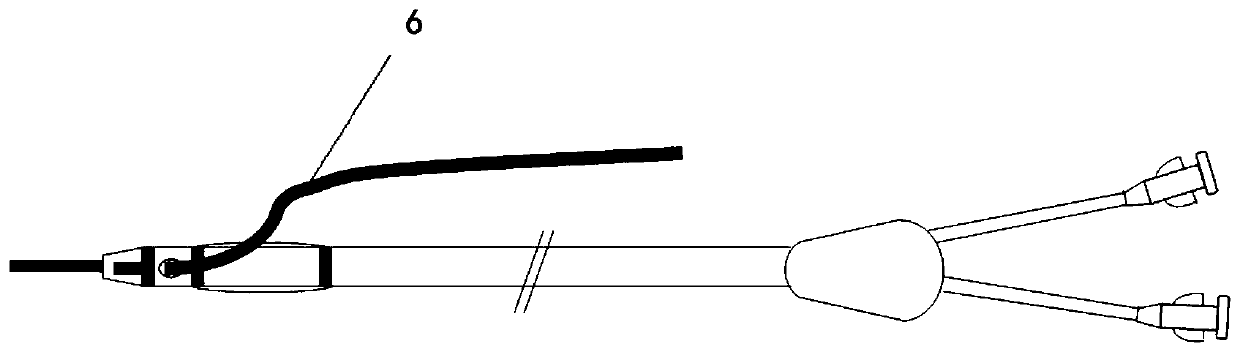
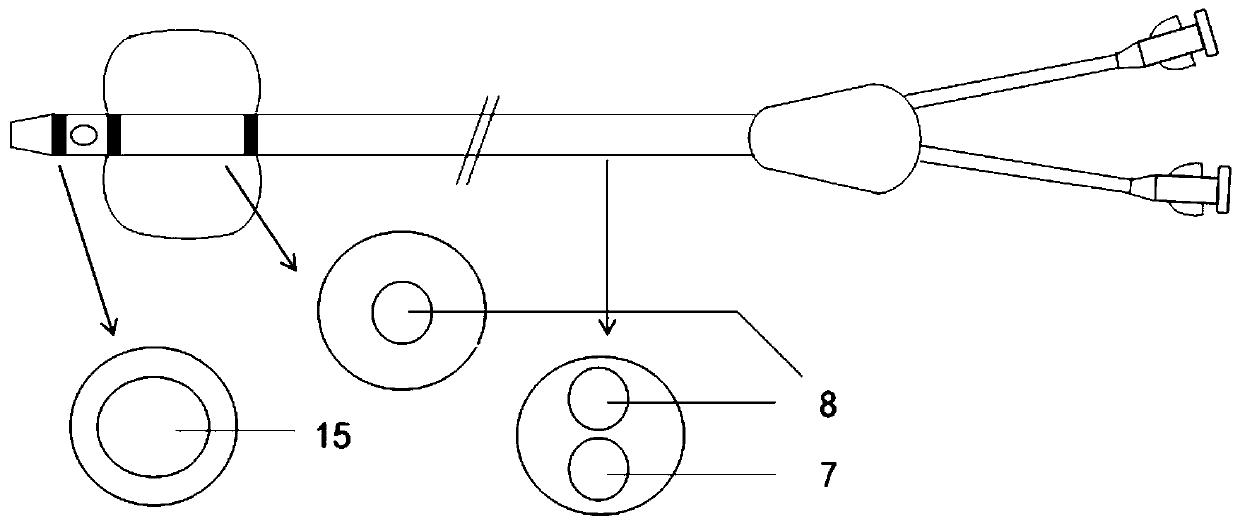
[0029] Such as figure 1 As shown, the embodiment of the present invention discloses a double-lumen stone extraction balloon, which includes a catheter body 1, a balloon portion 2 arranged at the front end of the catheter body 1, and a handle portion arranged at the rear end of the catheter body 1, wherein the inside of the catheter bod...