
Reagent for detecting novel coronavirus SARS-CoV-2 antibody and application thereof
A coronavirus, sars-cov-2n technology, used in reagents for detecting new coronavirus SARS-CoV-2 antibodies and their application fields, can solve the problem of complex experimental technology, unsuitable for rapid disease detection, accuracy and sensitivity issues to be further improved
- Summary
- Abstract
- Description
- Claims
- Application Information
AI Technical Summary
Problems solved by technology
Method used
Image

Examples
Embodiment 1
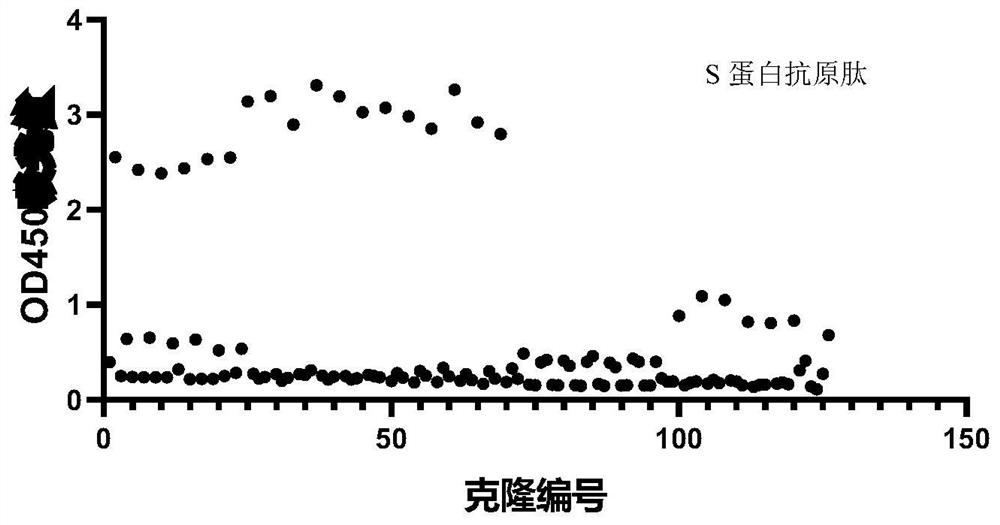
[0088] Example 1-Construction of S protein antigen peptide display library and preparation and screening of antigen peptide display library Phage S protein (Spike protein) is a membrane protein, which constitutes the envelope particles of the virus and is the main component of the virus infecting host cells. To infect cells, the new coronavirus must first introduce its genetic material RNA into the host cell. This process is mainly done through the S protein. The protrusion of S protein is the key part of its interaction with receptor and membrane fusion. The experimental steps for synthesizing S protein antigen peptide include:
[0089] 1. Construction of S protein antigen peptide display library;
[0090] (1) According to the above-mentioned Spike protein full-length sequence shown in SEQ ID NO.1 and the peptide sequence to be synthesized, the corresponding primer pair is designed. The peptide numbers to be synthesized are S1~S126, which correspond to the sequence of Spike prote...
Embodiment 2
[0110] Example 2-Preparation of colloidal gold detection reagent strips by using S protein antigen peptide and its effect verification
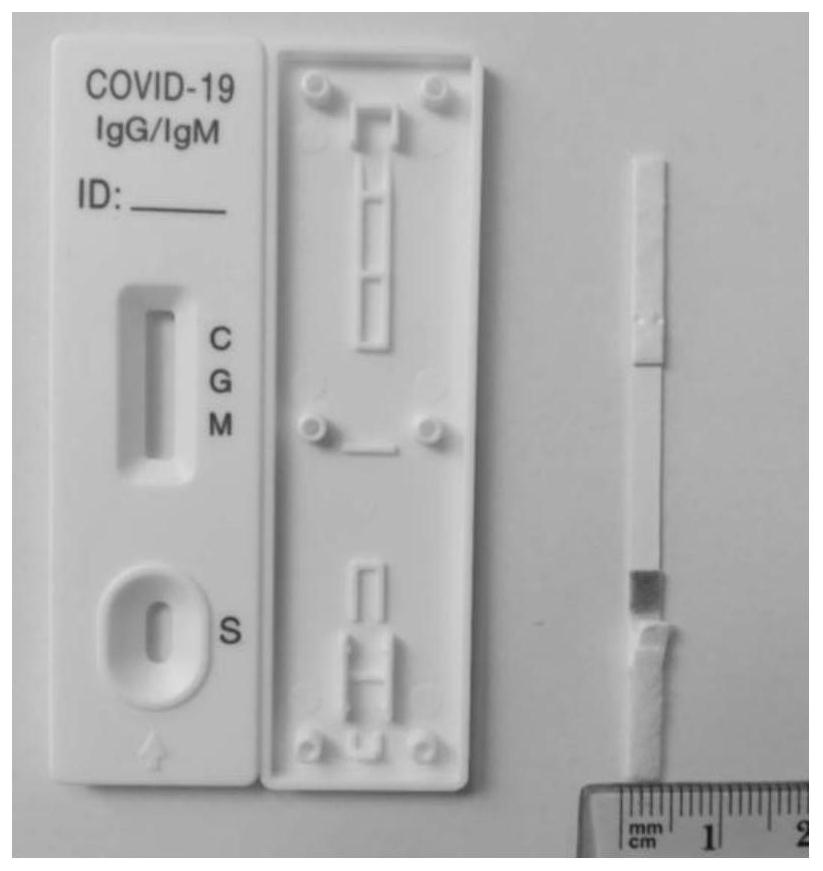
[0111] In this example, the predominant epitope peptide of the SARS-CoV-2 spike protein Spike screened in Example 1 is used as the solid phase, and the indirect method is used to detect whether the serum contains antibodies against the new coronavirus. The colloidal gold detection reagent strip The preparation steps include:
[0112] (1) Synthesize the dominant epitope peptides S22, S25 and S29 according to the steps in Example 1;
[0113] (2) Preparation of coating film: 0.01mol / L PBS diluted antibody, mouse anti-human IgG antibody concentration 1.0mg / mL sprayed on the NC membrane, marked as G line; mouse anti-human IgM antibody concentration 1.0mg / mL spray On the NC membrane, mark it as the M line; the goat anti-mouse IgG antibody concentration is 1.0mg / mL, spray on the NC membrane, and mark it as the C line
[0114] (3) Preparation of gold-labele...
Embodiment 3-N
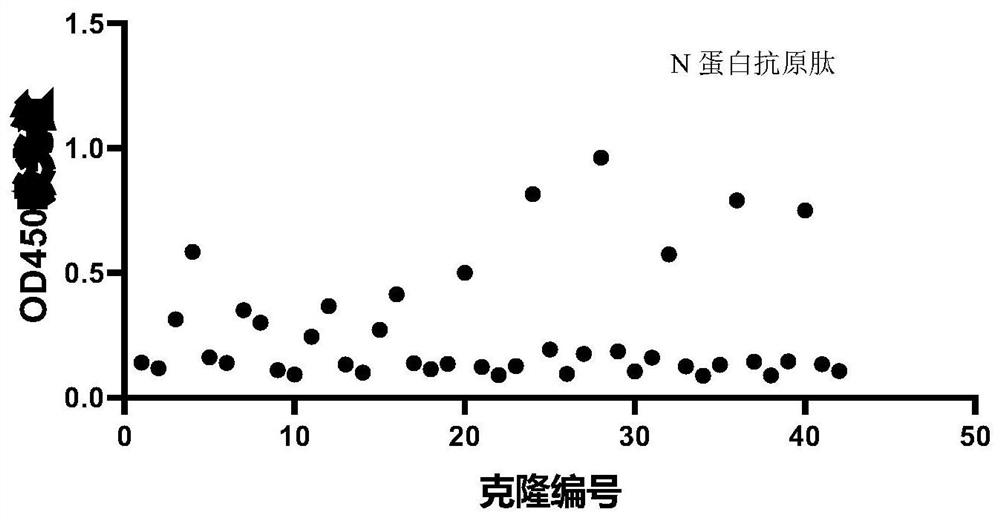
[0136] Example 3-Construction of N protein antigen peptide display library and preparation and screening of antigen peptide display library Phage
[0137] The N protein is an important structural protein in the coronavirus. The N protein is in the core part of the virus particle and exists in the form of binding to genomic RNA. The experimental steps of synthesizing N protein antigen peptide include:
[0138] 1. Construction of N protein antigen peptide display library;
[0139] (1) According to the above-mentioned N protein full-length sequence as shown in SEQ ID NO. 2 and the peptide sequence to be synthesized, the corresponding primer pair is designed. The peptides to be synthesized are numbered N1 to N42, which correspond to the N protein For partial amino acid sites, the corresponding primer numbers are N1F / N1R~N42F / N42R (SEQ ID NO.255~338), and each primer has sticky ends. The polypeptide sequence, its corresponding amino acid positions and the designed specific primers are s...
PUM
 Login to View More
 Abstract
Description
Claims
Application Information
 Login to View More