Pedestrian re-identification feature descriptor based on multi-task learning

A multi-task learning and pedestrian re-identification technology, applied in the field of pedestrian re-identification feature descriptors, a new network model TDFN, can solve problems such as suboptimal and ignoring information

Active Publication Date: 2020-09-29
SICHUAN UNIV
View PDF4 Cites 5 Cited by
  • Summary
  • Abstract
  • Description
  • Claims
  • Application Information

AI Technical Summary

Problems solved by technology

These methods can effectively learn the global pedestrian representation, but they ignore the very rich information around the local body position, which can produce suboptimal results in some scenarios.

Method used

the structure of the environmentally friendly knitted fabric provided by the present invention; figure 2 Flow chart of the yarn wrapping machine for environmentally friendly knitted fabrics and storage devices; image 3 Is the parameter map of the yarn covering machine
View more

Image

Smart Image Click on the blue labels to locate them in the text.
Viewing Examples
Smart Image
  • Pedestrian re-identification feature descriptor based on multi-task learning
  • Pedestrian re-identification feature descriptor based on multi-task learning
  • Pedestrian re-identification feature descriptor based on multi-task learning

Examples

Experimental program
Comparison scheme
Effect test

Embodiment Construction

[0011] The present invention will be further described below in conjunction with accompanying drawing:

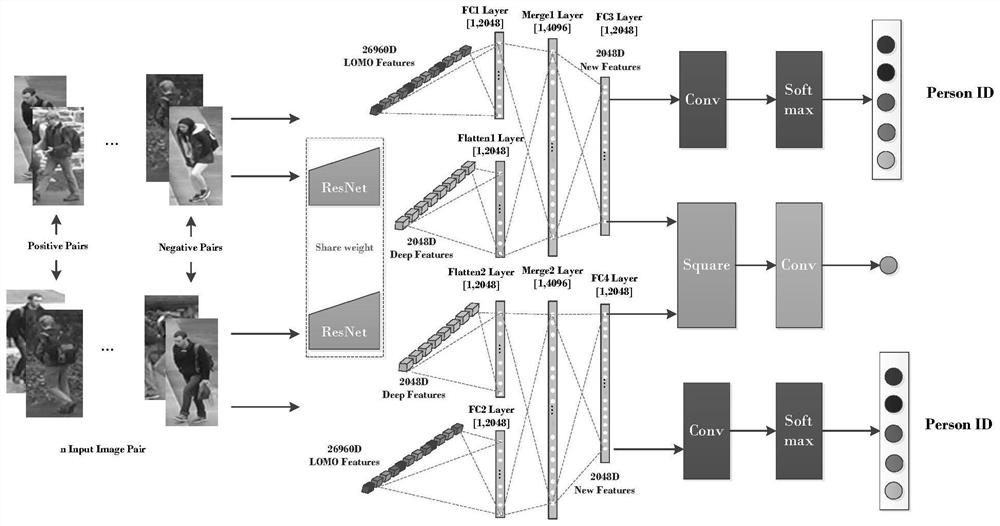
[0012] The network structure of the TDFN model is as follows:

[0013] The model adopts a twin network structure, including two CNN models (obtained by removing the last layer of FC from the ResNet-50 network), and the two CNN models share weights. Input two pictures, two CNN models output two deep features. In addition, the LOMO features of the two images are extracted and sent to the fully connected layer to reduce the dimensionality, which can alleviate the huge difference between the two feature dimensions for fusion. Then, the deep features extracted by the twin network and the dimensionally reduced LOMO features are sent to the Merge1 and Merge2 layers for fusion of the two features, and then sent to the FC3 and FC4 layers for learning to obtain two new features. There are three tasks in the network (two task of predicting pedestrian identity and one task of obtaini...

the structure of the environmentally friendly knitted fabric provided by the present invention; figure 2 Flow chart of the yarn wrapping machine for environmentally friendly knitted fabrics and storage devices; image 3 Is the parameter map of the yarn covering machine
Login to View More

PUM

No PUM Login to View More

Abstract

The invention discloses a pedestrian re-identification feature descriptor based on multi-task learning. A twin network structure with paired input is adopted; the method comprises the following stepsof: sending local maximum occurrence (LOMO) features and deep features into a network together, and mapping the features into a single feature space for training to form a new TDFN (Time Division Multiplexing Network) model by using a time division duplex (TDFN) algorithm, so that a new TDFN (Time Division Multiplexing Network) is formed. The neural network self-learning characteristic is utilized, and the network is updated by combining the loss functions of multiple tasks, so that the deep features learn more detail information complementary with the manual local features, and new features with higher discriminability are obtained. Experiments show that the average precision mAP and Rank-1 precision of the new features of the method are superior to those of a global descriptor directly extracted from a twin network. The method is suitable for application systems in the aspects of safety and monitoring, such as video monitoring analysis and content-based image and video retrieval.

Description

technical field [0001] The invention relates to the pedestrian re-identification problem in the field of video intelligent monitoring, in particular to a pedestrian re-identification feature descriptor based on multi-task learning and a new network model TDFN (Traditional and Deep features Fusion Network). Background technique [0002] Pedestrian re-identification (Re-Identification) aims to match image frames containing the same pedestrian in cross-camera surveillance video, which is a challenging topic in the field of intelligent surveillance analysis. Due to its important applications in security and surveillance, such as video surveillance analysis and content-based image and video retrieval, person re-ID has attracted extensive attention in both industry and academia. Re-identification models usually include two parts: representation learning and metric learning. In typical re-identification, a single feature is usually used to describe each pedestrian image, and then ...

Claims

the structure of the environmentally friendly knitted fabric provided by the present invention; figure 2 Flow chart of the yarn wrapping machine for environmentally friendly knitted fabrics and storage devices; image 3 Is the parameter map of the yarn covering machine
Login to View More

Application Information

Patent Timeline
no application Login to View More
IPC IPC(8): G06K9/00G06K9/62
CPCG06V20/53G06F18/213G06F18/214
Inventor何小海刘康凝熊淑华其他发明人请求不公开姓名
OwnerSICHUAN UNIV