Unlock instant, AI-driven research and patent intelligence for your innovation.

Continuous Sign Language Recognition System Based on Multilingual Collaboration

A recognition system, multi-language technology, applied in character and pattern recognition, instruments, biological neural network models, etc., can solve problems such as unfavorable sign language commonality and mining, and achieve the effect of improving sign language recognition performance

Active Publication Date: 2022-07-15
UNIV OF SCI & TECH OF CHINA
View PDF5 Cites 0 Cited by
  • Summary
  • Abstract
  • Description
  • Claims
  • Application Information

AI Technical Summary

Problems solved by technology

This approach can achieve certain results, but it ignores the problem of similar visual patterns between different sign languages, and the practice of separate and independent training is not conducive to the model's mining of sign language commonality

Method used

the structure of the environmentally friendly knitted fabric provided by the present invention; figure 2 Flow chart of the yarn wrapping machine for environmentally friendly knitted fabrics and storage devices; image 3 Is the parameter map of the yarn covering machine
View more

Image

Smart Image Click on the blue labels to locate them in the text.
Viewing Examples
Smart Image
  • Continuous Sign Language Recognition System Based on Multilingual Collaboration
  • Continuous Sign Language Recognition System Based on Multilingual Collaboration
  • Continuous Sign Language Recognition System Based on Multilingual Collaboration

Examples

Experimental program
Comparison scheme
Effect test

Embodiment Construction

[0021] The technical solutions in the embodiments of the present invention will be clearly and completely described below with reference to the drawings in the embodiments of the present invention. Obviously, the described embodiments are only a part of the embodiments of the present invention, rather than all the embodiments. Based on the embodiments of the present invention, all other embodiments obtained by those of ordinary skill in the art without creative work fall within the protection scope of the present invention.

[0022] Most of the existing sign language recognition frameworks only recognize a single sign language, and different sign languages ​​have shared visual patterns. Using different sign language datasets to train multiple independent models will ignore the commonality between different sign languages. The invention expresses the same visual pattern between different sign language languages ​​through a shared time sequence encoder, and realizes multi-languag...

the structure of the environmentally friendly knitted fabric provided by the present invention; figure 2 Flow chart of the yarn wrapping machine for environmentally friendly knitted fabrics and storage devices; image 3 Is the parameter map of the yarn covering machine
Login to View More

PUM

No PUM Login to View More

Abstract

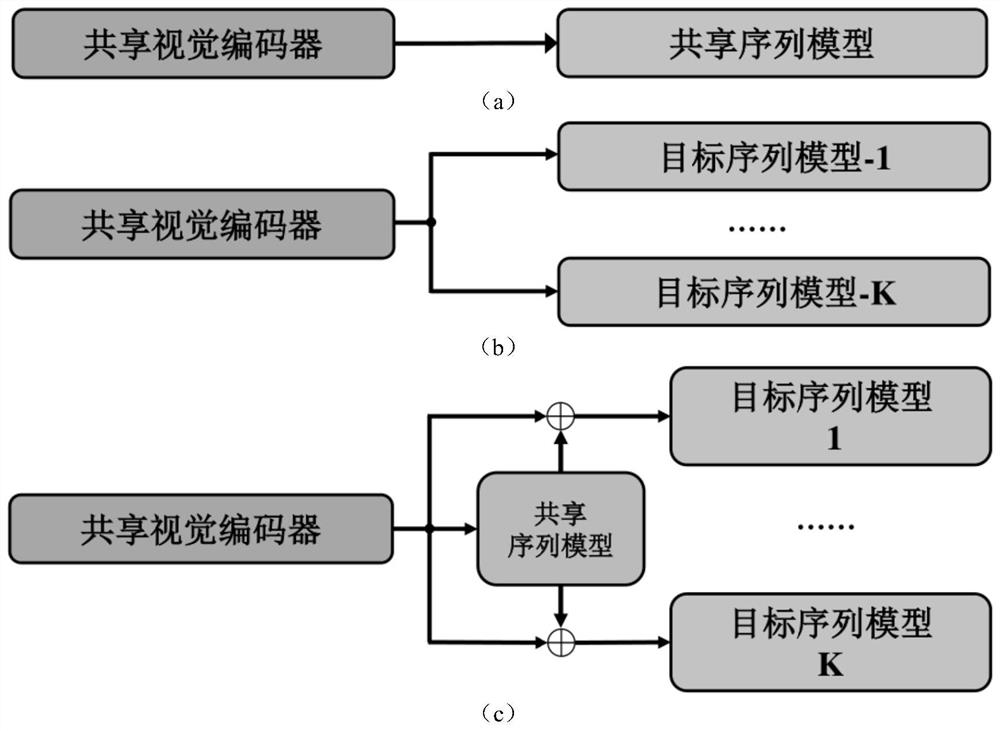
The invention discloses a continuous sign language recognition system based on multi-language collaboration. A common visual feature encoder is used to extract feature expressions. For sign languages ​​of different languages, different time sequence modeling networks (ie target sequence models) are used to learn corresponding Sign language language features. A shared temporal encoder (that is, a shared sequence model) is used to express the same visual patterns among different sign language languages, and is initialized by the language embedding vector. Through multilingual co-training, multilingual sign language recognition under a single framework is realized, and the Fully tap the visual commonality between different sign languages ​​to improve sign language recognition performance.

Description

technical field [0001] The invention relates to the technical field of action recognition in computer vision, in particular to a continuous sign language recognition system based on multilingual collaboration. Background technique [0002] In the continuous sign language recognition problem, each sign language video is annotated by an ordered sequence of sign language words. The essence of the continuous sign language recognition problem can be seen as the process of learning the mapping relationship between the video sequence and the labeled text sequence. Generally speaking, a continuous sign language recognition system consists of a visual feature encoder and a temporal modeling model. Video feature representation plays a very important role in continuous sign language recognition, and hand-crafted features such as SIFT and HOG were used to characterize hand shapes and trajectories in the early days. With the successful application of deep learning in computer vision, 2D...

Claims

the structure of the environmentally friendly knitted fabric provided by the present invention; figure 2 Flow chart of the yarn wrapping machine for environmentally friendly knitted fabrics and storage devices; image 3 Is the parameter map of the yarn covering machine
Login to View More

Application Information

Patent Timeline
no application Login to View More
Patent Type & Authority Patents(China)
IPC IPC(8): G06V40/20G06V20/40G06V10/764G06V10/82G06K9/62G06N3/04G06N3/08
CPCG06N3/08G06V40/28G06V20/40G06N3/045G06N3/044G06F18/24
Inventor 李厚强周文罡蒲俊福胡鹤臻
Owner UNIV OF SCI & TECH OF CHINA
Features
  • R&D
  • Intellectual Property
  • Life Sciences
  • Materials
  • Tech Scout
Why Patsnap Eureka
  • Unparalleled Data Quality
  • Higher Quality Content
  • 60% Fewer Hallucinations
Social media
Patsnap Eureka Blog
Learn More