
Artifical nano-urinary bladder and its making process
An artificial bladder and a manufacturing method technology, applied in the field of artificial organ manufacturing, can solve the problems of large surgical trauma, unable to replace bladder function, poor reliability, etc., to improve the quality of life and quality of life, avoid bladder stones, good urine storage function. Effect
- Summary
- Abstract
- Description
- Claims
- Application Information
AI Technical Summary
Problems solved by technology
Method used
Image

Examples
Embodiment Construction
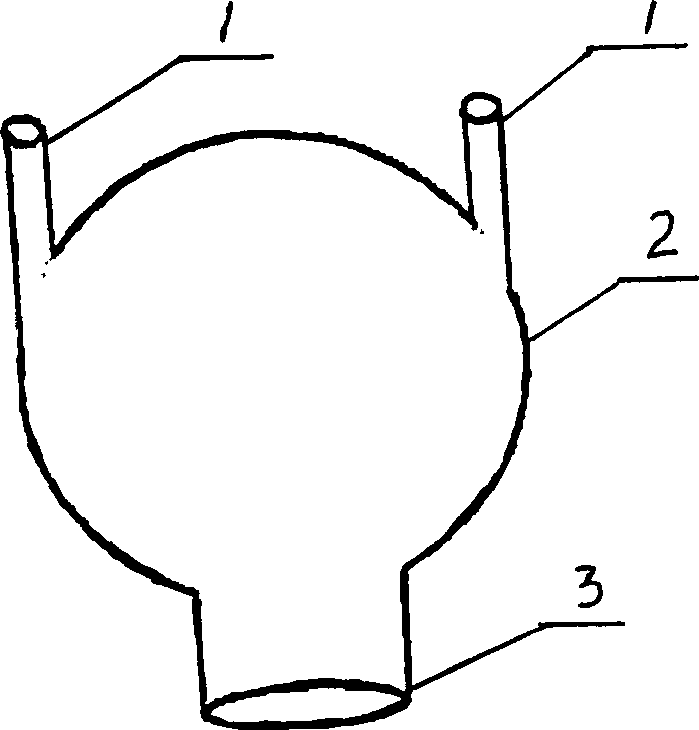
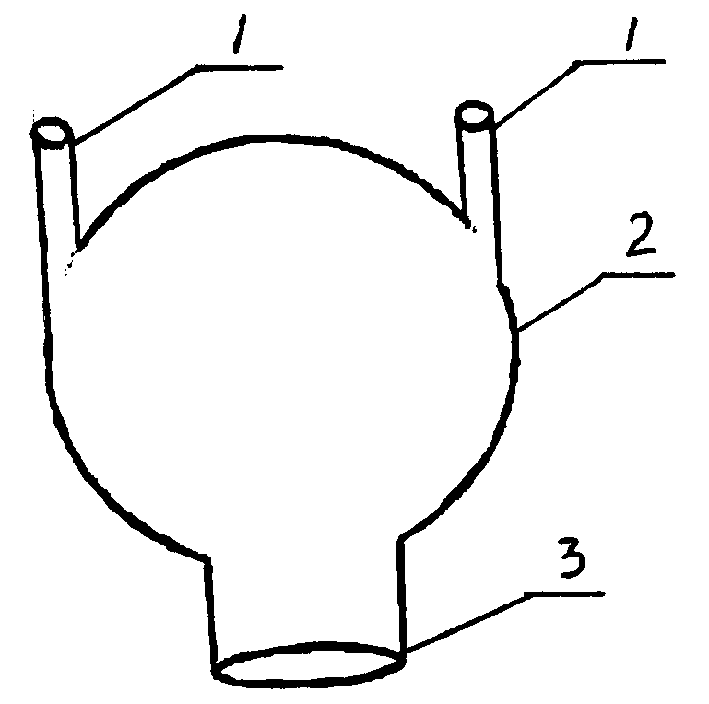
[0009] The artificial nano-bladder is composed of ureteral interface 1, urinary bladder bag 2 and urethral interface 3. The artificial nano-bladder is made of non-toxic, non-absorbable chemical fiber, silk, velvet or blended and other elastic materials such as bladder-like bladder bag, such as polyester Acrylonitrile nanofiber, with a capacity of about 300-500ml, contains an anastomosis connected with the urethra (about 1.5-2cm in diameter) and ureter (about 0.8-1.2cm in diameter), and the inner surface is treated with super-amphiphobic technology. Insert the original bladder to make it have a good urine storage function, and avoid complications such as bladder stones, urine leakage, electrolyte imbalance, etc., and satisfactorily replace the bladder. The method of making artificial nano-bladder from chemical fiber, silk, velvet or blended and other elastic materials: super-amphiphobic technology is used on the surface of the material to build a structure with complementary nan...
PUM
 Login to View More
 Abstract
Description
Claims
Application Information
 Login to View More