Check patentability & draft patents in minutes with Patsnap Eureka AI!

Receiver and method for decoding a coded signal with the aid of a space-time coding matrix

A decoding method and time coding technology, applied in the field of non-orthogonal space-time code receivers, can solve problems such as poor performance and ineffective solutions

Inactive Publication Date: 2012-01-25
FRANCE TELECOM SA
View PDF0 Cites 0 Cited by
  • Summary
  • Abstract
  • Description
  • Claims
  • Application Information

AI Technical Summary

Problems solved by technology

There are many schemes that cannot be implemented efficiently and in a well-performing manner e.g. in a CDMA type system
Furthermore, adaptive MRC (Maximum Ratio Combining) filters perform poorly for other types of codes than the proposed

Method used

the structure of the environmentally friendly knitted fabric provided by the present invention; figure 2 Flow chart of the yarn wrapping machine for environmentally friendly knitted fabrics and storage devices; image 3 Is the parameter map of the yarn covering machine
View more

Image

Smart Image Click on the blue labels to locate them in the text.
Viewing Examples
Smart Image
  • Receiver and method for decoding a coded signal with the aid of a space-time coding matrix
  • Receiver and method for decoding a coded signal with the aid of a space-time coding matrix
  • Receiver and method for decoding a coded signal with the aid of a space-time coding matrix

Examples

Experimental program
Comparison scheme
Effect test

Embodiment Construction

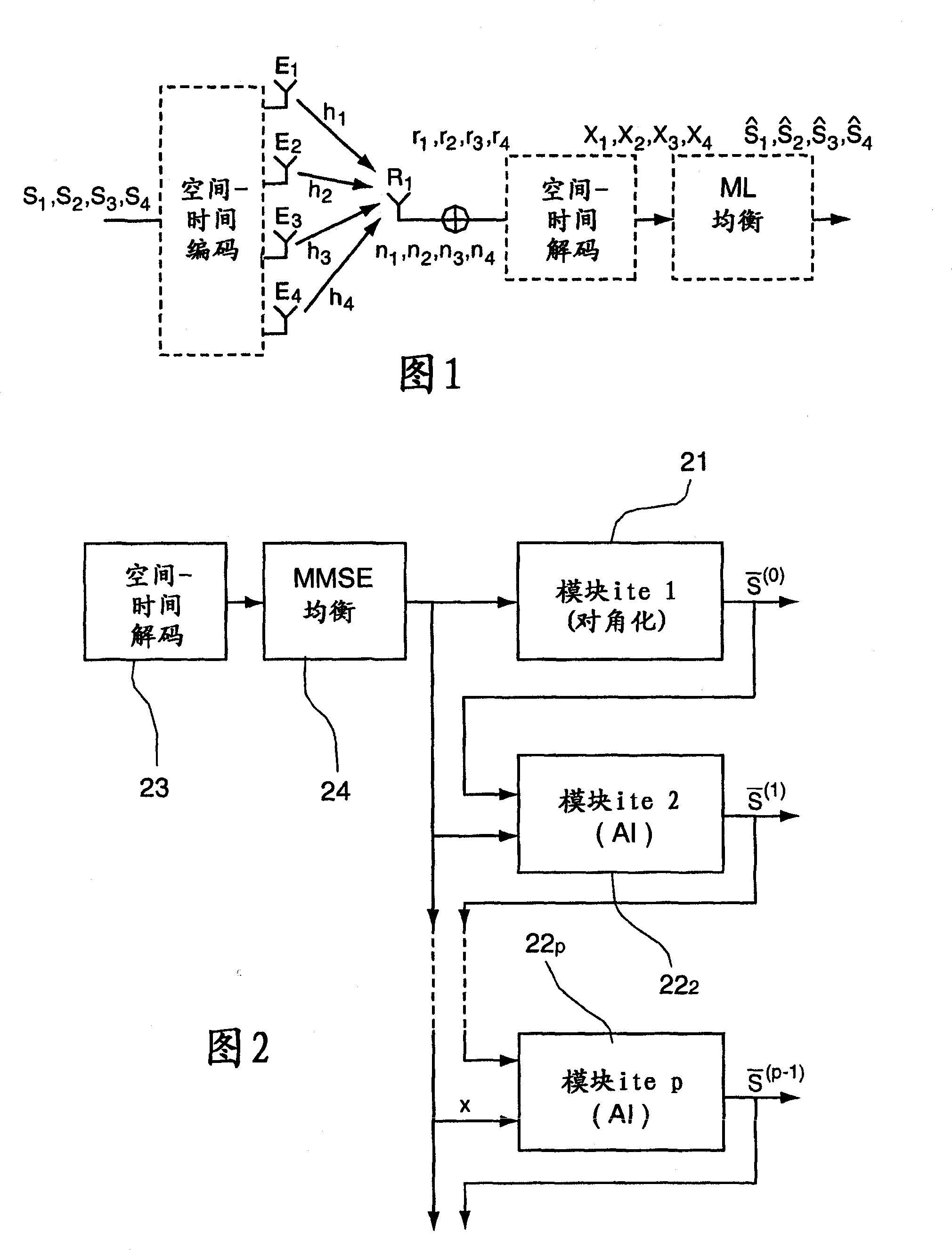
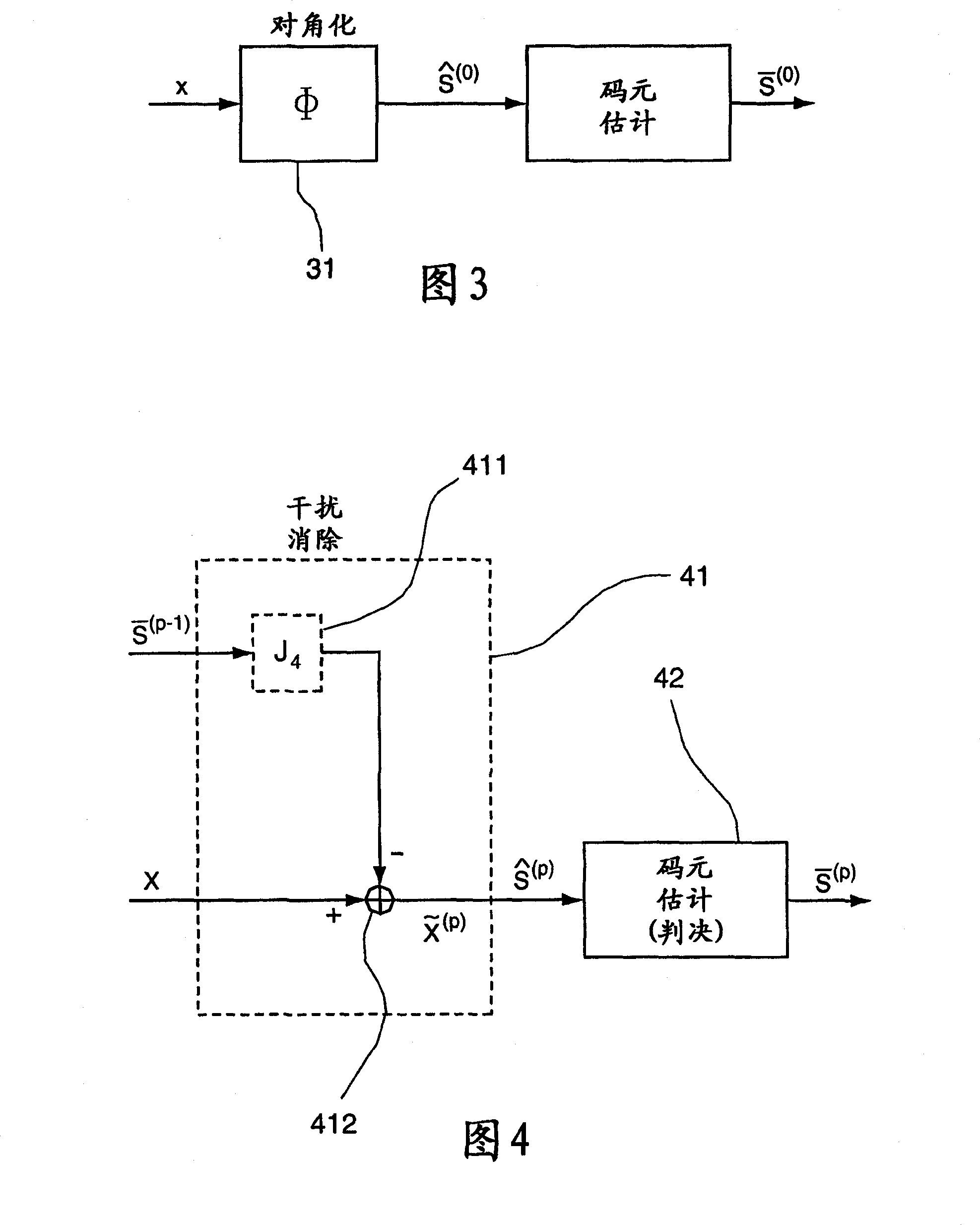
[0120] Therefore, the present invention proposes a novel scheme to perform decoding of space-time codes more efficiently and simply. To this end, it is proposed in particular to perform diversity precoding (spread spectrum or linear precoding methods) at the encoding stage and to perform an iterative process at the receiving stage. According to the invention, decoding and re-encoding corresponding to this precoding is performed at each iteration. This can give increasingly accurate estimates of the transmitted symbols, more and more effectively canceling the interference caused by the transmission from the received signal.

[0121] The first iteration is a special one including diagonalization (since the whole matrix turns out not to be diagonal). Prior to this, the received signal is equalized.

[0122] Subsequent iterations are identical, making the estimate more precise by subtracting the effects of disturbances as needed.

[0123]In order to facilitate the understanding...

the structure of the environmentally friendly knitted fabric provided by the present invention; figure 2 Flow chart of the yarn wrapping machine for environmentally friendly knitted fabrics and storage devices; image 3 Is the parameter map of the yarn covering machine
Login to View More

PUM

No PUM Login to View More

Abstract

The invention relates to a method for decoding a received signal comprising symbols which are distributed in space and time with the aid of a space-time coding matrix, comprising a space-time decoding stage and at least two iterations, each of which comprising the following sub-stages: diversity pre-decoding, the opposite of diversity pre-decoding carried out when the signal is emitted, providingprecoded data; estimation of symbols forming said signal on the basis of said pre-decoded data, providing estimated symbols; diversity precoding identical to diversity precoding carried out during emission, applied to the estimated symbols in order to provide an estimated signal.

Description

technical field [0001] The invention belongs to the technical field of wireless communication. More precisely, the invention relates to the technique of receiving, and in particular decoding, within a receiver, signals received via one or more transmission channels. [0002] More specifically, the present invention relates to techniques for iteratively decoding data encoded with non-orthogonal space-time encoding matrices. [0003] Thus, the invention is particularly (but not exclusively) applicable to transmission systems using multiple antennas (at least two antennas) for transmission and / or reception. Therefore, the present invention is very suitable for non-orthogonal spaces with Nt (Nt≥2) transmitting antennas and Nr (Nr≥2) receiving antennas based on MIMO (Multiple Input Multiple Output) and MISO (Multiple Input Single Output) systems - Timecode receiver. [0004] A typical field of application of the invention is radio communication, especially third, fourth and subs...

Claims

the structure of the environmentally friendly knitted fabric provided by the present invention; figure 2 Flow chart of the yarn wrapping machine for environmentally friendly knitted fabrics and storage devices; image 3 Is the parameter map of the yarn covering machine
Login to View More

Application Information

Patent Timeline
no application Login to View More
Patent Type & Authority Patents(China)
IPC IPC(8): H04L1/06H04B1/707H04B1/7115H04B1/715H04J99/00
CPCH04B1/7107H04L1/0618
Inventor 玛丽林·赫拉尔德皮埃尔-简·布维特温森特·勒尼尔罗多尔菲·勒古阿布尔
Owner FRANCE TELECOM SA
Features
  • R&D
  • Intellectual Property
  • Life Sciences
  • Materials
  • Tech Scout
Why Patsnap Eureka
  • Unparalleled Data Quality
  • Higher Quality Content
  • 60% Fewer Hallucinations
Social media
Patsnap Eureka Blog
Learn More