

Detection apparatus and display apparatus with touch detection function
a technology of detection apparatus and display apparatus, which is applied in the direction of instruments, computing, electric digital data processing, etc., can solve the problems of increasing the size and cost of the device having both configurations, and no information is obtained on the force detection in the first direction
- Summary
- Abstract
- Description
- Claims
- Application Information
AI Technical Summary
Problems solved by technology
Method used
Image



Examples
first embodiment
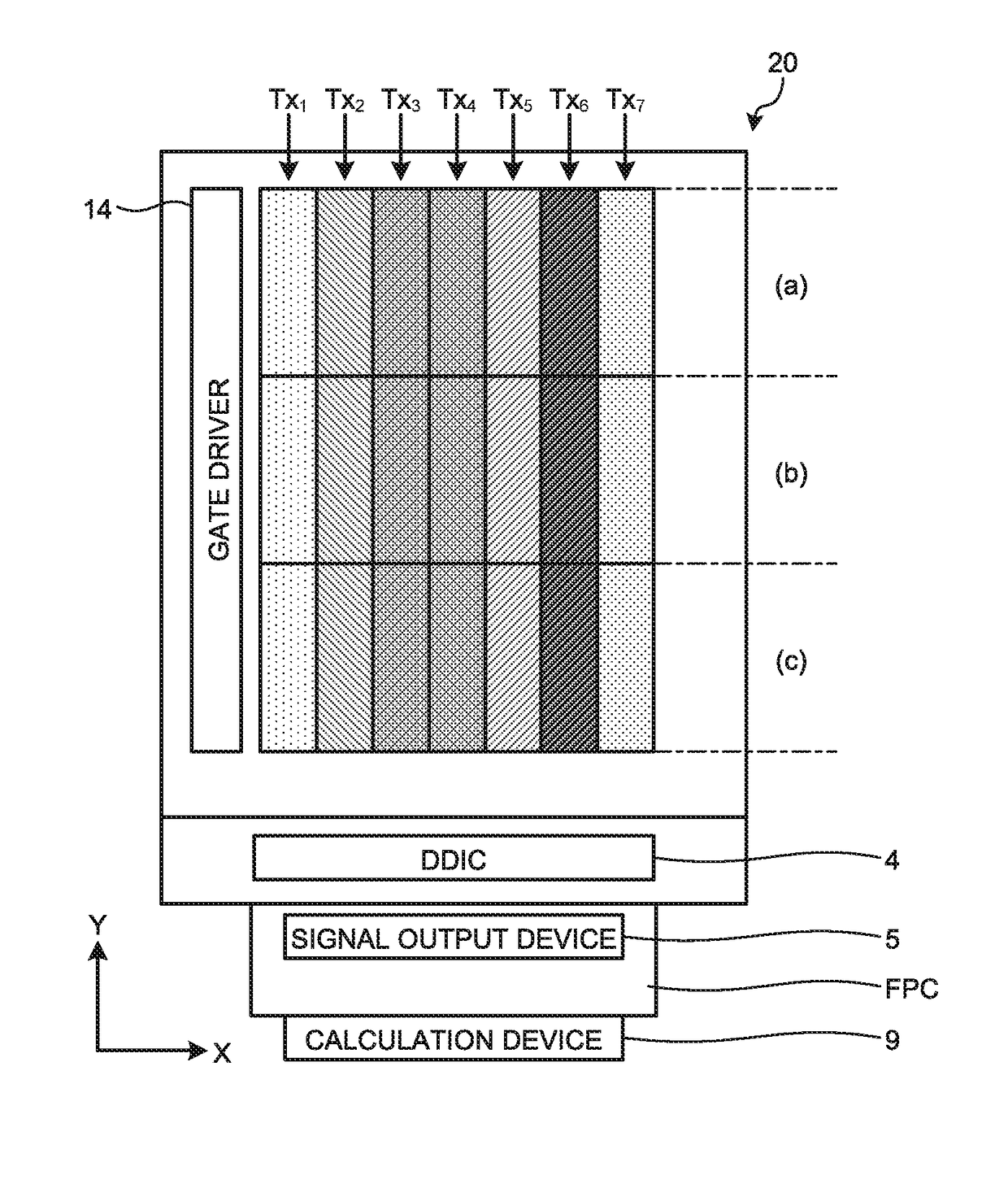
[0042]FIG. 1 is a block diagram illustrating a main configuration example of a display apparatus 100 according to a first embodiment. The display apparatus 100 includes, for example, a display panel with a touch detection function 1 and a calculation device 9. The display panel with a touch detection function 1 is what is called an in-cell display apparatus that is provided with a configuration for display output and a configuration for detecting a position and force of a touch operation. The display panel with a touch detection function 1 includes, for example, a display device 2, a touch detection device 3, a display driver integrated circuit (DDIC) 4 serving as a controller, a signal output device 5, and a base electrode 8. The calculation device 9 is a circuit that performs calculation related to the detection of the position and the force of the touch operation based on various signals output from the display panel with a touch detection function 1. The notation of “SELF” in FI...
second embodiment
Modification of Second Embodiment
[0120]The following describes a modification of the second embodiment. In the description of the modification, the same configurations as those in the second embodiment will be assigned the same reference signs, and will not be described in some cases.
[0121]FIG. 23 is a diagram illustrating the shapes of the divided electrodes and the first detection regions that are set for the force detection in a first modification, the first detection regions being distinguished by different shadings. In the first modification, the respective divided electrodes included in the first electrode Tx have a shape tapered or inversely tapered in the first direction (Y-direction). Specifically, as illustrated, for example, in FIG. 23, the first electrode Tx of the first modification includes divided electrodes Tj and Tk obtained by dividing the first electrode Tx into two parts by a parting line tracing one of the two diagonal lines of a rectangle representing the shape...
third embodiment
[0124]The following describes a third embodiment that is an embodiment different from the first and the second embodiments. In the description of the third embodiment, the same configurations as those in the first and the second embodiments will be assigned the same reference signs, and will not be described in some cases.
[0125]FIG. 26 is a block diagram illustrating a main configuration example of a display apparatus 100B according to the third embodiment. The display apparatus 100B of the third embodiment includes a signal output device 5B, instead of the signal output device 5A in the display apparatus 100A of the second embodiment. The display apparatus 100B of the third embodiment also includes a calculation device 9B, instead of the calculation device 9A of the second embodiment. The scheme of the detection of the touch operation position in the third embodiment is, for example, a scheme in which the position detection in the two-dimensional directions (XY directions) using th...
PUM
 Login to View More
 Abstract
Description
Claims
Application Information
 Login to View More