
Use of ADAMTS13 for treating, ameliorating and/or preventing vaso-occlusive crisis in sickle cell disease, acute lung injury and/or acute respiratory distress syndrome
a technology of vaso-occlusive crisis and adamts13, which is applied in the direction of drug compositions, extracellular fluid disorders, peptide/protein ingredients, etc., can solve the problems of slowing or stopping the flow of blood, obstructing the microcirculation, and unable to reach nearby tissues, so as to reduce the number of neutrophils
- Summary
- Abstract
- Description
- Claims
- Application Information
AI Technical Summary
Benefits of technology
Problems solved by technology
Method used
Image

Examples
example 1
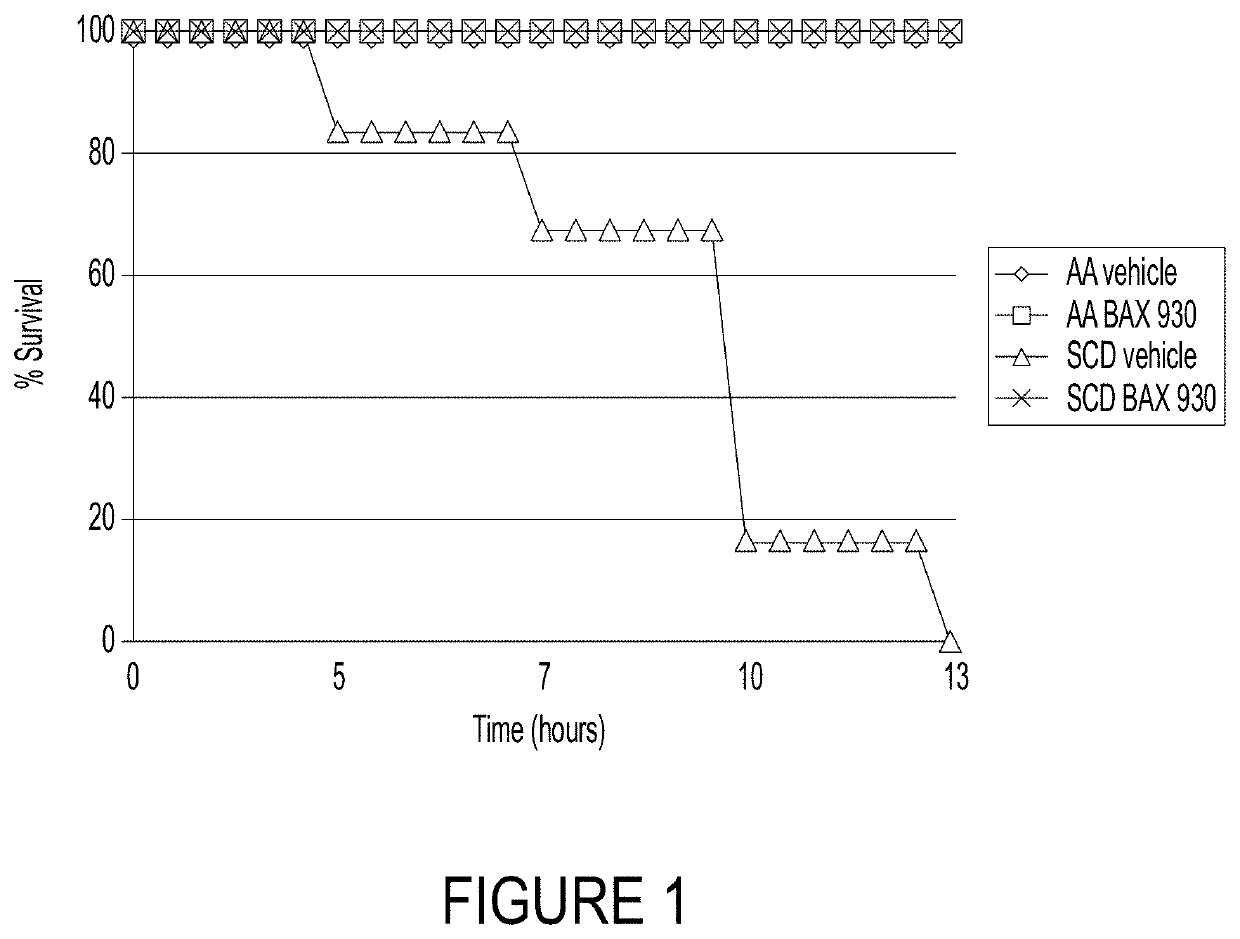
ADAMTS13 Prevented the Death of SCD Mice Exposed to Lethal Hypoxia-Induced VOC
[0238]Because acute sickle cell events are triggered by low oxygen (hypoxia), this example was conducted to evaluate the impact of ADAMTS13 on survival in a model of SCD subject to hypoxia. The objective of this example was to determine if recombinant ADAMTS13 (rADAMTS13 (BAX930 / SHP655)) could protect humanized SCD mice exposed to lethal hypoxia-induced VOC. It has been shown previously that the exposition of SCD mice to very severe, life-threatening hypoxia / reoxygenation stress can be useful in evaluating the effectiveness of novel therapeutic treatments on the survival of SCD mice (Sabaa et al., JCI 118:1924, 2008).
[0239]Experiments were performed on 4-6 week-old healthy control (Hbatm1(HBA)Tow Hbbtm3(HBG1,HBB)Tow) mice (i.e., AA) and SCD (Hbatm1(HBA)Tow Hbbtm2(HBG1,HBB*)Tow) mice (humanized mouse model for sickle cell disease (i.e., SCD or SS mice)). Healthy (AA) and sickle cell disease mice (SCD or SS)...
example 2
ADAMTS13 Reduces Hypoxia / Reoxygenation Stress-Induced Abnormalities in the Lung
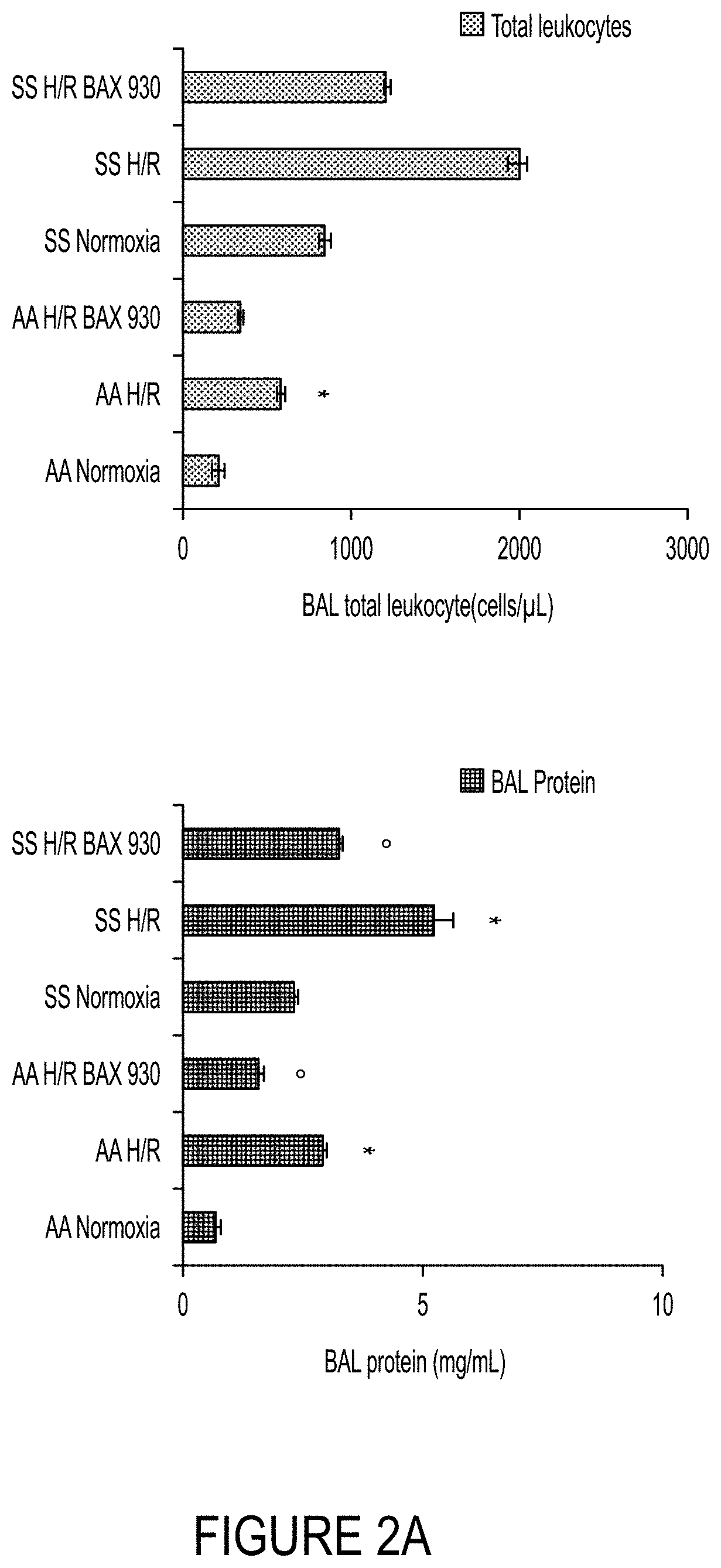
[0242]The objective of this example was to evaluate the impact of ADAMTS13 on lung injury and vascular inflammation induced by hypoxia / reoxygenation (H / R) stress.
[0243]Healthy control (Hbatm1(HBA)Tow Hbbtm3(HBG1,HBB)Tow) and SCD (Hbatm1(HBA)Tow Hbbtm2(HBG1,HBB*)Tow) mice were exposed to hypoxia / re-oxygenation (H / R) stress, which previously were shown to biologically recapitulate the acute VOC and the organ damage observed in acute VOC in human SCD patients. In particular, six experimental groups were used—(1) AA untreated normoxia; (2) SS untreated normoxia; (3) AA vehicle plus H / R; (4) AA ADAMTS13 (BAX930 / SHP655) plus H / R; (5) SS vehicle plus H / R; and (6) SS ADAMTS13 (BAX930 / SHP655) plus H / R. In this experiment, H / R conditions were 8% oxygen for 10 h followed by 3 h recovery at about 21% oxygen, an experimental scheme usually not fatal for SCD mice (Kalish et al., Haematologica 100:870-80, 2015).
[0244]Un...
example 3
ADAMTS13 Reduced Hypoxia / Reoxygenation Stress-Induced Lung Vascular Activation
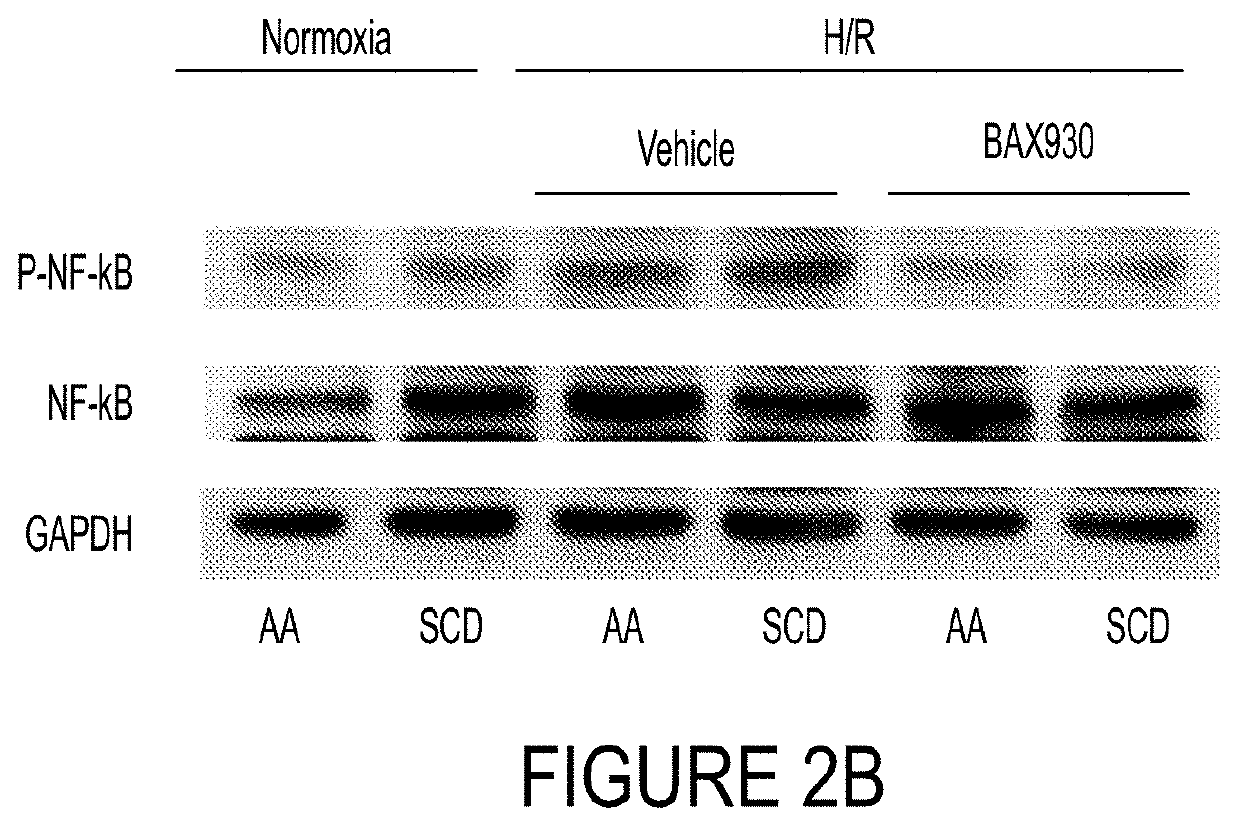
[0249]In order to study the effects of ADAMTS13 on injury and vascular inflammation in the lung, additional experiments were conducted with the same six experimental groups, as described in Example 2 (i.e., (1) AA untreated normoxia; (2) SS untreated normoxia; (3) AA vehicle plus H / R; (4) AA ADAMTS13 (BAX930 / SHP655) plus H / R; (5) SS vehicle plus H / R; and (6) SS ADAMTS13 (BAX930 / SHP655) plus H / R). In this example, like that reported in Example 2, animals were administered vehicle or ADAMTS13 and then exposed to 8% oxygen for 10 h followed by 3 h recovery at 21% oxygen. Additional controls (AA and SCD) were also subjected to conditions of normoxia without vehicle or ADAMTS13.
[0250]Immunoblot analyses with specific antibodies against various markers of inflammation, vaso-constriction and platelet aggregation (i.e., nuclear factor kappa B (NF-kB), endothelin-1 (ET-1), heme-oxygenase 1 (HO-1), intercellular adh...
PUM
| Property | Measurement | Unit |
|---|---|---|
| time | aaaaa | aaaaa |
| time | aaaaa | aaaaa |
| distance | aaaaa | aaaaa |
Abstract
Description
Claims
Application Information
 Login to View More