[0019] Another objective of the present invention is to allow for the presentation of language to someone without requiring of them either the ability to hear or requiring of them any prerequisite literacy or rote memorization.
[0020] Yet another objective of the present invention is to allow the automatic acquisition of literacy, without requiring any prerequisite literacy, rote memorization, or access to electronic devices or already literate people.
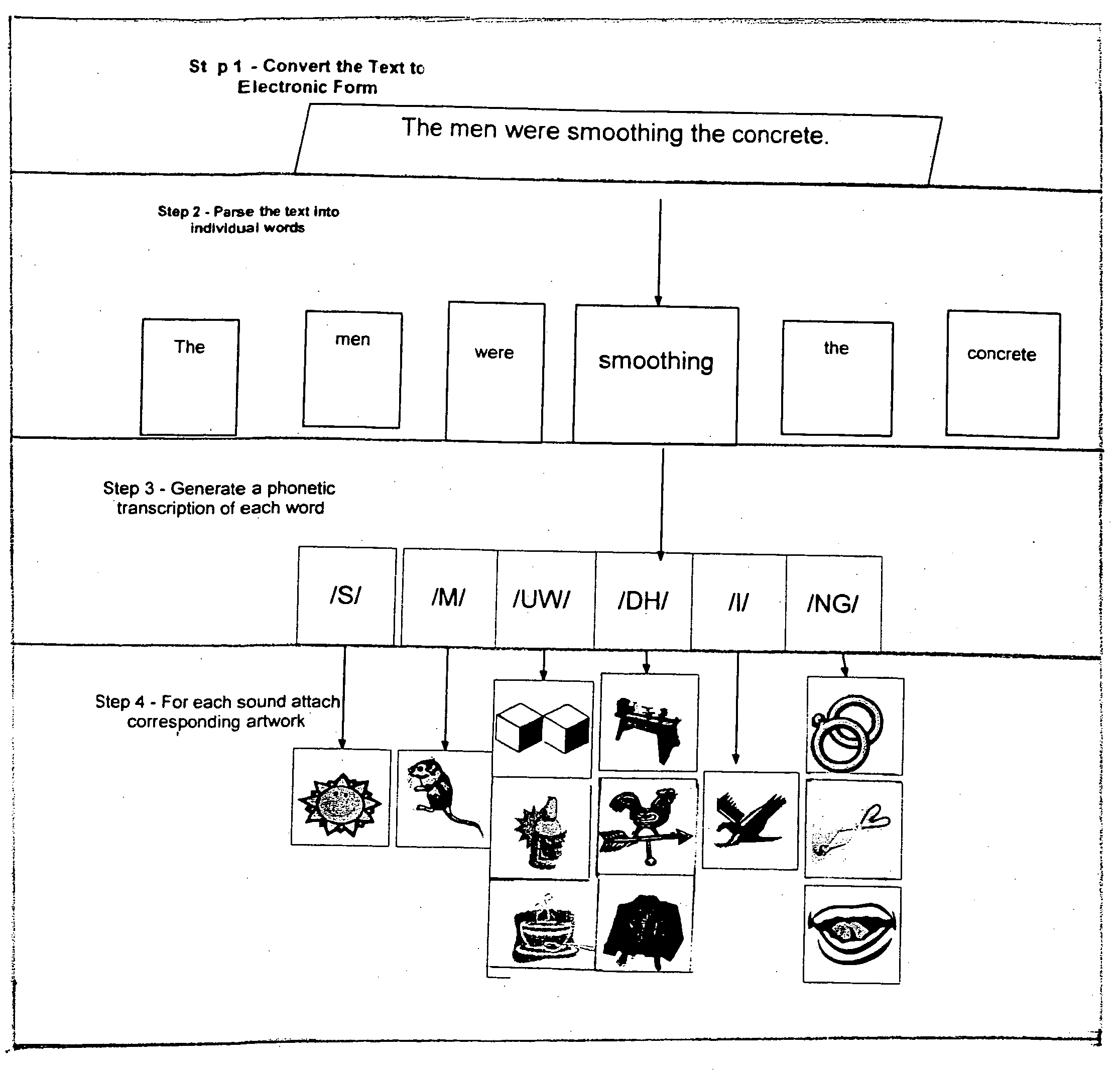
[0030] It is also possible to automate the selection process, by converting the desired text into
unicode either by producing it as described or by scanning printed text and performing
optical character recognition on it. Further,
automation may occur by direct conversion from some electronic or
computer based form. The
unicode text is then parsed into words. Each word may then be converted into the form described above by selecting or creating a number of pictures as described above for each sound of the language which one wishes to represent; thereby generating a phonetic engine for the language. A phonetic engine may be a processor capable of taking a selected word and producing the sounds which make up the selected word. In the case of languages with a regular orthography, such as Spanish, this engine can be readily created. In a more complicated case, such as English, a sizable table of exceptions to the algorithms which occasionally allow discerning the sounds from the spellings may be necessary. In the most complicated cases, such as Chinese, no
algorithm is possible and the exception table contains the entire language. It is best to organize this phonetic engine in such a way that the syllabic divisions of the words are clear, so that the reader can be presented with the text in such a way as to make it easy to sound out the picture sequence, and so that any alphabetic writing is associated to the degree that it is meaningful with corresponding sounds, thereby providing the reader the means of acquiring the so-called phonic skills to the extent that the customary written form of the language makes that possible. Of course the occasional
homograph may require human intervention. Phonetic dictionaries are generally available, and where they do not provide division into syllables, the rules identified by linguists may be used. The simple device of identifying the
consonant clusters that occur at the beginning and at the end of words gives an indication that syllables are likely to end the same way words do, and begin the same way words do, and often that insight is enough to automate the process of dividing words into syllables.
[0032] In a language written left to right, one may place the collection vertically, so that it is clear that all the pictures together pertain to one sound. One may also provide a visual separation between words and / or between syllables. Further, one may place the sound collections left to right, while having below each sound or possibly sequence of sounds the letter or possibly sequence of letters that it corresponds to, as well as the normal classical written form of the whole word. While not necessary, it may be best to also distinctively mark the
vowel sounds of each
syllable for ease of sound fusion. Still further, one may add directions for reading. Examples of directions for reading include signaling by arrows and having all of the objects face the same direction.
[0033] It would be extremely useful to have a form of mutely created representations of language, and an inaudibly presented language, so as to allow anyone to use such methods. Further, such a language will allow anyone to benefit from another's use of such methods, without requiring the whole or partial rote memorization of symbols.
[0034] It would also be extremely useful to have a means for teaching existing writing systems, with their enormous wealth of existing texts without incurring the enormous training costs which currently is required for currently existing writing systems and communication means.



 Login to View More
  Login to View More